I have a complicated relationship with Thomas Kinkade's work. I always have. As a fine art photographer who has spent years thinking seriously about what distinguishes genuine artistic expression from mass-market decoration, Kinkade represents exactly the kind of tension that makes the art world interesting: a man of undeniable technical gifts who built one of the most commercially successful art empires in history, beloved by millions and dismissed by the critical establishment, who spent his days manufacturing the world's most comforting images while his private life was quietly falling apart.
I have stood in front of his paintings. I have looked at the glow coming from those cottage windows and the way his light sits differently from any other painter working in his era — luminous from within, not reflected from without. And I have thought: this man understood something true about what people want from visual art. He may have commodified it in ways that troubled the art world, but he understood it. And understanding what people want from a painting — what emotional need a great image serves — is not a small thing.
My art professor friend, who has spent a lifetime studying artists from every tradition, handed me a research document on Kinkade recently that filled in details I hadn't known. Much of what follows comes from that research and from my own thinking about how his work and life connect to the broader questions of art, craft, and legacy that I think about constantly. Let's go through the whole story — the brilliant parts and the dark parts together.
The Crucible — A Cold Childhood and a Mentor Who Changed Everything
Thomas Kinkade was born in 1958 in Placerville, California — a small Sierra Nevada foothills town once known as Hangtown during the Gold Rush. His father abandoned the family when Kinkade was young, leaving them in genuine financial hardship. They often lacked adequate heating. The windows of his childhood home were dark and cold in winter.
This biographical detail is not incidental. Every art historian who looks seriously at Kinkade's work eventually arrives at the same observation: the glowing cottage windows that appear in hundreds of his paintings — warm, amber, welcoming, lit from within — are not just compositional choices. They are the exact opposite of the windows he grew up looking at. He spent his entire career painting the home he never had. The glow was autobiographical.
The turning point came when he was twelve. A retired art professor named Glenn Wessels moved in next door. Wessels took the young Kinkade under his wing formally, teaching him the mechanics of light and shadow, the manipulation of tone, the discipline of observation. Kinkade later credited Wessels with saving his life — with giving a poor, fatherless kid in a small California town a reason to stay on a constructive path when other paths were available and easier. He spent his adult life trying to repay that debt by mentoring others in his studio.
Thomas Kinkade — Key Facts
- Born: 1958, Placerville, California
- Died: April 2012, Monte Sereno, California (age 53)
- Style: Romantic Realism; influenced by Hudson River School luminism
- Key mentor: Glenn Wessels, retired art professor and neighbor
- Early career: Co-authored The Artist's Guide to Sketching (1982); painted 700+ backgrounds for Fire and Ice (1983)
- Trademark: Registered "Painter of Light™" with the U.S. Patent and Trademark Office in 1996
- Peak reach: Estimated 1 in 20 American homes contained a Kinkade reproduction circa 2001
- Pseudonym: Painted 69 works in a French Impressionist style under the name Robert Girrard
- Estate: Valued at approximately $66 million at time of death
In 1980, Kinkade and his college friend James Gurney — who would later create the celebrated Dinotopia series — dropped out of the Art Center College of Design in Pasadena and hopped freight trains across America with sketchbooks, watercolors, and almost no money. They drew everything: rail yards, small-town main streets, the vast American landscape from the rolling door of a boxcar. Watson-Guptill Publications was interested enough to commission a book from their drawings. The Artist's Guide to Sketching, published in 1982, became a practical handbook for field sketching at a time when the plein air movement hadn't yet found its modern audience. More importantly for both men, it served as the portfolio that got them hired by Ralph Bakshi Studios to paint over 700 animation backgrounds for the 1983 fantasy film Fire and Ice.
It was on that production — creating cinematic atmosphere at scale, manipulating light sources across enormous backgrounds, making glowing windows and street lamps read as warmth and safety against dark dramatic skies — that Kinkade perfected the technical foundation of what would become his signature style. He learned how to make light feel rather than just look.
Romantic Realism — The Style and Its Traditional Roots
Kinkade officially classified his style as Romantic Realism — a 19th-century term that he applied to a very specific set of contemporary techniques. Understanding what he was actually doing technically helps explain both why the work is more accomplished than critics admitted and why it occupies the commercial space it does.
He was deeply influenced by the Hudson River School — the same American landscape painting tradition I have written about in connection with Ansel Adams and Albert Bierstadt. The Hudson River School's luminism — the use of light to create a sense of divine presence and majesty within a landscape — runs directly through Kinkade's work. Where Bierstadt used it to make the American West feel like sacred territory, Kinkade used it to make a cottage garden in the English Cotswolds feel like a place where nothing bad could ever happen.
His two core techniques were glazing and what he called reverse gradation. Glazing is a Renaissance oil painting method — thin, transparent layers of paint applied over a darker base, allowing light to pass through each layer and reflect off the one below, creating the impression that luminosity is coming from within the canvas rather than sitting on its surface. Rembrandt used it. J.M.W. Turner used it. Kinkade used it to make cottage windows look like they were actually lit from inside by a warm fire. The technique works. Anyone standing in front of a Kinkade original in the right light will notice that the windows genuinely appear to glow in a way that reproduction images cannot capture.
Reverse gradation placed the brightest highlights — those glowing windows, those street lamps, those morning sunrises — directly against the darkest surrounding tones. Deep twilight blues and purples pressed against warm amber and gold. The contrast creates the illusion that the light source is real, not painted. It is a technically deliberate choice, not an accident of his style.
These are, as I have written about in both the traditional art and traditional artist pieces on this blog, the practices of a traditional artist working with deep craft in an established lineage. The fact that Kinkade applied these techniques to idealized cottages rather than Sierra Nevada granite does not change the technical validity of what he was doing. He studied Rembrandt and Turner specifically to learn how they manipulated light and shadow for emotional resonance. He then applied those lessons with enormous technical competence to subjects that had maximum emotional accessibility for the widest possible audience. That is a different artistic goal than what Ansel Adams or Albert Bierstadt pursued — but it is not a less skilled one.
He also painted 69 works under the pseudonym Robert Girrard, in a loose French Impressionist style with broad brushstrokes and natural, unidealized light — keeping these entirely separate from his commercial brand. The existence of the Girrard work suggests that Kinkade was fully aware of the artistic limits he had set for himself commercially, and maintained a private creative life that operated outside those limits. He was, in other words, a more complex artist than the cottage paintings alone suggest.
The Famous Works — And What to Look For in Them
The Christmas Cottage is the most autobiographical — a depiction of his actual childhood home transformed into the warm, safe, luminous place he wished it had been. The windows glow. The snow is soft. The entire scene is the emotional antithesis of his real childhood winters.
A Light in the Storm features a solitary lighthouse on a cliff — a subject I find immediately resonant as someone who has spent years photographing the California coast and the specific drama of structures standing at the edge of the Pacific. The symbolism Kinkade embedded in lighthouses — resilience, hope, the fixed point of light in darkness — translates directly into visual terms that work whether or not you know his biography.
"Every glowing window was an antidote to a dark memory. And every night he went home to the dark, and painted it somewhere nobody could see."
The daughter cottages deserve special attention because they reveal the personal dimension of his work most clearly. He painted four major estate and cottage works named directly after his four daughters: Evening at Merritt's Cottage, Chandler's Cottage, Winsor Manor, and Everett's Cottage. Each was designed to match his vision of each daughter's personality. Merritt, who loved sunsets, got a scene set at twilight with a sky streaked in gold and violet. Chandler, who loved elaborate, delicate things, got a Victorian gingerbread cottage buried in climbing roses. Winsor got a grand stone manor on rolling hills. Everett's cottage, created as a tribute for her first birthday, featured a sprawling garden with a family of ducks by a pond under a weeping willow.
He also hid his wife Nanette's name within the brushwork of most of his paintings — concealed in tree roots, stone textures, stream ripples, and flower shadows. Near his signature on many canvases he added an "N" with a number indicating how many times her name was hidden in that specific work. It is, for collectors who know to look for it, a scavenger hunt embedded in every painting he made. The N count became one of the most talked-about details in the Kinkade collector community — a private romantic code made public across millions of reproductions.
"The Painter of Light" — The Trademark and the Controversy
The phrase "Painter of Light" was not Kinkade's invention. It had historically been applied to J.M.W. Turner, the 19th-century English Romantic painter whose dramatic, light-filled marine paintings and landscapes Kinkade studied and admired directly. Kinkade appropriated the title early in his career because it genuinely described what he was attempting technically.
In 1996, he went further and registered "Painter of Light" as a trademark with the U.S. Patent and Trademark Office — legally barring any other living artist, gallery, or commercial entity from using the phrase to promote artwork. The art world was outraged. Critics argued that monopolizing a phrase historically reserved for one of the great masters of Western painting was an act of astonishing commercial arrogance. Kinkade argued it was a necessary business shield to protect his brand from copycats.
Both positions contain truth. As someone who is currently in the process of trademarking "Tru Masterpiece™" for the Only One collection, I understand the impulse to legally protect a brand designation that has genuine commercial and artistic meaning. I also understand why the art establishment found Kinkade's move presumptuous. The difference, perhaps, is that "Painter of Light" was a generic descriptive phrase with historical attachment to another artist, while "Tru Masterpiece™" is a specific coined term that describes a genuine structural commitment: one print, ever, of each image. The trademark protects an actual promise, not just a marketing position.
What Kinkade built around the trademark was extraordinary by any business measure. At the peak of his empire around 2001, he operated between 350 and 400 "Thomas Kinkade Signature Galleries" — franchise operations in upscale malls and tourist destinations across the country. The gallery experience was engineered for conversion: private viewing rooms with dimmable lighting that demonstrated how his paintings changed character from dawn to dusk, consultants trained to build emotional connection to specific works, and "Master Highlighters" who applied physical dabs of wet oil paint to mass-produced canvas reproductions for a premium fee, giving each piece a unique physical texture. At the height of the empire it was estimated that one in every 20 American homes contained a Thomas Kinkade reproduction.
Carmel-by-the-Sea — Where His First Gallery Still Stands
In 1992, Thomas Kinkade opened the very first gallery in his eventual network at Thomas Kinkade Studio in the Garden on Ocean Avenue in Carmel-by-the-Sea, California. It was the artistic coastal village that heavily inspired many of his early beach and cottage scenes, and it remains one of the most significant galleries in the Kinkade network to this day — a garden-incorporated space on the same street that has been selling his work for over thirty years.
Carmel-by-the-Sea sits at the northern edge of the Monterey Peninsula, directly adjacent to Pebble Beach. And Pebble Beach is where I have spent significant time with my camera, photographing two subjects that could not be more different and yet both carry that specific quality of the California coast at its most dramatic.
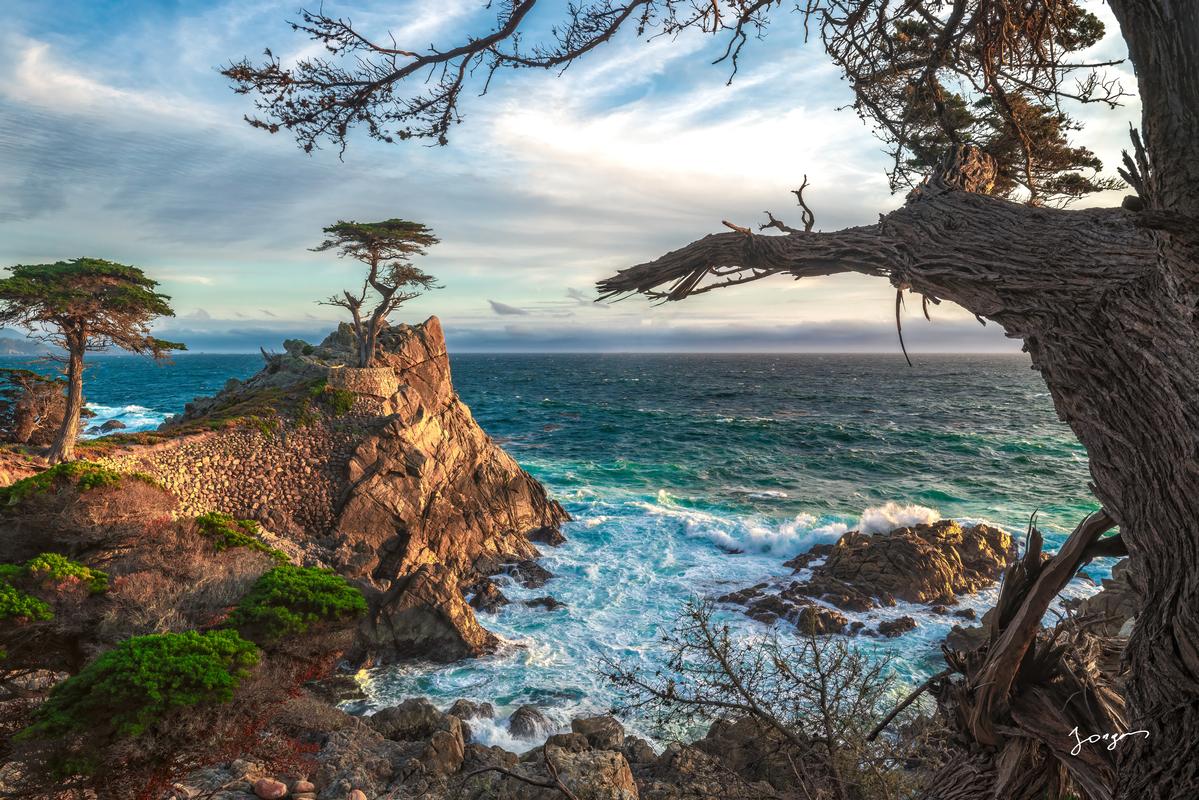
The first is the Lone Cypress — the single Monterey cypress growing from a granite headland above Carmel Bay that has been photographed more times than almost any tree in the world. I wrote about this tree in the tree photography article; it is estimated to be over 250 years old, held in place now by cables that protect its branches from the Pacific storms. It stands about three miles from the gallery where Kinkade sold his first paintings. The same coastline, the same quality of light, the same dramatic relationship between a solitary subject and the Pacific Ocean behind it. Kinkade would have known that tree. He photographed locations extensively before painting them.
The second is Pebble Beach Golf Links itself — arguably the most photographed golf course in the world, running along the clifftops above Stillwater Cove with the Pacific as its backdrop on virtually every hole. I have photographed it in the early morning light when the greens are still dark with dew and the ocean fog is beginning to lift from the cypress groves along the cart paths. It produces a specific quality of California coastal light that I have not found anywhere else on the coast — the combination of salt air, cypress shadow, and the way the Pacific reflects light upward onto the landscape from below the cliffs. This is California fine art photography at its most specifically located.
Kinkade painted subjects near here. His first gallery stood here. And the same coastline that inspired his cottage-and-cove aesthetic — the rocks, the cypress trees, the sea mist, the specific quality of Northern California coastal light — is still producing images worth making.
The Landscape Photography Parallel
There is a direct line between Kinkade's luminism and what fine art photography has always done with light at the California coast and across the American West.
The Hudson River School's core argument — that the American landscape deserved to be treated as a serious artistic subject, rendered with the full technical resources of the craft to convey its emotional and spiritual weight — runs through Bierstadt's Yosemite paintings, through Ansel Adams's Zone System work in the Sierra Nevada, and through the tradition of fine art landscape photography that operates today. Kinkade positioned himself explicitly within this tradition. He cited Bierstadt as an influence. He used luminism as a technical foundation.
What photography adds to this tradition is the unrepeatable moment — the specific quality of light on a specific morning that cannot be manufactured or recalled through technique alone, only witnessed and captured. The glowing window in a Kinkade cottage is beautiful and technically accomplished. But it is imagined. The golden hour light hitting the granite walls of Yosemite at the moment Adams pressed the shutter was real — happened once, lasted minutes, is now permanently recorded. The fine art photography print on a wall carries that irreducible fact: this light existed, in this place, at this specific unrepeatable moment. It was not constructed. It was found.
That distinction is not a judgment against Kinkade. It is a description of what the two disciplines offer differently. His paintings offer comfort and the ideal. Fine art photography at its best offers the actual. Both have their place on a wall, and in a life.
The Gallery Empire — Rise, Lawsuits, and the Hiddenbrooke Disaster
The commercial success of Kinkade's gallery network was extraordinary right up until it wasn't. Between 2002 and 2005, the number of franchise locations plummeted by more than half as a wave of independent gallery owners filed lawsuits alleging that Kinkade's corporate entity had misled them into investing $80,000 to $150,000 in startup costs before saturating the market with discounted reproductions through internet retailers. Courts ordered his company to pay millions in punitive damages. One of his primary manufacturing arms filed for Chapter 11 bankruptcy in 2010.
In 2001, at what turned out to be the peak of his empire, he had attempted something genuinely unprecedented: building a real-estate development entirely inspired by his paintings. The Village at Hiddenbrooke in Vallejo, California was a planned community with model homes named after his four daughters, streets named Summer Gate and Rose Arbor Way, and a promise of "Calm, not chaos. Peace, not pressure."
The reality, when journalists visited, was ordinary suburban construction. California building codes and fire regulations meant no thatched roofs, no stone chimneys, no sprawling wild gardens — the signature elements of his painted world. The partnership with construction firm Taylor Woodrow dissolved almost immediately. Then, in 2008, Vallejo became one of the largest cities in American history to file for municipal bankruptcy. Homes that had peaked near $700,000 lost between 40 and 50 percent of their value. The street names Kinkade had chosen remain. The Kinkade branding was quietly scrubbed from the signage years ago.
The slogan — "Calm, not chaos" — was not, in the end, how things went.
The Secret Vault
After Kinkade's death in April 2012 — he was found at his Monte Sereno home, having died from a combination of alcohol and prescription sedatives at 53 — his family discovered a physical vault inside his studio that contained a body of work nobody knew existed.
The vault held decades of unreleased paintings in a style completely unlike his commercial output: darker themes, moody color palettes, surrealist imagery, raw emotional content. The cheerful cottage painter had been maintaining a private artistic life that expressed things his brand explicitly excluded. He was, in the vault, the kind of painter the art world might have taken seriously — exploring the complexity and darkness he spent his public career actively hiding behind warm windows and garden gates.
I find this the most poignant detail of his entire story. He understood what he was doing. He knew the gap between his private artistic instincts and his commercial output. He built a vault — literally a vault — to contain what couldn't be sold in a mall gallery. The commercial success trapped him in a style he had chosen because it sold, and the person who chose that style was still producing, privately, the art that had nothing to do with cottages.
Every glowing window was an antidote to a dark memory. And every night he went home to the dark, and painted it somewhere nobody could see.
What Kinkade Understood About People — And What He Got Wrong
Kinkade understood something genuinely true: people crave images of places where nothing bad is happening. They want warm windows and safe streets and gardens that are always in bloom. They want the visual equivalent of being told that somewhere, a version of the world exists where the lights are on and someone is home and the path to the front door is clear and lit.
That desire is real. It is not naive or unsophisticated. It is a fundamental human need that great art of every tradition has always addressed in one form or another. The Impressionists addressed it with light on water. The Hudson River School addressed it with the majesty of wild America. Kinkade addressed it with cottage windows, and he was right that millions of people needed exactly that.
What he may have gotten wrong — and the lawsuits from gallery owners suggest this — was the idea that art could be industrialized indefinitely without the industrial process eventually destroying the very quality that gave it value. At ten million reproductions in circulation, the scarcity that underpins all art market value is gone. A Kinkade print in a mall gallery competes with nine million nine hundred and ninety-nine thousand nine hundred and ninety-nine identical prints for the attention of a collector. The math does not favor investment.
This is the argument I make in the photography investment article on this blog, and it applies to painting reproduction as directly as it applies to photography. Kinkade's originals — the actual hand-painted oils that he kept or sold privately — have sold at auction for up to $50,000. The mall reproductions sell for $100 to $1,000. The gap between those numbers is the value of genuine scarcity.
Kinkade and Bob Ross — Two Sides of the Same Canvas
No honest assessment of Thomas Kinkade is complete without addressing the comparison that comes up constantly, and for good reason: Bob Ross. The two men are the most commercially recognizable figures in late twentieth-century American popular art. Both painted idyllic landscapes — mountains, forests, rivers, cozy cabins. Both were dismissed by the fine art establishment as kitsch. Both bypassed traditional galleries to build massive audiences directly. And yet their philosophies, their business models, and ultimately their legacies could not be more different.
The similarities are real and worth acknowledging. Both focused almost exclusively on idealized nature scenes designed to evoke warmth, comfort, and nostalgia. Both viewed art as an approachable skill rather than an elite talent — Ross through his PBS tutorials, Kinkade through instructional guides and reproducible techniques. Both were rejected by major museums and curators during their lifetimes, their work categorized as too commercial, too repetitive, too sentimental for serious critical attention. In that sense they were traveling the same road, just in completely different vehicles.
"Ross gave away thirty thousand paintings. Kinkade mass-produced ten million reproductions. One democratized the making of art. The other democratized the owning of it. Both were radical departures from the fine art world — they just departed in opposite directions."
The differences, though, are where the story gets interesting. Kinkade's primary medium was detailed, layered oil painting — heavy highlighting, dramatic internal light effects, intricate architectural and scenic detail that took significantly longer to produce than anything Ross completed on air. Ross worked wet-on-wet, alla prima, designing a system specifically for speed and completion in a single thirty-minute sitting. The techniques reflect their entirely different relationships to the finished object.
Their business models were almost perfect inversions of each other. Ross hosted 403 episodes of The Joy of Painting on PBS without taking a single dollar in salary. The show was the advertisement. His actual revenue came from branded paints, brushes, instructional books, and certified teaching programs. The canvas was the demonstration prop — not the product. Kinkade built the opposite model: a multi-million-dollar retail empire of franchised galleries, hand-highlighted mass-produced canvas reproductions, and home décor licensing. For Kinkade, the canvas was always the product, right up until there were too many of them.
Perhaps the deepest difference was philosophical. Ross championed process over product — the joy of making, the "happy little accident," the idea that the act of creation was the point and the finished painting almost incidental. Kinkade was always primarily concerned with the image, the object, the thing on the wall — its symbolism, its emotional charge, its capacity to carry themes of faith, family, home, and American spirituality into a living room. One man wanted to give viewers a brush. The other wanted to give them a painting. Both reached millions of people. Neither was entirely wrong about what those people needed.
Ross is remembered today as a beloved pop culture icon — a soothing educator whose influence lives on through streaming platforms, social media, and the entire paint-and-sip industry. His original canvases, of which very few exist in private hands, now command over a million dollars at auction. Kinkade remains a more contested figure — a pioneer of hyper-commercialized mass marketing in fine art whose business practices drew lawsuits and whose estate entered bankruptcy. His paintings still hang in one in twenty American homes. The mall galleries are gone. The street names in Vallejo remain.
The full story of Bob Ross — his life, technique, the Bob Ross Effect, and what his paintings are worth today — is covered in depth in a separate article on this blog. Reading both profiles side by side is the best way to understand what American popular art was doing in the final decades of the twentieth century, and what it was trying to say about what people need from a painting.
The Legacy — An American Original, For Better and Worse
Thomas Kinkade died in 2012, legally separated from his wife of thirty years, battling the alcoholism that had been quietly consuming him for the final decade of his life. His estate was valued at approximately $66 million. His girlfriend and his estranged wife fought an ugly legal battle over handwritten wills that he had apparently scribbled while intoxicated. The matter was settled out of court.
His nephew Zachary Kinkade, who studied at the Academy of Art University in San Francisco and then the Art Center College of Design — his uncle's alma mater — now works at Thomas Kinkade Studios as a principal artist, continuing the style while developing his own layered, narrative approach to it. New "Thomas Kinkade Studios" works are still released, painted by the apprentices he trained in the glazing and reverse gradation techniques he developed over four decades.
His first gallery still stands on Ocean Avenue in Carmel-by-the-Sea. The streets in Vallejo still bear the names he gave them. One in twenty American homes, at the peak of his empire, contained his work. No fine art photographer and very few painters in the 20th century achieved that level of household penetration. Whatever the art world thought of him, he reached people in a way that most artists never come close to.
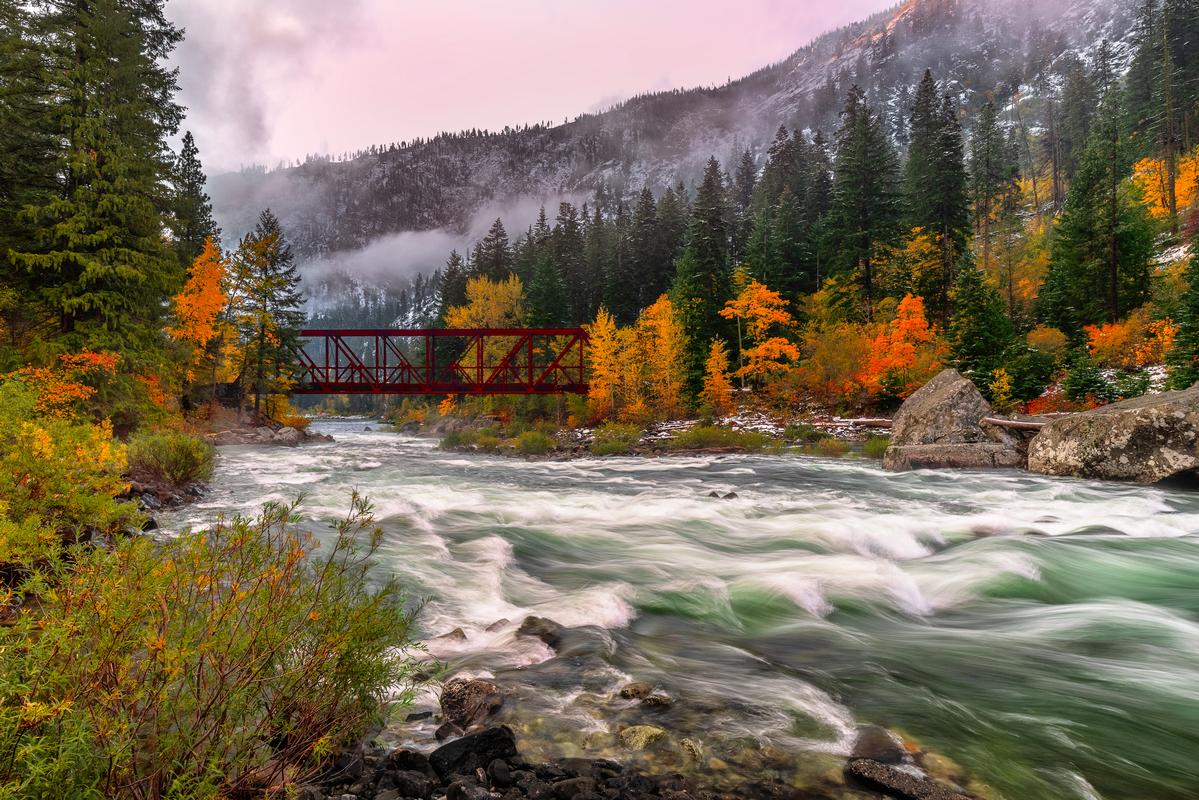
I think about him when I photograph the California coast — when I am standing at the Lone Cypress above Carmel Bay or looking out at the Pacific from the Pebble Beach cliffs, a few miles from where his first gallery opened in 1992. He was a California artist who understood California coastal light, who started with a sketchbook on a freight train and ended with a trademarked empire of reproductions. He was a traditional artist in the fullest technical sense, working in a lineage that runs from Rembrandt and Turner through the Hudson River School to a mall gallery in suburban America. And he was, privately, a more complex and troubled figure than the cottage windows suggested.
The art was not the whole story. It rarely is.
Explore Eddie Jongas's California Photography Collection →
Explore Landscape Photography Prints →
Explore Fine Art Photography Prints →
Eddie Jongas is a modern fine art photographer based in Las Vegas, Nevada, who has photographed the California coast, the Pebble Beach peninsula, and landscapes across 48 states and 15 countries. His TruLife acrylic-mounted limited edition prints are available exclusively through jongasfineartphotography.com. Free shipping to all 50 states.
