There is a photograph that stopped the United States government in its tracks. A woman with weathered skin and a furrowed brow sits in a lean-to shelter, her right hand raised to her chin, her eyes focused somewhere in the distance that holds no comfort. Two children press against her shoulders with their faces turned away, as if they already know the camera is there and cannot bear to be seen. A third child, an infant, sleeps in her lap. The photograph is called Migrant Mother. The year is 1936. The photographer is Dorothea Lange.
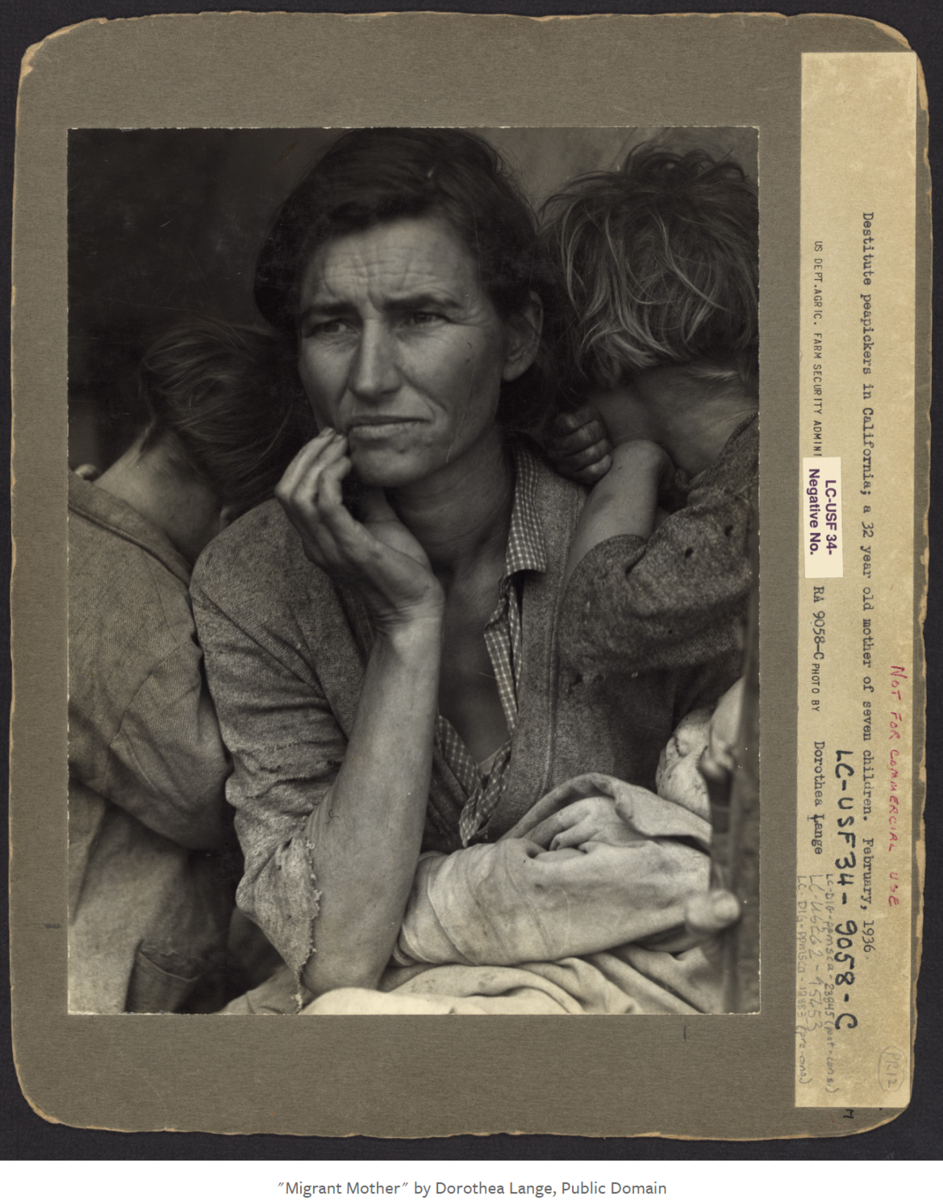
Within days of the image appearing in San Francisco newspapers, the federal government dispatched 20,000 pounds of food and emergency supplies to the starving migrant camp in Nipomo, California where it was taken. A single photograph forced the hand of a federal bureaucracy that weeks of field reports and economic data had failed to move. That is the specific kind of power Lange spent her career understanding and deliberately using — the power of a human face to do what statistics cannot.
She despised being called an artist. Her preferred title was “tradeswoman.” She saw her camera not as an instrument of self-expression but as a practical tool for investigative observation — the same way a reporter uses a notepad, or a lawyer uses a subpoena. What she did with that tool turned out to be art of the highest order, almost despite her intentions. And the city where she built the foundation for everything that followed was San Francisco.
From Polio to Portrait Studio — How San Francisco Made Her
Dorothea Lange was born in Hoboken, New Jersey in 1895. At age seven she contracted polio, which left her right leg permanently weakened and gave her a distinctive limp she carried for the rest of her life. She spent years learning to walk as smoothly as possible, wearing long skirts, managing the physical and social reality of a visible disability in early 20th-century America.
She would later describe the limp as the most important thing that ever happened to her as a photographer. When she entered the squalid migrant camps and the desperate breadlines that became her primary subjects in the 1930s, she would deliberately let the limp show. People who were defensive, exhausted, and deeply suspicious of anyone with a camera or a government badge would see her faltering gait and something in them would relax. Her own physical vulnerability disarmed theirs. She had weaponized a childhood disability into a documentary technique. “It formed me,” she said. “Guided me, instructed me, helped me, and humiliated me. I’ve never gotten over it, and I am aware of the force and power of it.”
In 1918, a young Lange and a friend set out from New York to travel the world, planning to finance the trip as they went. Almost immediately upon arriving in San Francisco — their first stop — a pickpocket stole all her money. Stranded and penniless in an unfamiliar city, she took a job at a local photo finisher’s shop. Within two years she had embedded herself so thoroughly in San Francisco’s creative community that she had opened her own portrait studio at 540 Montgomery Street, catering to the city’s wealthy elite. The pickpocket who robbed her effectively made her career.
Through the 1920s, Lange’s studio was one of the most fashionable portrait destinations in San Francisco. She photographed socialites, business leaders, and the Bay Area’s cultural establishment. She was technically accomplished, commercially successful, and professionally comfortable. Then the Depression hit, and the streets outside her studio window began telling a different story than the one she was photographing inside it.
Black Tuesday and the Decade That Followed
On October 29, 1929 — Black Tuesday — the speculative bubble that had been inflating through the Roaring Twenties finally collapsed. Stock prices wiped out billions of dollars in a single afternoon. More than 9,000 American banks failed in the years that followed, destroying the savings of millions of ordinary families. By 1933 the national unemployment rate had reached 25 percent — one in four working Americans without a job. The homeless built entire settlements on the edges of major cities from cardboard and scrap lumber, naming them “Hoovervilles” after the president they held responsible.
Nature compounded the economic disaster with an ecological one. A decade-long drought across the Southern Great Plains — Texas, Oklahoma, Kansas, Colorado, New Mexico — combined with decades of aggressive, soil-stripping farming practices to produce one of the worst environmental catastrophes in American history. The Dust Bowl. Giant walls of black dirt, called Black Blizzards, swept across 100 million acres of farmland, burying crops, suffocating livestock, and filling the lungs of anyone caught outdoors. On April 14, 1935 — Black Sunday — the worst storm of the decade turned mid-afternoon pitch black across the plains.
Roughly 2.5 million people packed whatever they could carry and headed west. They followed Route 66 and the northern highways toward California, lured by flyers promising agricultural work in the Central Valley. When they arrived they found a state already reeling from the Depression, wages barely sufficient to survive on, and living conditions in the roadside ditch camps that no official report had yet adequately described. They were called Okies regardless of which state they came from, and they were systematically invisible to the political process that was supposed to be addressing the crisis.
Lange looked out her studio window at the San Francisco streets in the early 1930s and could not stay inside. “I had to put myself in front of what was happening,” she said later. She wrapped her large Graflex camera in a dark cloth to make it less conspicuous, dressed in plain dark clothing, and began walking the streets documenting the breadlines, the labor strikes, the unemployed men standing in the rain with nowhere to go. Her 1933 photograph White Angel Breadline — a man in a crowd at a San Francisco soup kitchen, his back turned from the line, his hands folded over the rim of a tin cup — was one of the first images to capture the specific quality of Depression-era despair: not dramatic, not loud, just an ordinary person in an impossible situation.
Hired as a Stenographer — The Government’s Most Effective Employee
Agricultural economist Paul Taylor had been filing detailed field reports on the conditions of migrant workers in California’s Central Valley for years. The reports were accurate, thorough, and comprehensively ignored. He came to the conclusion that statistics were not going to move anyone and that what was needed were photographs that put human faces on the data. The state bureaucracy refused to approve a budget line for a photographer. So Taylor hired Lange under the administrative title of “Stenographer.” Her only job was to ride in the truck and shoot film. The paperwork called her a typist. The record she produced changed American history.
Over the next several years, working for the Farm Security Administration’s documentary photography project, Lange traveled extensively across California, the South, and the Dust Bowl states. Her technique was deceptively simple: she moved slowly, talked to people extensively before raising the camera, and never rushed a shot. She called it “sauntering” — a deliberate, unhurried presence that made people forget they were being documented. The limp helped. The plain clothes helped. The dark cloth wrapped around the camera helped. Mostly it was the patience and the genuine attention she paid to the people she photographed that made the difference between a photograph that recorded a face and a photograph that recorded a life.
“The camera is an instrument that teaches people how to see without a camera.”
The Farm Security Administration had an unspoken editorial directive: document primarily white families for maximum political impact with Congress. Lange flatly refused to comply. She used federal film to meticulously document African American sharecroppers, Latino farmworkers, Asian American laborers, and displaced families from every background the official record preferred to omit. The government quietly suppressed these images from official publications. Lange kept shooting them anyway, ensuring that what actually happened would have a visual record regardless of what the political process found inconvenient.
Migrant Mother — The Photograph That Fed a Camp
In February 1936, Lange was driving back from a field assignment in the Central Valley when she passed a sign for a migrant workers’ camp in Nipomo, California. She had been traveling for a month and wanted to get home. She drove past the sign. Then she turned around.
In the camp she found Florence Owens Thompson, a 32-year-old woman of Cherokee descent who had arrived in California from Oklahoma with her children after the family’s car broke down on the highway. They were surviving on frozen vegetables from the surrounding fields and birds her children could catch. Lange spent approximately ten minutes with her, taking six exposures. She did not ask her name.
The resulting photograph shows Thompson with her right hand raised to her chin, her eyes focused on something in the distance, two children pressed against her with their faces turned away. It is a composition of extraordinary restraint — nothing dramatic, nothing staged, just the specific weight of a specific woman in a specific situation that somehow manages to carry the entire decade in one frame. When the image appeared in San Francisco papers, the federal government dispatched 20,000 pounds of food and supplies to the Nipomo camp within days. Thompson, who went on to live until 1983, spent decades ambivalent about the photograph that made her the face of an era while giving her nothing directly in return. The complexity of that situation — the subject who was helped and also used, simultaneously — is part of what makes the history of documentary photography interesting and not entirely comfortable.
Migrant Mother — Key Facts
- Date taken: February 1936, Nipomo, California
- Subject: Florence Owens Thompson, age 32, Cherokee descent
- Exposures made: Six negatives over approximately ten minutes
- Immediate impact: 20,000 pounds of federal food and supplies dispatched within days
- Subject’s name recorded: No — Lange did not ask her name at the time
- Florence Owens Thompson lived until: 1983
Ansel Adams, Imogen Cunningham, and the San Francisco Photography Circle
San Francisco in the 1920s and 1930s was home to one of the most concentrated creative photography communities in the world, and Lange was at the center of it. The city’s small, interconnected community of photographers crossed paths constantly at exhibitions, in studios, and in the social circles that formed around the medium when it was still fighting for recognition as a legitimate art form.
It was in this world that Lange met Ansel Adams — a San Francisco native who was steadily building his reputation for large-format photography of Yosemite and the High Sierra. They became close friends and spent four decades as professional counterparts whose work represented almost perfectly opposed philosophies about what photography was for. Adams believed in the pristine, unpeopled landscape — nature rendered with technical perfection and the Zone System’s precise control of tone. Lange believed the camera’s highest purpose was the human face in extremity. Adams once dismissed social documentary teams as “a bunch of sociologists with cameras.” Lange would have taken that as a compliment.
Their friendship survived the philosophical disagreement because genuine respect ran beneath it. When both photographed the Japanese American internment during World War II — Lange hired by the government in 1942, Adams going independently to Manzanar in 1943 — the difference in their approaches was precisely what their careers had predicted. Lange’s images documented the systemic injustice of families being rounded up and removed. They were so critical of U.S. government policy that the military immediately impounded and censored them, and they sat classified in the National Archives for decades before finally receiving museum exhibition. Adams photographed the same people and saw their resilience, their agricultural gardens in the desert, their dignified endurance. Both bodies of work are important. They are important in different ways.
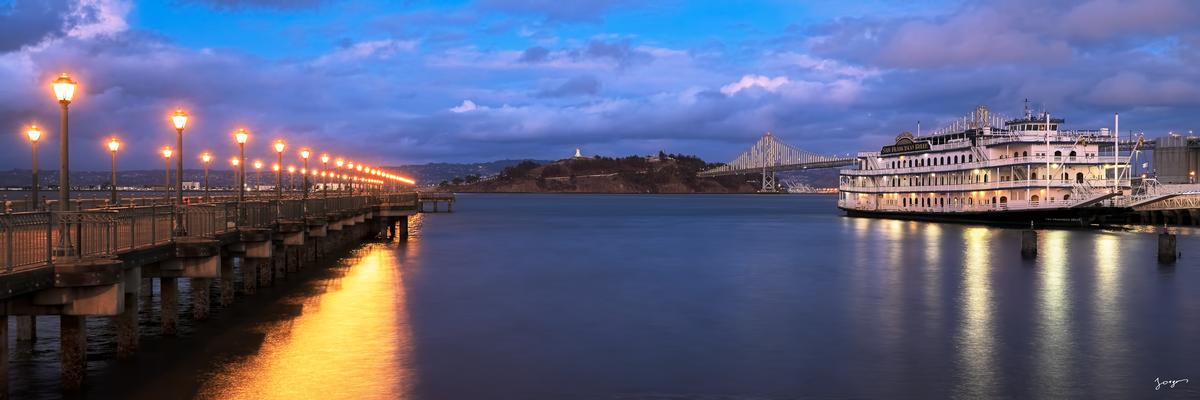
In 1945, Adams was tasked with establishing the very first dedicated fine art photography department in the United States at the California School of Fine Arts — now the San Francisco Art Institute. He invited Lange to join the founding faculty alongside himself, Minor White, and Imogen Cunningham. Cunningham was a significant figure in her own right — a co-founder of Group f/64 alongside Adams and Edward Weston, celebrated for her botanical photography and intimate portraits, and one of the West Coast photographers who had been arguing for decades that photography deserved to be taught and exhibited on the same terms as painting and sculpture. The four of them, collectively, built the institutional foundation for fine art photography education in America.
In 1952, Lange and Adams were among the co-founders of Aperture magazine, alongside Minor White, Barbara Morgan, and others. The journal — still publishing today and still one of the most respected photography publications in the world — was their attempt to bridge the gap between documentary photography and fine art photography: to create a serious publication that took both seriously as disciplines rather than treating them as opposites.
The most revealing episode in their friendship came in the summer of 1953, when Lange convinced Adams to join her on a field assignment for Life magazine documenting three rural Mormon communities in Utah. They spent weeks in brutal August heat photographing the towns of Gunlock, Toquerville, and St. George together. Equipment failures in the heat meant they frequently had to swap cameras, and because Adams’ lab assistant developed all the negatives together, some of the photographs from the trip are still disputed attribution today. The creative friction was considerable: Adams wanted to photograph architectural geometry and landscape. Lange wanted to photograph the people. When Life published the piece in September 1954, they ran 28 of Lange’s images and 7 of Adams’. Adams called the result a “caricature” and was furious. The friendship survived. When Lange was dying of esophageal cancer in 1965, Adams was among those defending her legacy publicly and without reservation.
The Final Retrospective — A Race She Almost Didn’t Win
In 1941, Lange became the first woman ever awarded a Guggenheim Fellowship in photography. She turned the money down almost immediately to document the Japanese American internment instead. In 1952 she co-founded Aperture. In 1945 she helped establish the first fine art photography department in the country. By any measure she had already built a legacy that would outlast her.
In 1964, the Museum of Modern Art in New York told her they wanted to mount a solo retrospective of her work. It would be the first solo retrospective MoMA had ever given a female photographer. Lange was seventy years old and had been diagnosed with esophageal cancer. She spent the final months of her life doing what she had always done: working. She curated the show herself — 200 images selected, arranged, and considered with the same meticulous attention she had given to her field notes in the migrant camps thirty years earlier. She died in October 1965, before the exhibition opened. The retrospective opened in 1966 to major critical response and confirmed, if confirmation was still needed, that Lange belonged in the first rank of American photographers of any era.
The Tradeswoman’s Legacy
Dorothea Lange permanently changed what documentary photography is understood to be. Before her, a photograph of a social problem was evidence. After her, it was an argument. The specific combination she developed — the technical precision of a formally trained portrait photographer, the patience and empathy of someone who had spent years earning the trust of difficult subjects, the field reporter’s instinct for the image that carried the whole story — produced a body of work that no amount of economic data could replicate.
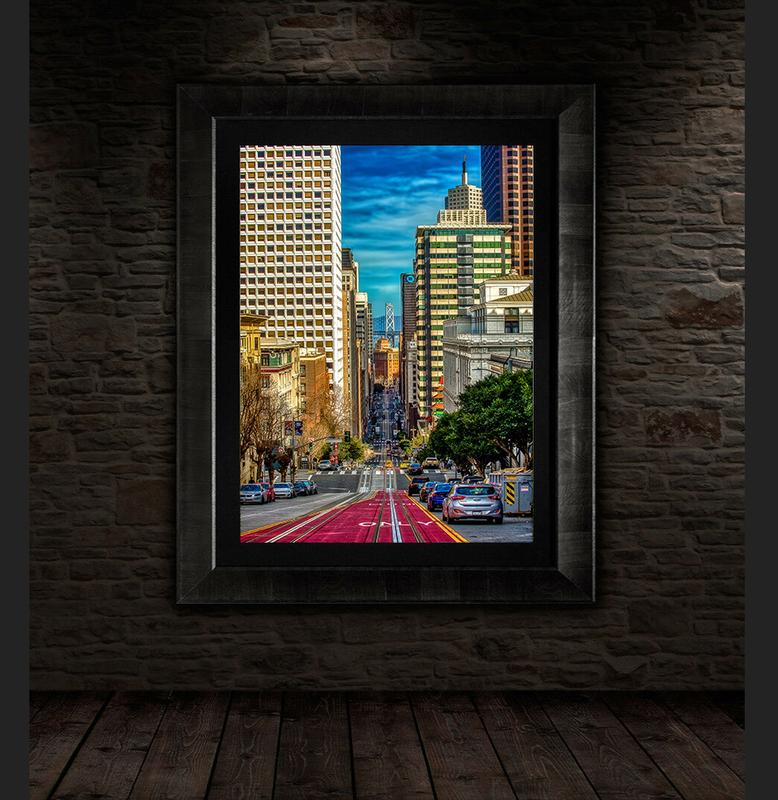
She spent her career in San Francisco — a city whose light and geography and social character shaped her sensibility as directly as the Depression shaped her subject matter. The portrait studio on Montgomery Street. The streets of the Tenderloin where she first took her camera outdoors. The California School of Fine Arts where she helped build the institution that would train generations of photographers who came after her. The city is inseparable from the work.
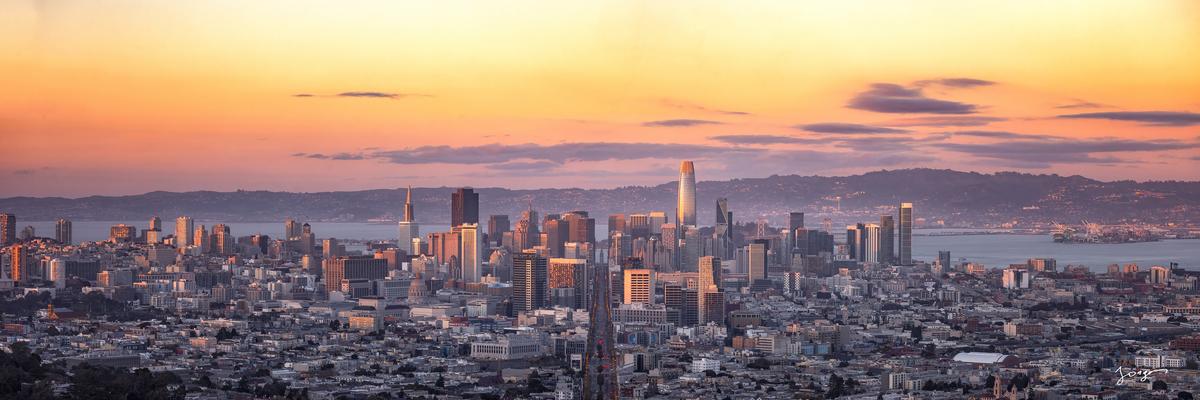
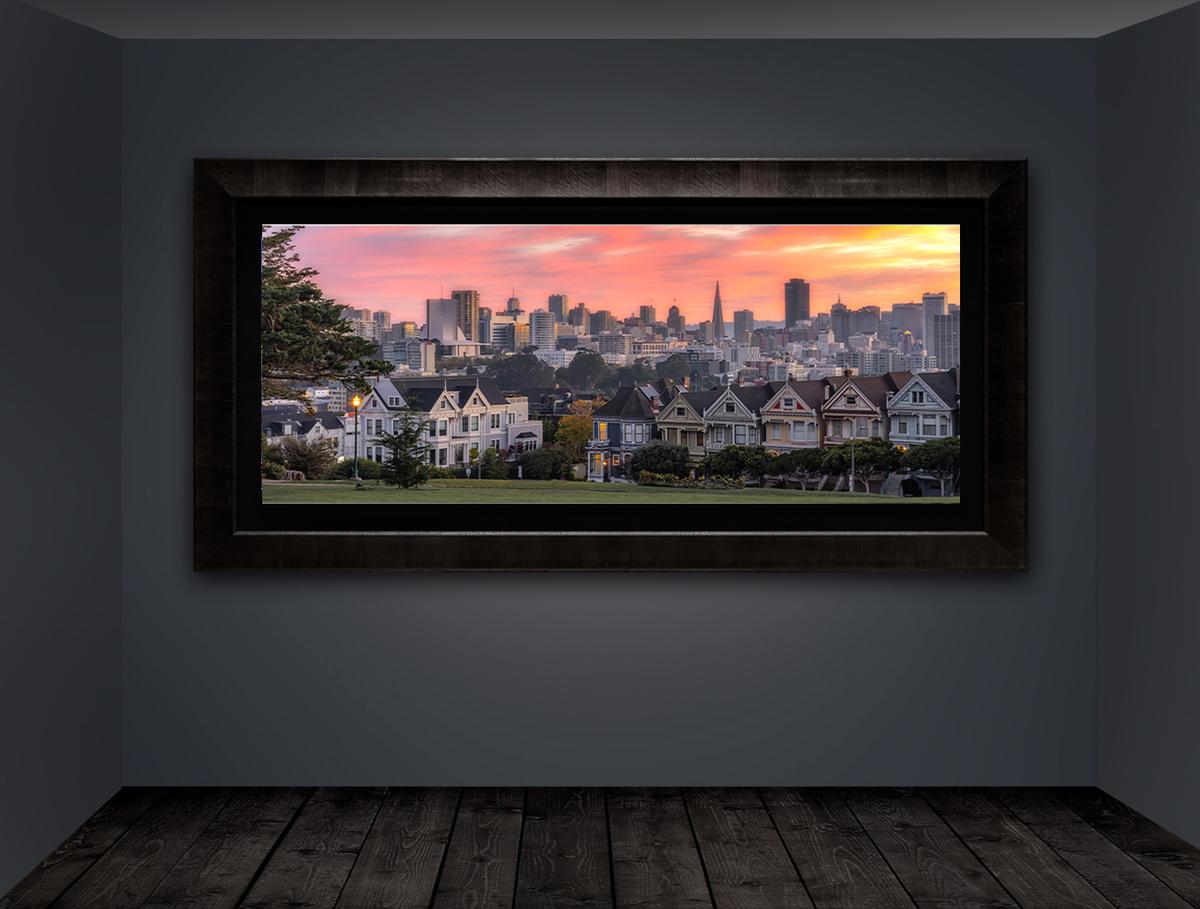
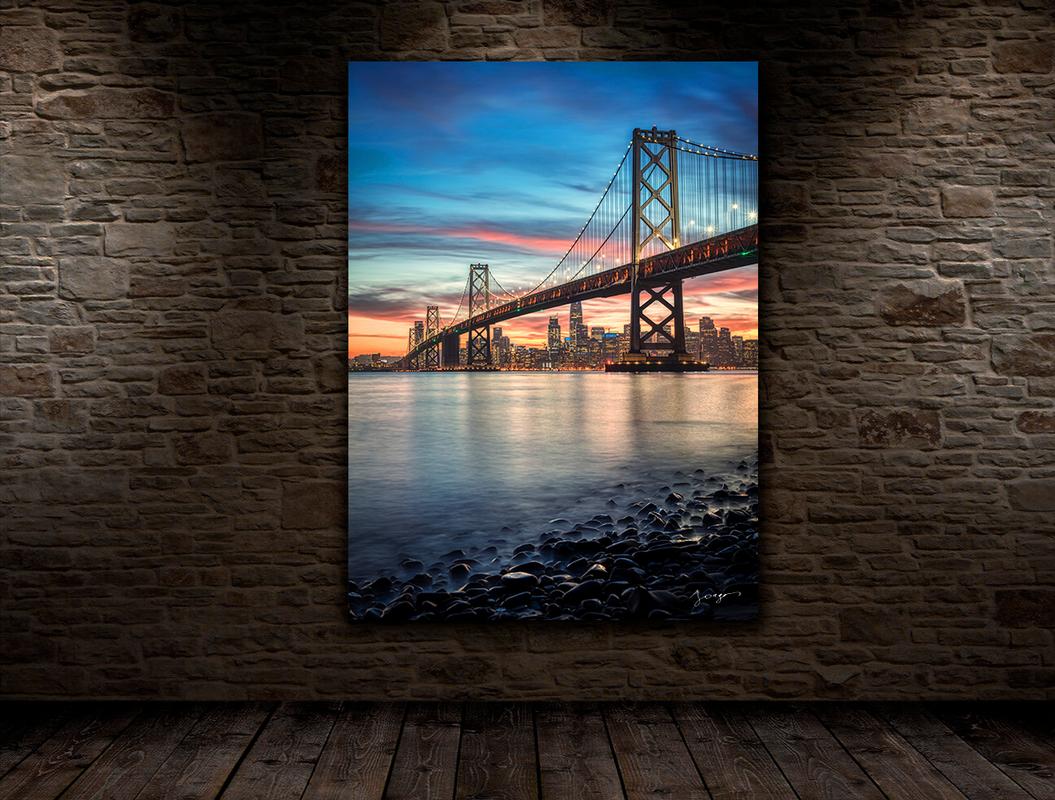
I have photographed San Francisco extensively — the cable cars and the fog and the bay and the specific quality of light that the hills and the water produce together in ways that don’t exist anywhere else. My San Francisco photography collection covers the city Lange made her professional home for four decades. It is a different kind of photography than what she made there — fine art landscape and urban work rather than social documentary — but it is made in the same light, in the same city, with the same understanding that a great photograph of a place carries more than its subject.
The camera, as Lange said, is an instrument that teaches people how to see without a camera. She spent forty years proving it.
Read the Ansel Adams article →
Explore San Francisco Photography Prints →
Explore Fine Art Photography Prints →
Eddie Jongas is a modern fine art photographer based in Las Vegas, Nevada. His TruLife acrylic-mounted limited edition prints are available exclusively through jongasfineartphotography.com. Free shipping to all 50 states.
