The first time I stood at the rim of the Taughannock gorge and looked down, my knees did something they don’t usually do. They registered the height before my brain did. That particular response — a slight involuntary bend, a recalibration of balance — is something I’ve only experienced at a handful of places in 48 states and 15 countries of travel. The edge of the Grand Canyon rim. The observation deck on the Empire State Building the first time, years ago. And this gorge in the Finger Lakes region of central New York, in a state park that most people outside of the Northeast have never heard of.
I’ve been to Taughannock Falls three times now. Each visit was different. Each one produced images I couldn’t have gotten on the previous trip. And each time I left thinking that this place is one of the most genuinely overlooked natural wonders in the eastern United States — spectacular in a way that its relative obscurity makes even more striking when you finally encounter it.
215 Feet — Taller Than Niagara
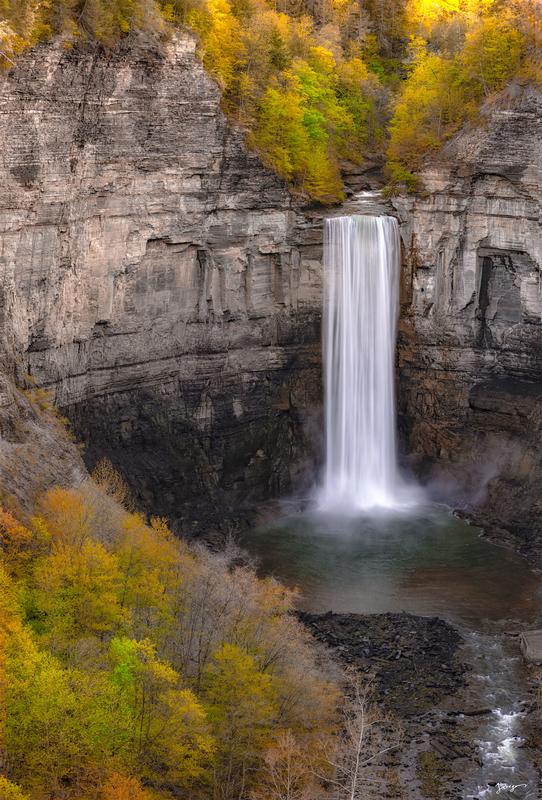
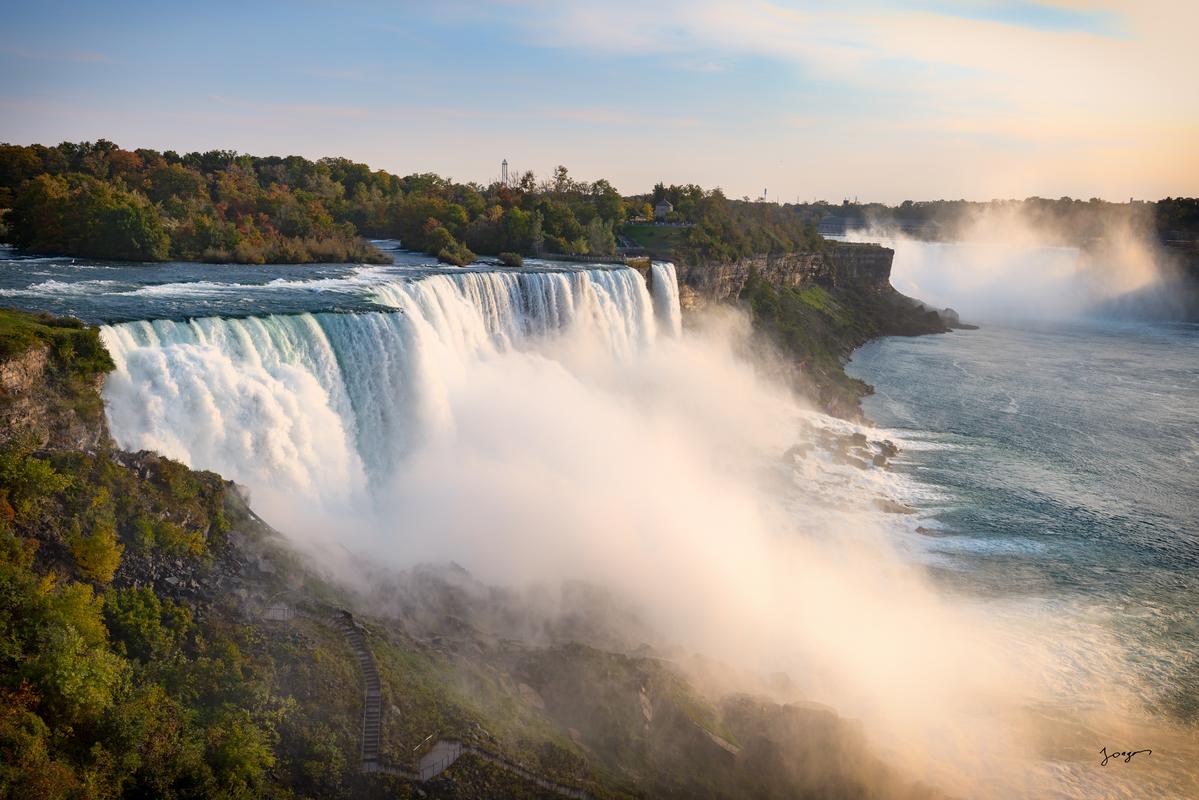
Here is the fact that stops people: Taughannock Falls drops 215 feet in a single, uninterrupted, free-falling plunge. That is 33 feet taller than Niagara Falls.
Read that again. A waterfall in a state park northwest of Ithaca, New York is taller than Niagara Falls. Most people — including most New Yorkers — have no idea this is true. Niagara has the volume, the tourism infrastructure, the honeymoon industry, the casinos on both sides of the border. What it does not have is that single vertical drop. Taughannock has that, and it has it in an amphitheater of shale and sandstone and limestone cliffs that rise nearly 400 feet above the gorge floor, channeling the sound of the falling water into something that reverberates off the rock walls and hits you in the chest before you can even see the falls.
The word Taughannock — pronounced Tuh-GAN-nick, which I mangled embarrassingly on my first visit — likely derives from the Algonquian word Taghkanic, meaning “great fall in the woods.” The name is also tied to a Delaware chieftain whose story I’ll get to shortly. What you need to understand first is the physical scale of what you’re looking at: a single curtain of water falling two hundred and fifteen feet into a natural bowl carved from layers of rock that were deposited on the floor of an ancient sea 350 to 400 million years ago. The gorge itself has been cutting into that rock since the last glacier retreated, roughly 12,000 years ago. It is still cutting now. The landscape is not finished.
When to Go — And Why Spring Is the Answer
Over my three visits, I’ve learned something practical that most travel articles about Taughannock don’t tell you: the timing of your visit dramatically changes what you see.
I went once in the fall, expecting spectacular foliage framing the waterfall. The foliage was beautiful. The waterfall was… modest. By late autumn, Taughannock Creek has spent the summer running down and the flow can thin considerably — sometimes to a narrow ribbon dropping through the cliff face rather than the full curtain of water you’ve seen in photographs. It’s still impressive by any reasonable standard. It just isn’t the Taughannock at its best.
Late spring is when you go. The snowmelt from the hills above feeds the creek at its maximum annual volume, and the result is the full version of the falls — a broad, powerful, roaring curtain of water that fills the entire amphitheater with sound and mist. I came in late spring for the second and third visits specifically because of what I saw — and didn’t see — on the first.
It was on that third visit, in the spring of 2023, that I got the shot I’d been waiting for. The water volume was exactly right, the morning light was coming from a low angle that caught the mist in the gorge, and I found a vantage from the gorge trail where the falls framed perfectly between the canyon walls. That image became Timeless Flow — one of my favorite pieces in the waterfall photography collection and, I think, one of the best arguments I’ve made in a single image for why fine art landscape photography belongs in the same conversation as any other serious visual art tradition.
Getting Close — The Gorge Trail
The trail into the gorge is almost deceptively easy. It’s approximately 1.5 miles round trip on a flat, wide gravel path that runs alongside Taughannock Creek directly to the lower viewing area below the falls. The difficulty level is minimal — I’ve seen people do this in flip flops, which I wouldn’t recommend but which is technically possible. The accessibility is part of what makes this trail extraordinary: because it’s easy to walk, you have time and energy to actually look at where you are.
And where you are, as you walk in, becomes progressively more remarkable. The canyon walls rise on either side as you approach, the creek runs alongside you, and the scale of the rock faces on either side increases steadily until you emerge into the amphitheater and the falls are directly in front of you. The feeling at that moment is difficult to describe accurately. The water is loud — not Niagara-loud, but loud in a way that fills the enclosed space completely. The mist from the base rises into the bowl. And the walls around you are genuinely, measurably enormous — nearly 400 feet of shale and limestone standing vertical on either side.
If you want the aerial perspective, the North and South Rim Trails offer sweeping views looking down into the gorge from the canyon edges above. These are seasonal trails, typically open from April through October. The overlook off Taughannock Park Road gives you the classic top-down view without hiking — drive up, park, walk thirty feet, and you’re standing at the rim looking down. This is where my knees first made their involuntary assessment of the situation.
“The canyon walls rise on either side as you approach… until you emerge into the amphitheater and the falls are directly in front of you. The water is loud in a way that fills the enclosed space completely.”
The Chief, the Daughter, and the Lady in the Mist
No place this dramatic exists without mythology attached to it, and Taughannock has several.
The most prevalent legend concerns the origin of the name itself. According to 19th-century accounts, a young Lenni Lenape (Delaware) chieftain named Taughannock led his warriors northward into Cayuga territory to avenge an insult or a raid. Outnumbered and cornered at the cliff’s edge above the gorge, he fought to his last breath rather than surrender. His body was cast over the precipice — 215 feet into the water below — and out of respect for his courage, the Cayuga people named the cataract after their fallen adversary. There is something genuinely moving about that detail: a place named not for conquest but for the bravery of the defeated.
A second legend mirrors the structure of the Multnomah Falls story in Oregon, with a chieftain’s daughter at the center. In this version, Cayuga warriors arrived at Taughannock’s camp when he was heavily outnumbered. He hid his warriors in pits beneath the ground, covered with brush and leaves, leaving only the women and children visible. When the Cayuga leader confronted the chief’s daughter — described as “as beautiful as the morning rainbow that springs from the mist of the falls” — and demanded to know where the men were, she pointed at the ground and said they were “all down below.” The Cayuga leader, believing the men had fled or perished, stepped forward and was immediately surrounded when the warriors burst from the earth. Seeing his daughter’s blush at this attention, Taughannock chose peace over revenge. The Cayuga leader married the chief’s beautiful daughter at the edge of the falls. A peace sealed by the mist.
Then there is the Lady of the Mist. In the late summer months when the water volume drops to its lowest, a rock formation becomes visible directly behind the falling water — a shape that local folklore has always read as a Native American maiden standing watch behind the veil of the cataract. In high water season she is hidden entirely. When the falls thin in late summer, she appears. I have not seen her. But I plan to look next time.
The Giant, the Tightrope, and the Wheelbarrow
Beyond its mythology, Taughannock has accumulated a collection of eccentric 19th-century human stories that say a great deal about how Americans responded to dramatic natural landscapes in the era before national parks and proper tourism infrastructure.
In the summer of 1874, a Canadian acrobat known professionally as “Professor Jenkins” arrived at the gorge with 1,200 feet of hemp rope. He strung a tightrope directly across the 400-foot chasm in front of the waterfall and, before a crowd of thousands, walked it. Crawled it. Turned flips on it. And then, because merely walking a tightrope across a 400-foot gorge apparently wasn’t enough, he crossed it again pushing a wooden wheelbarrow. I have stood at that rim and looked down. I cannot fully process what Professor Jenkins was thinking. I can only confirm that the drop is exactly as serious as it sounds.
Five years later, in 1879, workers widening a road near the hotel above the falls dug up what appeared to be the petrified body of a seven-foot prehistoric giant weighing 800 pounds. It became an overnight sensation. More than 5,000 tourists paid admission to see the “Taughannock Giant,” and even scientists from nearby Cornell University debated its authenticity. It was eventually revealed as an elaborate hoax engineered by the local hotel owner, who had manufactured the figure from stone dust, iron filings, eggs, and beef blood, buried it, and then arranged for it to be “discovered.” The tourist business, presumably, improved. The scientific community was not amused.
The Return of the Fastest Birds on Earth
Of all the stories connected to Taughannock Falls, the one that moved me most when I read about it is the most recent.
In 1909, the legendary Ithaca bird artist Louis Agassiz Fuertes documented a peregrine falcon nesting site on the sheer cliffs of the Taughannock gorge. Peregrine falcons — the fastest animals on Earth in a dive, reaching speeds over 240 miles per hour — nested on those cliff faces for decades. Then, mid-century, the pesticide DDT entered the food chain and decimated peregrine populations across North America. The cliffs went empty. For 74 years, no peregrines nested at Taughannock.
Then, in the spring of 2020, they came back. A breeding pair returned and nested on a ledge directly opposite the falls overlook. They have continued to return and nest each year since. Park visitors and photographers can now watch the world’s fastest birds hunting and raising their chicks against the backdrop of a 215-foot waterfall. This is what conservation done right actually looks like over the long term — not a single dramatic intervention but decades of incremental work that eventually allow a place to become itself again.
If you visit between April and July, bring binoculars. And look at the cliffs.
The Ice Volcano
I have not visited Taughannock in winter. After reading about what happens there in a deep freeze, I intend to.
The gorge acts as a micro-climate — the dense rock walls trap cold and damp air far below the temperature of the surrounding terrain. In prolonged winter freezes, the spray from the 215-foot drop accumulates at the base of the cliff in a specific and extraordinary way: it doesn’t freeze solid. The heart of the creek keeps moving behind an accumulating shell of ice, and the freezing spray builds upward in a growing hollow cone — an ice volcano, locals call it — that in particularly brutal winters rises several stories from the ground, reaching toward the descending icicles from above. The result is a translucent frozen fortress at the base of one of the tallest waterfalls in the Northeast, drawing photographers from across the region specifically for this winter spectacle.
The gorge is also a living, changing landscape in a more permanent sense. In 2010, freeze-and-thaw cycles caused a massive section of cliff face to cleave off and crash into the pool below. The rockfall altered the shape of the amphitheater. The waterfall is technically receding — cutting further back into the hillside every year as the softer shale beneath the hard limestone capstone erodes. The landscape you photograph today is not the landscape of a century ago, and it will not be the landscape of a century from now.
Beyond the Falls — What Else the Region Offers
Taughannock Falls State Park covers 750 acres and extends all the way across Route 89 to the shoreline of Cayuga Lake — making it a genuinely multi-experience destination rather than a single-attraction stop. There is a swimming beach, a marina, kayak rentals, camping cabins, and a summer sunset concert series on the lakefront lawn. In winter, the trails become cross-country ski routes.
The village of Trumansburg, a few minutes northwest of the park, has the kind of independent restaurant and cafe scene that tends to appear around places with genuine natural character. The Finger Lakes GrassRoots Festival of Music and Dance, an internationally recognized four-day event held there every July, is reason enough to plan a trip around the dates.
Eight miles south is Ithaca, the college town whose famous motto — “Ithaca is Gorges” — is both a pun and a literal statement of fact. The gorges of Ithaca are real, dramatic, and in some cases accessible from the middle of town. The Cornell Lab of Ornithology sits on the edge of campus, looking out over the Sapsucker Woods Sanctuary with its boardwalk trails through wetlands and forests. If you went to see the peregrine falcons at Taughannock and found you wanted to know more about why their return matters, the Cornell Lab is the institution that can tell you.
The Finger Lakes State Park Trifecta
- Robert H. Treman State Park: Just south of Ithaca — a heavily forested canyon with 12 distinct waterfalls and a lifeguarded natural pool fed by the creek beneath Lower Lucifer Falls.
- Buttermilk Falls State Park: On the edge of Ithaca — a violent, foaming cascade down a massive tiered rock staircase that you can walk directly alongside on the trail up.
- Watkins Glen State Park: Thirty minutes west on the southern tip of Seneca Lake — hand-cut stone staircases and tunnels through a 400-foot-deep cavern past 19 waterfalls in under two miles, including Rainbow Falls, where the trail passes directly underneath the water.
And running along the entire length of Cayuga Lake: the Cayuga Lake Wine Trail, America’s first organized wine trail, connecting over a dozen boutique wineries and cideries on hillsides overlooking the water. The deep glacial lake creates a micro-climate that produces exceptional cool-climate Rieslings. A long day at the falls followed by a late afternoon at a winery on the lake is not a bad way to understand why people move to the Finger Lakes and never entirely leave.
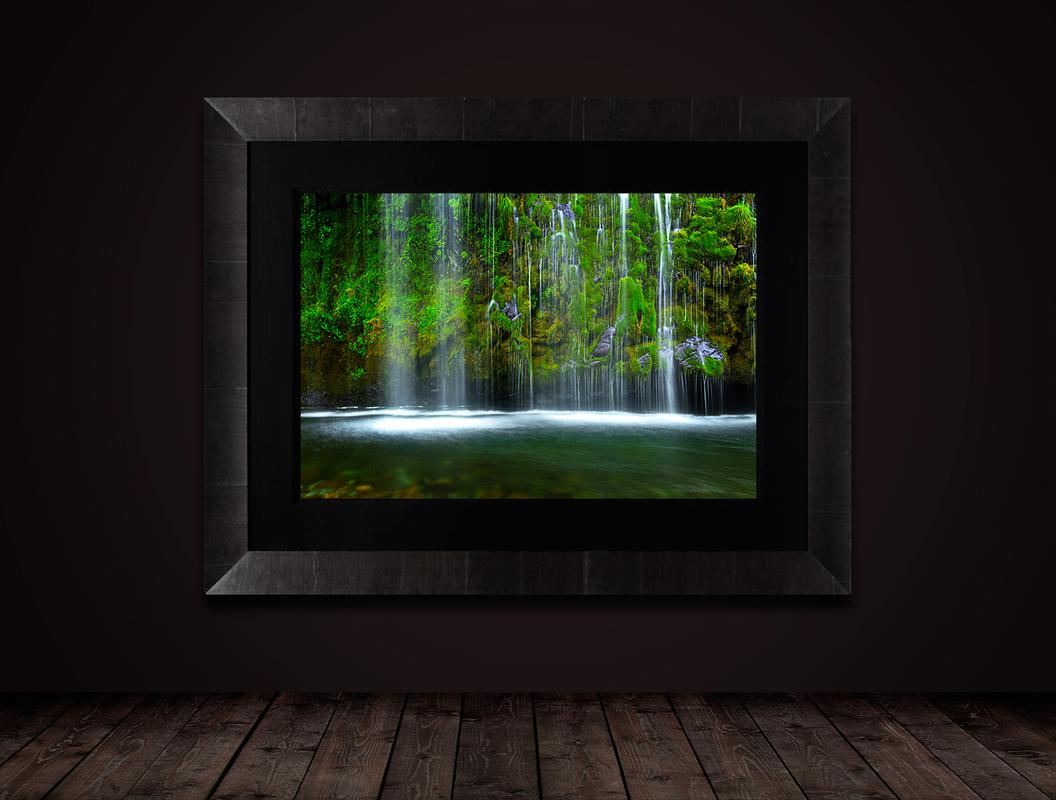
Why I Keep Going Back
Three visits to the same waterfall might seem excessive. I don’t think it is. The first visit teaches you the place. The second visit teaches you what you missed. The third visit gives you the image you couldn’t have gotten on either of the first two, because you finally understood the conditions that produce it.
Taughannock in spring 2023, with the water at full volume and the morning light hitting the mist at exactly the right angle, gave me Timeless Flow — a photograph that I think captures something true about what it actually feels like to stand in front of 215 feet of falling water enclosed in 400-foot rock walls. Not the information of it. The feeling of it.
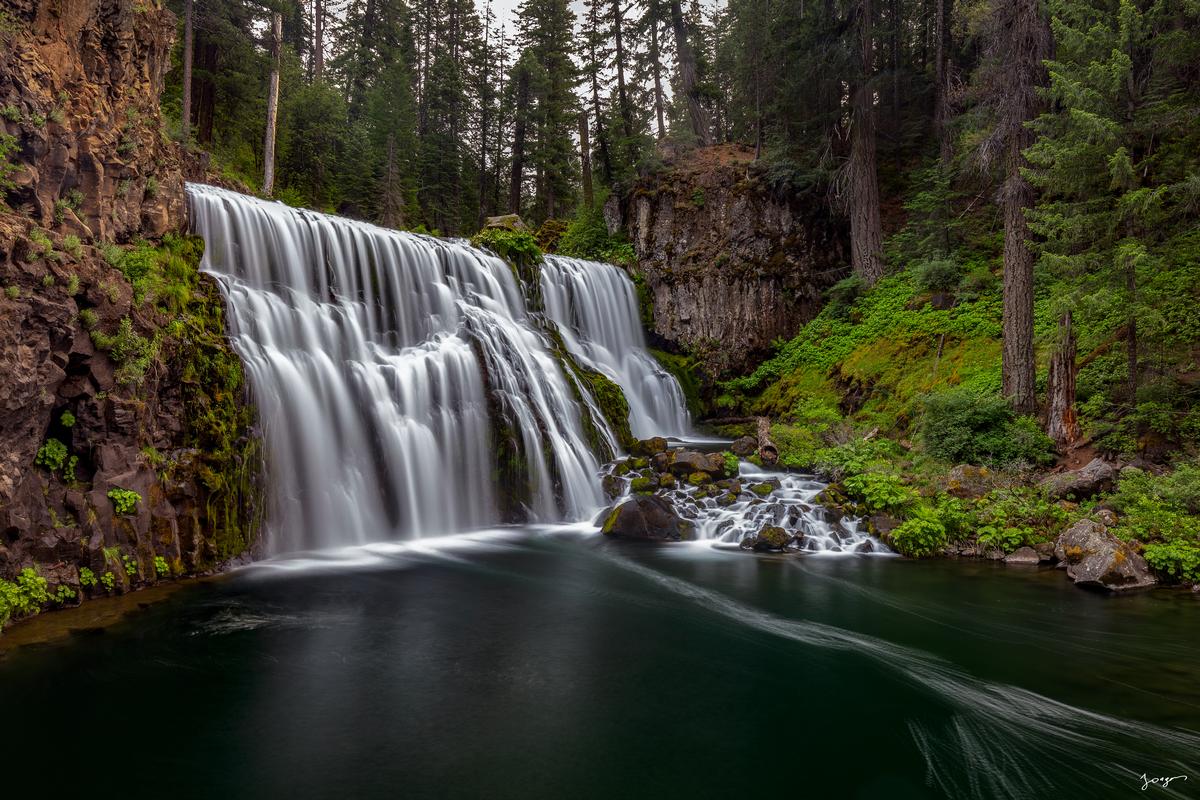
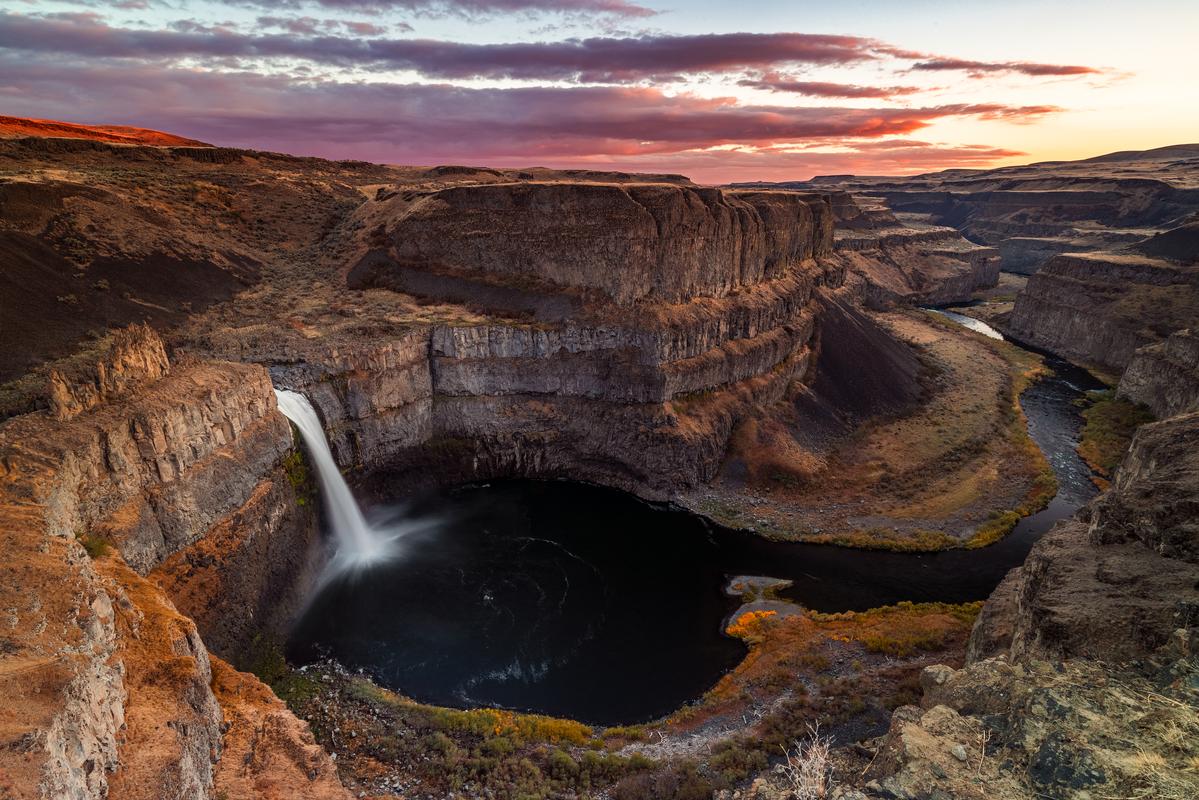
The East keeps surprising me. Taughannock is proof that extraordinary landscapes don’t require a trip to the American West — though I’ll admit my heart still lives out there. I’ve spent years chasing waterfalls across the Pacific Northwest and California, standing at the base of falls that come off mountains still carrying snowmelt in June, and driving back roads in Oregon where the water drops off basalt cliffs into forests so dense the light barely reaches the canyon floor. If the West Coast waterfall circuit is on your list, I put together a guide to the best waterfalls to visit on the West Coast from everything I learned doing it the hard way. Start there and work your way East. Taughannock will be worth the wait when you finally arrive.
Go in late spring. Stand at the rim and let your knees make their assessment. Walk the gorge trail all the way in. Look up.
Then look for the peregrines on the cliff face. They came back after 74 years. They know something about this place worth staying for.
Browse the Jongas Waterfall Photography Collection →
Browse New York Photography Prints →
Eddie Jongas is a modern fine art photographer based in Las Vegas, Nevada, who has photographed landscapes across 48 states and 15 countries. His TruLife acrylic-mounted limited edition prints — including Timeless Flow from Taughannock Falls — are available exclusively through jongasfineartphotography.com. Free shipping to all 50 states.
