There is a moment in Edward Steichen's life that sounds almost too dramatic to be true.
In 1923, surrounded by paintings he had created over years of work, Steichen destroyed many of his canvases in a bonfire. He had spent much of his early life trying to succeed simultaneously as a painter and photographer. Now he was making a choice.
But the fascinating part of the story is that Steichen had already spent years making photographs that deliberately blurred the distinction between those two art forms.
His early photographs were atmospheric, manipulated and sometimes individually worked by hand. Then, after helping establish that kind of Pictorialist photography as legitimate fine art, he changed direction dramatically. He embraced sharper photography, became one of the defining fashion and celebrity photographers of his generation, photographed two world wars, directed an Academy Award-winning documentary, ran the photography department at the Museum of Modern Art, and created The Family of Man, one of the most widely seen photographic exhibitions ever assembled.
Even more interesting to me as a photographer is what happened between those accomplishments.
Steichen repeatedly questioned what photography should be — and what kind of artist he himself wanted to become.
His career is therefore more than the biography of an important photographer. It is also a story about something almost every serious artist eventually confronts: the possibility that the work you once believed in may no longer represent the artist you are becoming.
Who Was Edward Steichen?
Edward Steichen (1879–1973) was a Luxembourg-born American photographer, painter and curator who became one of the most influential figures in the development of modern photography.
His career crossed an extraordinary number of photographic eras. He helped Alfred Stieglitz promote photography as fine art through the Photo-Secession movement. His early Pictorialist photographs deliberately borrowed qualities from painting. He later abandoned that aesthetic for much sharper modern photography, became chief photographer for Vogue and Vanity Fair, worked in military photography during both World Wars, and eventually became director of photography at New York's Museum of Modern Art.
Few photographers provide a better example of how radically photography changed during the first half of the twentieth century. For a broader look at those technological and artistic changes, see my history and evolution of photography.
Edward Steichen — Key Facts
- Born: March 27, 1879, Bivange, Luxembourg
- Died: March 25, 1973, West Redding, Connecticut
- Nationality: Luxembourg-born American
- Known for: Pictorialist photography, fashion photography, military photography, curatorial work
- Key movement: Photo-Secession (co-founded with Alfred Stieglitz, 1902)
- Major publications: Chief photographer, Vogue and Vanity Fair
- MoMA role: Director of Photography, 1947–1962
- Notable exhibition: The Family of Man, MoMA, 1955
- Record sale: The Flatiron (1904), approx. $11.8 million at Christie's, 2022
From Painter to Photographer
Édouard Jean Steichen was born March 27, 1879, in Bivange, Luxembourg. His family immigrated to the United States when he was a child and eventually settled in Milwaukee, Wisconsin.
At fifteen, Steichen began a lithography apprenticeship. He painted outside work and soon became interested in photography, purchasing an early camera while still a teenager.
That combination matters.
Steichen did not begin with the assumption that painting was "art" and photography was something completely different. He developed both visual languages together.

His surviving paintings show influences associated with Tonalism, Symbolism and modern European art. Mood, atmosphere, twilight and color interested him — qualities that would soon become equally important in his photographs.
By 1900, Steichen had met photographer Alfred Stieglitz. Their relationship would become one of the most consequential partnerships in the early history of American fine-art photography.
Photo-Secession and the Fight to Make Photography Art
In the early twentieth century, photography still faced a basic cultural problem: many people considered the camera a mechanical recording device rather than a serious artistic medium.
Steichen and Stieglitz helped challenge that assumption.
In 1902 they became central figures in the Photo-Secession movement, which championed photography as a legitimate form of artistic expression. Stieglitz's influential journal Camera Work presented photography with the seriousness normally reserved for painting, drawing and printmaking.
Their Little Galleries of the Photo-Secession at 291 Fifth Avenue — usually called simply "291" — became important not only to photography but to American modern art. Through connections in Europe, Steichen helped introduce American audiences to artists including Auguste Rodin, Henri Matisse, Paul Cézanne, Pablo Picasso and Constantin Brâncu?i.
Photography was changing from a technology used to record the world into a medium artists could use to interpret it.
Steichen was at the center of that transition.
Who was Edward Steichen?
Edward Steichen (1879–1973) was a Luxembourg-born American photographer, painter and curator. He became one of the most influential figures in the development of modern photography, helping to establish it as a legitimate fine art through the Photo-Secession movement alongside Alfred Stieglitz.
Why did Steichen burn his paintings?
In 1923, Steichen destroyed many of his canvases as a deliberate act of artistic commitment. Having spent years working as both a painter and photographer, he was choosing a direction — though his photographic work had long carried the sensibility of a painter with it.
What is Pictorialism in photography?
Pictorialism was a movement that rejected purely mechanical reproduction in favor of atmospheric, manipulated photographs that borrowed qualities from painting. Steichen was one of its leading practitioners, using processes like platinum printing and gum bichromate to make prints that functioned as individual artistic objects.
How much did Steichen's photograph The Flatiron sell for?
A vintage print of Steichen's The Flatiron (1904) sold at Christie's in 2022 for approximately $11.8 million, placing it among the most expensive photographs ever sold at auction.
What was The Family of Man exhibition?
Organized by Steichen at the Museum of Modern Art in 1955, The Family of Man was one of the most widely seen photographic exhibitions ever assembled — a sweeping survey of humanity across cultures, eventually viewed by millions of people worldwide.
What can photographers learn from Steichen's career?
Steichen's story is a reminder that serious artistic careers involve genuine reinvention — not just refinement. He questioned work that had already made him important, shifted aesthetic direction more than once, and continued producing significant work across seven decades.
Pictorialism: When Photography Tried to Become Painting
Steichen's early work belonged to a movement known as Pictorialism.
Pictorialists rejected the idea that photography had to reproduce reality with mechanical precision. They embraced atmosphere, soft focus, unusual printing methods and extensive artistic intervention.
Steichen's famous early prints could involve processes such as platinum printing and gum bichromate, allowing tone, pigment and surface to become part of the finished object.
"The exposure was not necessarily the finished artwork — the photographic print itself could become another stage of creation."
This is an important distinction: the exposure was not necessarily the finished artwork.
The photographic print itself could become another stage of creation.
That makes Pictorialism particularly interesting when viewed alongside traditional art. Painting and photography are usually treated as separate media, but Steichen was deliberately working near the boundary between them.
Pictorialism and Photorealism: Art History in Reverse
There is also an interesting historical reversal here.
Pictorialists such as Steichen manipulated photographs to resemble paintings.
Decades later, Photorealist painters would use photographs as references while creating paintings that resembled photographs.
The influence traveled in opposite directions.
That relationship is part of what makes the history of photography so interesting. Photography did not simply replace older artistic processes. Painting influenced photography, photography changed painting, and both continued changing in response to one another.
The Flatiron: A Photograph That Became an $11.8 Million Artwork
Steichen's The Flatiron, created in 1904, is probably the clearest example of his early philosophy.
Instead of photographing New York's Flatiron Building as straightforward architectural documentation, Steichen photographed it at twilight through tree branches. The building becomes almost secondary to the atmosphere surrounding it.
The result feels closer to a Tonalist painting than conventional architectural photography.
More than a century later, one vintage print of The Flatiron sold at Christie's in 2022 for approximately $11.8 million, placing it among the most expensive photographs ever sold.
Its value is not simply the result of an important subject or famous photographer.
Scarcity matters too.
Only a tiny number of vintage prints of The Flatiron are known, and the individually worked nature of Steichen's early printing methods means that a vintage print should not be thought of in quite the same way as an unlimited modern reproduction.
The Pond—Moonrise: When Scarcity Changes the Meaning of a Photograph
The Pond—Moonrise, also created in 1904, provides an even more dramatic example.
The photograph shows a wooded landscape reflected in water beneath a rising moon. Like The Flatiron, its mood depends as much on Steichen's interpretation and printmaking as on what stood in front of the camera.
A vintage print sold at Sotheby's in 2006 for approximately $2.9 million, then an auction record for a photograph.
Only a very small number of vintage examples are known.
That scarcity illustrates an important principle of collecting: the image and the collectible object are not necessarily the same thing.
You can see a reproduction of The Pond—Moonrise in a book or on a screen. That does not make the reproduction equivalent to a vintage Steichen print.
The distinction matters when discussing whether art can also function as an investment. Provenance, artist reputation, historical importance, condition and scarcity can all influence how collectors value a physical artwork.
This is also one reason I produce my own fine-art photography as signed and numbered limited editions rather than treating a photograph as something that should be reproduced indefinitely. Scarcity alone does not make art valuable — but when scarcity accompanies artistic significance and demand, it becomes part of the object's history.
The Physical Print Is Part of the Artwork
Steichen's early work also demonstrates something photographers sometimes forget in the digital era: a photograph is not necessarily finished when the shutter closes.
For Steichen, printing could be part of authorship.
His processes and mine are separated by more than a century and are technically very different. I work with modern photographic capture and produce my finished limited editions using contemporary fine-art printing and presentation, including Lumachrome HD photographic paper and TruLife acrylic face mounting.
But the larger idea is familiar.
The image is one stage. The finished physical artwork is another.
That is why the choices involved in producing a fine-art print — paper, tonal reproduction, color, surface, mounting, scale and presentation — matter. I explain my own process in more detail on the Jongas print creation process page.
Why The Flatiron Still Matters to Me as a Photographer
What interests me most about The Flatiron is not its auction price.
It is Steichen's decision not to photograph the building merely as a building.
He waited for atmosphere.
The trees interrupt the architecture. Twilight removes detail. Color and darkness change New York from a recognizable location into a mood.
That is something I understand from photographing cities myself.
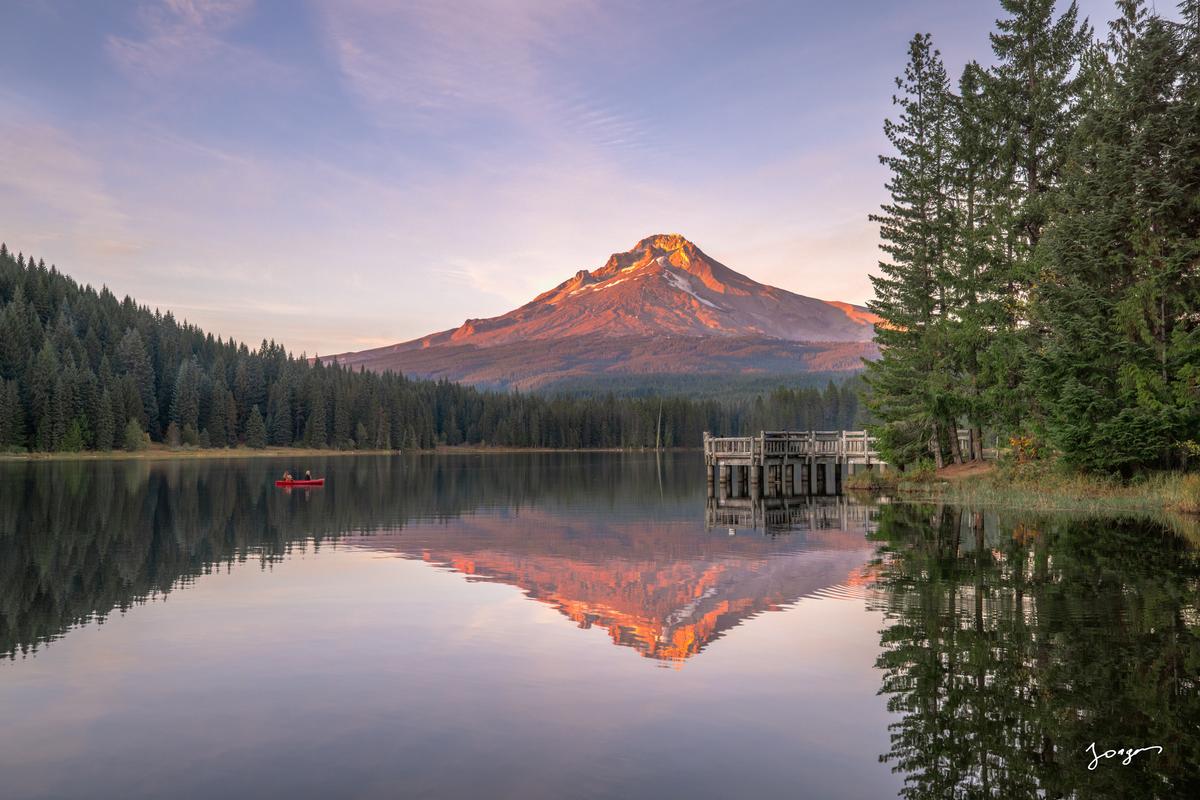
When I photograph a city, I am rarely interested in simply proving that a landmark exists. Thousands of photographs can do that. I am looking for the moment when weather, light, emptiness, reflections or darkness transform a familiar location into something that feels different.
For the kind of photography I make, that remains one of the things worth pursuing more than a century after Steichen made The Flatiron.
You can see that approach throughout my City Photography Collection.
The Artist Who Burned His Own Paintings
Then comes the episode that makes Steichen's career especially fascinating.
In 1923, Steichen destroyed many of his paintings.
It is tempting to interpret that event as a simple declaration: painting was the past; photography was the future.
But Steichen's own career makes the story more complicated.
His early photography had already borrowed heavily from painting. He had spent years manipulating photographic prints precisely because he did not believe the camera had to be limited to mechanically recording what stood in front of it.
In that sense, he had not simply abandoned painting for photography. He had carried part of the painter's mentality into photography.
And then he changed his mind again.
Steichen's 180-Degree Turn: When an Artist Questions His Own Art
This may be the part of Steichen's story I find most interesting.
Artists are often presented in retrospect as though they discovered a style, perfected it and then spent a lifetime confidently producing it.
Real artistic careers are rarely that clean.
Steichen helped establish Pictorialism. He produced some of its masterpieces. He fought for the idea that manipulated, painterly photography deserved to be recognized as fine art.
Then he largely left that aesthetic behind.
His experience with military photography during World War I had exposed him to another capability of the camera: precision, information and direct observation. During the 1920s his work became sharper, cleaner and more modern.
Think about what that means personally for an artist.
Steichen wasn't a young photographer abandoning failed experiments. He was questioning an approach that had already made him important.
That is much harder.
Every serious artist eventually confronts some version of the same questions:
Is this still my work? Am I repeating myself? Is the style people recognize me for becoming a limitation? Am I changing because the work genuinely demands it — or because I have lost confidence in what I was doing?
There is no camera setting that answers those questions.