Every time I visit Yosemite National Park — and I have been there more times than I can count — I make a point of walking into the Ansel Adams Gallery in the village. It sits there quietly between the parking lot and the shuttle stop, easy to walk past, and most tourists do exactly that. I never do. There is something about standing in front of an original Ansel Adams silver gelatin print that a screen simply cannot replicate. The luminosity of the whites. The depth of the shadows. The way the granite seems to glow from inside the paper rather than reflecting light off the surface. I’ve stood in front of Clearing Winter Storm in that gallery and felt the pull to immediately go back outside and find the spot where he stood. Every time, without fail.
That is what great photography does. It doesn’t make you want to own the print — though you do — it makes you want to go to the place. It makes you want to see the actual thing with your own eyes, in the actual light, on an actual morning. Adams understood this better than anyone who has ever pointed a camera at a landscape. And the fact that his images, made between the 1920s and the 1980s on glass plates and large-format film with technology I would never use, still produce that response in a photographer carrying a Canon R5 in 2026 — that is the measure of what he achieved.
This article is my attempt to do justice to a figure who is routinely reduced to “the Yosemite photographer” or “the Zone System guy,” when the actual story is so much richer and stranger and more interesting than that. We touched on Adams in both our What Is Traditional Art? article and our What Is a Traditional Artist? piece — because his work sits precisely at the intersection of traditional craft and photographic vision. Here is the full story.
What is Ansel Adams most famous for?
Ansel Adams is most famous for his large-format black and white photographs of the American West, particularly Yosemite National Park. Images like Moonrise, Hernandez, New Mexico and Clearing Winter Storm are among the most recognized photographs ever made. He is also celebrated as the co-developer of the Zone System, a method for precisely controlling tonal range in black and white photography.
What is the Zone System in photography?
The Zone System, developed by Adams and Fred Archer in the late 1930s, divides the tonal range of a photograph into eleven zones from pure black (Zone 0) to pure white (Zone X). It gives photographers a precise method to pre-visualize exactly how tones in a scene will render in the final print, and then set exposure and development to achieve that specific result — eliminating guesswork from the process.
Was Ansel Adams a conservationist?
Yes — Adams served on the Board of Directors of the Sierra Club for 37 consecutive years and used his photographs directly in lobbying campaigns to Congress for the expansion of the National Park system. His work was instrumental in the establishment of Kings Canyon National Park in 1940. He was a fierce, active conservationist who saw his camera as a political instrument.
Did Ansel Adams only photograph landscapes?
No. While Adams is best known for empty, grand landscapes, he also produced significant social documentary work. His photographs of Japanese-Americans interned at the Manzanar War Relocation Center during World War Two represent some of the most politically powerful images of his career — placing the permanent Sierra Nevada mountains behind the barren, temporary camp in a deliberate visual argument about injustice and endurance.
What is the meaning of Adams's phrase "the negative is the score, the print is the performance"?
Adams — a formally trained pianist before he became a photographer — used this musical analogy to explain that a negative is not a fixed record but raw material to be interpreted. Just as two pianists produce different performances from the same score, Adams believed every darkroom session was an interpretive act. The negative captured light; the print expressed his artistic vision of what that light meant.
What books did Ansel Adams write about photography?
Adams wrote a technical trilogy considered definitive for film photography: The Camera (1980), The Negative (1948), and The Print (1968). He also wrote Examples: The Making of 40 Photographs, which tells the story behind 40 major images in his own words, and an autobiography completed shortly before his death in 1984.
A Childhood Shaped by San Francisco — and an Earthquake
Ansel Easton Adams was born in San Francisco on February 20, 1902 — four years before the great earthquake that would literally leave its mark on him. During an aftershock in 1906, four-year-old Ansel was thrown against a garden wall, breaking his nose. It never set correctly. That distinctive crooked nose — visible in every photograph ever taken of him — was his first souvenir from the American West.
His family were prosperous San Franciscans whose fortune was tied to a timber business, and the financial panic of 1907 destroyed much of it. Adams watched his father struggle for years to rebuild their position, an experience that gave him a lifelong complicated relationship with wealth and a famously intense work ethic. By the time he was an adult he was routinely working 18-hour days until he collapsed from what his family diplomatically called “the flu.”
Adams struggled intensely in formal schooling — restless, almost certainly dyslexic, unable to stay inside the structure of a conventional classroom. His parents eventually pulled him out entirely. His father became his tutor, and Adams spent his teenage years in an extraordinary act of self-directed learning, visiting the Panama-Pacific International Exposition of 1915 nearly every single day. For an intellectually voracious fourteen-year-old in San Francisco, the Exposition — with its exhibitions of art, science, technology, and world culture — was essentially a private university. He never finished high school. He never needed to.
The Pianist Who Became a Photographer
Before he was a photographer, Ansel Adams was seriously, rigorously, professionally a pianist. Through most of his adolescence and young adulthood, music was his primary identity and photography was a hobby he had picked up during his first visit to Yosemite at age 14, when his parents gave him a Brownie camera and pointed him at the most spectacular landscape in California.
He practiced piano for hours every day, performed publicly, and considered a concert career his most likely path. For years, the camera was something he carried to Yosemite each summer — the Sierra Club gave him a residency at their LeConte Memorial Lodge — while music remained the serious pursuit.
The turning point came in 1930 when he met the photographer Paul Strand and saw his negatives. Adams later described the experience as a revelation — the realization that a photograph could achieve the same kind of technical precision and emotional depth that he had been pursuing at the piano keyboard. He made his decision. Photography would be the career. Music would be the teacher.
That last part matters enormously. Adams never stopped thinking about photography in musical terms. His most famous formulation — “the negative is the score, and the print is the performance” — came directly from his years as a pianist. A musical score is not the music. It is a set of instructions that a performer interprets. Two pianists playing the same Beethoven sonata produce two entirely different performances. In the same way, Adams believed a negative was raw material to be interpreted in the darkroom — not a fixed record but a starting point. Every print was a performance. Every darkroom session was a concert.
The Zone System — Photography Becomes a Science
In the late 1930s, Adams and fellow photographer Fred Archer developed what became known as the Zone System — a method so influential that it is still taught in photography schools today, nearly ninety years later, despite the fact that the medium it was developed for (large-format film) is no longer in common use.
The Zone System divides the tonal range of a photograph into eleven zones, from pure black (Zone 0) to pure white (Zone X), and gives the photographer a precise method for controlling exactly where any given tone in the scene will land in the final print. Rather than guessing at exposure or relying on a light meter’s average reading, an Adams-trained photographer could look at a scene, identify the key tones, decide in advance how they wanted each to render, and then set exposure and development accordingly to produce exactly that result.
“The negative is the score, and the print is the performance.”
The concept he called “pre-visualization” was the heart of it: the idea that a photographer should be able to see the finished print in their mind’s eye before pressing the shutter. Not guess at it. Not hope for it. See it, specifically, with enough clarity that the exposure and development decisions are in service of that vision rather than in hope of discovering it later.
This is why Adams’s black and white photography looks the way it does. The luminosity of the whites in Moonrise, Hernandez, New Mexico. The way the shadows in Clearing Winter Storm hold detail that any lesser photographer would have let go to black. These are not lucky accidents or the result of exceptional equipment. They are the product of an exact science applied with the discipline of a concert pianist who spent decades developing his instrument.
Group f/64 — The Manifesto for Sharp Photography
In 1932, Adams co-founded Group f/64 alongside Edward Weston, Imogen Cunningham, and a handful of other West Coast photographers. The name refers to a very small lens aperture — f/64 produces maximum depth of field, meaning virtually everything in the frame is in sharp focus from foreground to background.
The manifesto was a direct challenge to the prevailing “pictorialist” movement, which deliberately produced soft, painterly, slightly blurry photographs in an attempt to make photography look more like painting and thereby earn it art-world credibility. Group f/64 took the opposite position: photography was its own art form, and it should look like photography. Sharp. High contrast. Detailed. Honest to the medium rather than apologetic about it.
This was not a merely technical argument — it was a philosophical one about what photography was for and what it could be. It is also, I think, the argument that has won. Nobody today photographs landscapes with soft-focus lenses to make them look like Impressionist paintings. We embrace what the camera actually does. Adams and his colleagues established that principle, and it shaped every serious landscape photographer who came after them.
The Iconic Images — How They Were Made
Moonrise, Hernandez, New Mexico (1941) is probably his most recognized photograph. He was driving with his son and assistant when he spotted the scene — a full moon rising over a small New Mexico village, the white crosses in the cemetery below catching the last light of the sun. He pulled over in such a rush that he couldn’t find his light meter. He calculated the exposure from memory, using the known luminance of the moon. He had time for one exposure before the light changed and the image was gone. That single frame became one of the most reproduced photographs in history.
Monolith, The Face of Half Dome (1927) was a turning point. He had planned to use an ordinary yellow filter and was already preparing to leave the mountain when he made a last-minute decision to use a deep red filter instead — one that would dramatically darken the sky and heighten contrast, producing a sky almost black behind the pale granite. He later said this was the first photograph in which he consciously imposed an emotional response rather than simply recording what he saw. It was the moment he understood what photography could be.
Clearing Winter Storm, Yosemite Valley (c. 1937) — the image I keep coming back to in that village gallery — was made from Inspiration Point as a storm was breaking over the valley. The combination of clearing fog, wet rock catching light, and the scale of the valley walls produced something Adams described as one of the most emotionally powerful landscapes he ever witnessed. The print is evidence of a man who understood that patience was as much a part of the job as technique. You cannot manufacture a clearing winter storm. You can only be ready when it happens.
The Conservationist — A Camera as Political Weapon
Adams served on the Board of Directors of the Sierra Club for 37 consecutive years. His photographs were used directly in lobbying campaigns to Congress for the expansion and protection of the National Park system — most significantly in the successful campaign to establish Kings Canyon National Park in California in 1940. He used his work the way an attorney uses evidence: as a factual, irrefutable argument for why something mattered.
He was not a gentle activist. He was a fierce one. He was so adamant about wilderness preservation that he once attempted to resign from the Sierra Club Board so he could publicly protest a road-widening project in Yosemite without “embarrassing” the organization. The Board refused to accept his resignation. He served out his term and kept fighting.
There is an 11,700-foot peak in the Sierra Nevada called Mount Ansel Adams. His friends informally named it after him in 1933. He had to die before the U.S. Geological Survey would officially put his name on it — the USGS has a strict policy against naming geographic features after living people. The mountain waited for him.
The Human Side — Manzanar
The Ansel Adams most people know photographs empty landscapes — granite and sky and the absence of human beings. The Ansel Adams fewer people know spent time at the Manzanar War Relocation Center during World War Two, photographing the Japanese-Americans who had been forcibly removed from their homes and interned in the California desert.
The resulting photographs — particularly Mt. Williamson, Sierra Nevada, from Manzanar (1944) — place the massive, permanent Sierra Nevada in the background of the barren, temporary camp, creating a visual argument about endurance and injustice that requires no caption. The mountains have been there for millions of years and will be there long after every human tragedy has passed. It is a deeply political image from a man who is mostly remembered for images with no people in them at all.
This dimension of his work connects directly to the tradition of social documentary photography — and to the argument I make in the traditional art article that great visual art, whether painting or photography, always carries a moral weight beyond its surface subject.
Adams and Georgia O’Keeffe — An Unlikely, Enduring Friendship
One of the less-told stories in American art history is the friendship between Ansel Adams and Georgia O’Keeffe — two artists who seem, on the surface, to have nothing in common beyond their connection to the American landscape. He was a technical obsessive who worked with large-format cameras and complex chemistry. She was a painter of flowers, skulls, and desert forms who said she painted what she “knew best.” He was Northern California and the Sierra. She was New Mexico and the desert.
They were brought into each other’s world by Alfred Stieglitz — the legendary photographer and gallery owner who was O’Keeffe’s husband and one of the first serious champions of Adams’s work. Through Stieglitz’s gallery, An American Place in New York, Adams and O’Keeffe became not just colleagues but genuine friends, corresponding regularly for decades.
Adams photographed O’Keeffe on multiple occasions, producing some of the most striking portraits of her — particularly the famous images of her at Ghost Ranch in New Mexico, in her wide-brimmed hat against the desert sky, looking exactly like the landscape she painted. O’Keeffe reportedly told Adams that his photographs of the Southwest made her see the landscape differently — which is a remarkable thing for a painter to say to a photographer. She is said to have called him “the best thing to come out of California,” which, given her feelings about California versus New Mexico, was high praise.
What united them was their shared insistence on the American landscape as a serious subject for serious art — and their shared refusal to apologize for working in mediums that the established art world of their era treated as secondary. O’Keeffe’s flowers and skulls were dismissed by critics who couldn’t understand why a formally trained painter was making large-scale paintings of things you could see in a garden or a desert. Adams’s photographs were dismissed by critics who couldn’t understand why a camera lens counted as a genuine artistic instrument. Both of them kept working. Both of them won the argument.
I wrote about O’Keeffe in both the What Is Traditional Art? article and the What Is a Traditional Artist? piece — because she sits exactly where Adams sits, at the point where traditional artistic discipline and American landscape vision intersect. The connection between them is not incidental. They were both doing the same thing in different mediums in the same country in the same era, and they recognized it in each other. That mutual recognition produced a friendship that lasted decades.
The Technical Trilogy — His Greatest Gift to Photographers
Adams understood that a craft dies when its knowledge dies, so he wrote it down. His three technical books — The Camera (1980), The Negative (1948), and The Print (1968) — were considered the definitive technical manuals for film photography for decades and are still widely read today despite being written for large-format analog work. They were not how-to guides for beginners. They were systematic explorations of the technical and philosophical dimensions of each stage of the photographic process, written with the same precision and depth that Adams brought to every print he made.
The Adams Technical Library
- The Camera (1980): Equipment, optics, and the mechanics of exposure — the first volume in his definitive technical trilogy.
- The Negative (1948): Film, development, and the Zone System in full depth — still the authoritative text on tonal control in black and white photography.
- The Print (1968): Darkroom craft, dodging and burning, and the philosophy of the print as performance.
- Examples: The Making of 40 Photographs: The story behind each of 40 major images — decisions made, light seized, moments nearly lost.
- Autobiography (1985): Completed shortly before his death and published the following year; the personal account of a life spent in pursuit of light.
His autobiography, completed shortly before his death in 1984 and published the following year, gives the personal account. His book Examples: The Making of 40 Photographs does something more unusual and more valuable — it tells the specific story behind each of 40 major images: where he was, what he saw, what decisions he made and why, what went right and what nearly went wrong. It is the clearest window into how his mind worked, and it reads like a master class taught by someone who has nothing left to prove and everything worth sharing.
Ansel Adams and AI — Who Controls an Artist’s Legacy?
There is a coda to Adams’s story that he never could have imagined, and it is still unfolding as I write this. In April 2026, Danziger Gallery brought a color reinterpretation of Moonrise, Hernandez, New Mexico to the AIPAD Photography Show in New York — Adams’s most recognizable image, run through an AI system to imagine what the scene might have looked like in color, then reworked over months of human editing, regeneration, proofing, and Photoshop work. Gallery owner James Danziger was direct about the process on the wall label. The prints were not a hypothetical art-world thought experiment. They were offered for sale in editions of ten, at three sizes, priced at roughly $6,000, $8,000, and $10,000. This already happened, to one of the most famous photographs ever made, by an artist who has been gone for over forty years and cannot weigh in on what was done with his name.
The Ansel Adams Publishing Rights Trust objected immediately, and the way they objected matters more than the fact that they objected. They were not arguing that AI has no place near photography. The Trust actually acknowledged that Adams himself was fascinated by technological change and had anticipated the possibilities of electronic imaging — a 1983 statement of his, written the year before he died, predicted that astonishing developments awaited photography in exactly that area. Their objection was narrower and, I think, more serious: that Adams’s name, reputation, and artistic legacy were being used commercially without consent. Danziger’s defense was that Moonrise is in the public domain — he says he retained a copyright attorney before starting the project and built the work on that legal advice. Major museum catalogues, meanwhile, continue to display rights notices tied to the Adams Trust. Whether the underlying copyright question is actually settled and whether a museum’s rights notice reflects that are two different things, and as of this writing, nobody outside a courtroom has fully resolved it.
This was not even the first time. In 2024, the Adams estate publicly pushed back on Adobe after AI-generated landscape images carrying Adams’s name showed up for licensing through Adobe Stock — Adobe pulled the content once it was flagged. That dispute and the Moonrise dispute are actually two different problems wearing the same name. One asks whether someone can generate new images “in the style of” a photographer and sell them under his name. The other, harder question is whether someone can take one specific, iconic photograph, transform it with AI, and sell the result as new fine art. Adams is not the only photographer this will happen to — he is simply the first famous enough, and recently enough, for the question to become unavoidable, and the fuller story of AI’s collision with the art world is covered in the Jongas piece on AI and the world of visual arts.
Here is what I keep coming back to, and it connects directly to something I said earlier about the negative being the score and the print being the performance. A traditional Adams print is the record of specific decisions — where he placed the camera, when he released the shutter, how he exposed and developed the negative, how he interpreted it afterward in the darkroom. Every one of those decisions was his. An AI interpretation of Moonrise introduces a different kind of participant into that chain — a model trained on enormous quantities of other people’s photographs, generating colors that Adams’s film never recorded and Adams never chose. What comes out the other end might be visually compelling. It might even be legally permissible. But it is not an Ansel Adams photograph, in the way that print in the Yosemite village gallery is an Ansel Adams photograph. I cover this larger arc — where photography has actually been transformed by new technology, versus where something categorically different is happening — in The Evolution of Fine Art Photography, From the First Camera to AI. The Moonrise controversy is the clearest real-world case study I have found for the question that article is actually asking.
Why His Work Still Matters — And Still Inspires
I come back to the village gallery every time I visit Yosemite. Not out of obligation or pilgrimage but because those prints do something to me that very few images in any medium manage. They make the park larger. They make the light more significant. They create an anticipation for the next morning’s dawn that no amount of planning or preparation produces on its own.
There is something in Adams’s work that is genuinely timeless in a way that has nothing to do with nostalgia and everything to do with craft. His photographs were made with technology that is now entirely obsolete. The specific chemistry of a silver gelatin print, the large-format 8x10 view camera, the Zone System calculations done by hand — none of this is how photography works in 2026. And yet the results — the luminosity, the tonal range, the compositional authority — are still the benchmark against which serious black and white landscape photography is measured.
What I carry from Adams into my own work is not technique but disposition: the willingness to wait, the insistence on pre-visualization, the understanding that the moment you press the shutter should not be a guess. When I drove fourteen hours to the Palouse to photograph the wheat harvest at golden hour, I was operating in a lineage that runs through Adams and back to Albert Bierstadt — the same lineage I described in the traditional artists article. Different instruments, same calling.
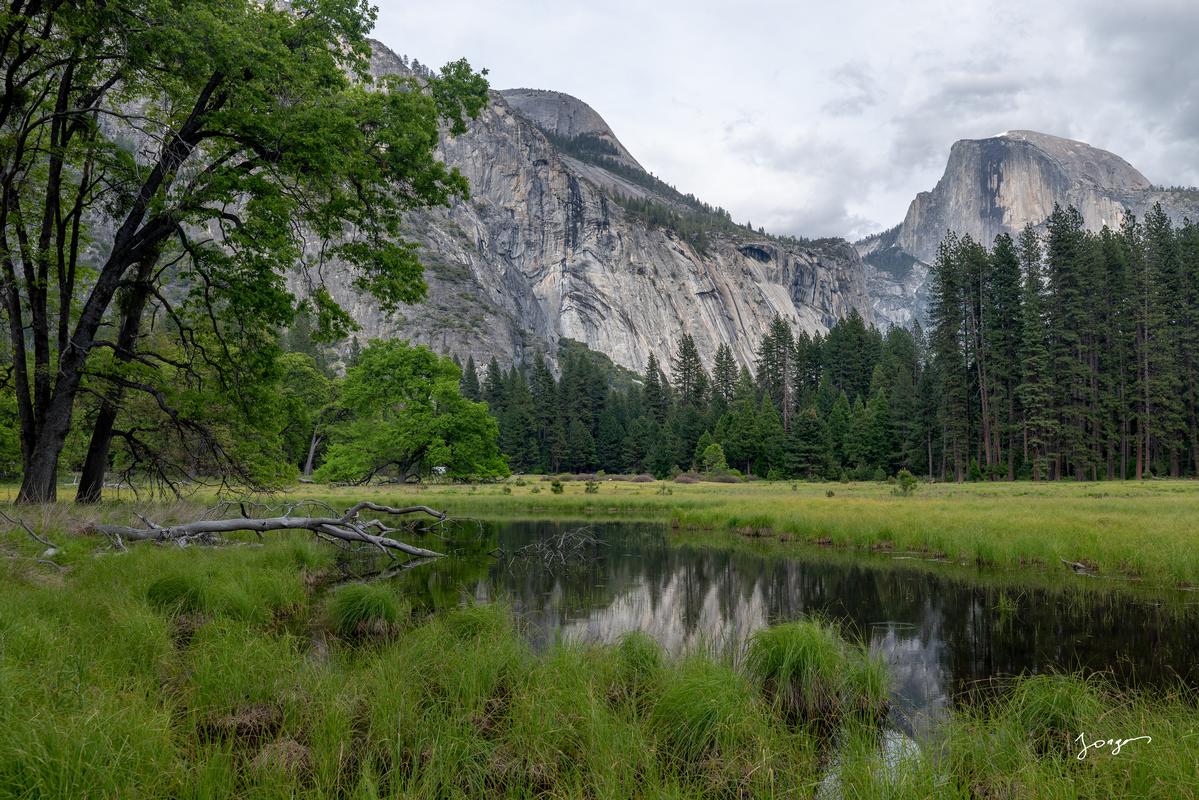
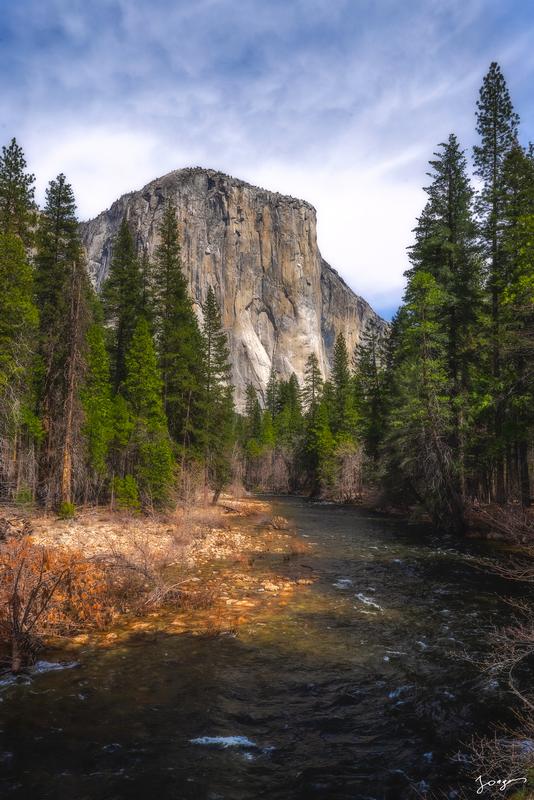
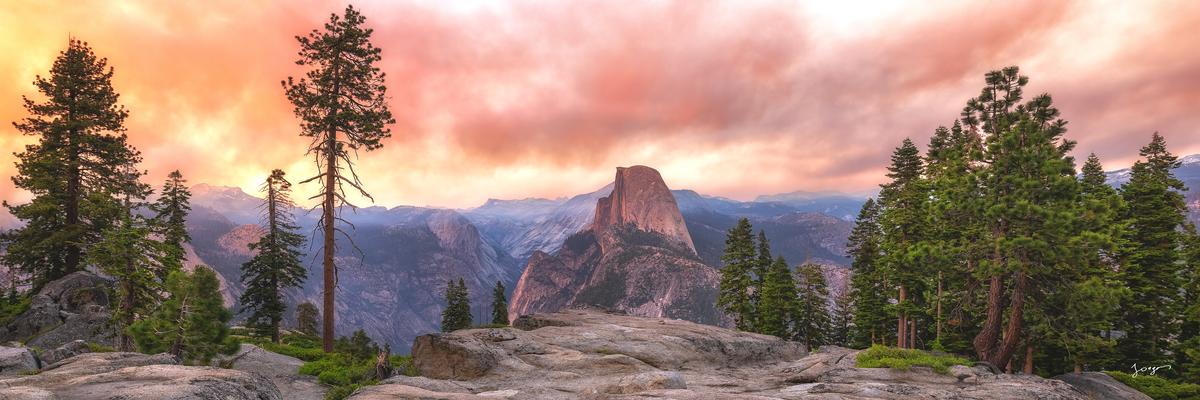
The Yosemite photography in my own gallery is my contribution to a conversation Adams started. I photograph the same valley, the same granite, the same play of light on the same rock faces he photographed across six decades. I do not pretend to approach what he achieved in that specific place. What I bring is a different eye, a different era, and a different instrument that produces a different kind of image. The luminous color depth of a TruLife acrylic-mounted print of Yosemite at golden hour is something Adams’s medium could not produce — just as the tonal range of his silver gelatin prints is something digital photography struggles to match. We are not in competition. We are in conversation, separated by eighty years and a revolution in technology, united by the same valley and the same impossible light.
He died in April 1984, at eighty-two, while working on a book about the national parks. The mountain in the Sierra Nevada that bears his name had to wait for him to be gone before the geographers would officially put it on the map. The photographs didn’t need to wait for anything. They were already there.
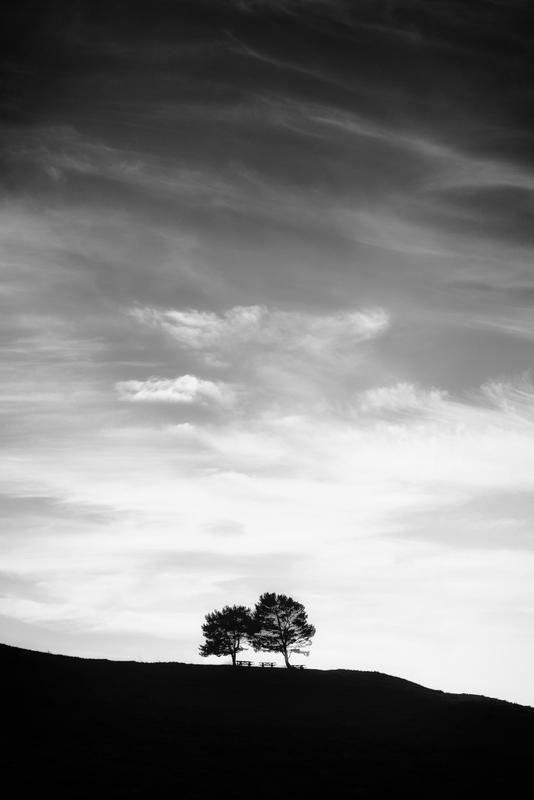
Browse Eddie Jongas’s Black and White Photography Collection →
Browse the Yosemite Photography Collection →
Browse the Landscape Photography Collection →
Eddie Jongas is a modern fine art photographer based in Las Vegas, Nevada. His TruLife acrylic-mounted limited edition prints are available exclusively through jongasfineartphotography.com. Free shipping to all 50 states.
