I was somewhere in rural Lithuania, on a country road that barely qualified as a road, when a farmer handed me a bottle of liquid that looked exactly like water. He made an enthusiastic gesture toward the trees at the edge of the field — white-barked, slender, standing close together in that particular way trees do when they’ve been growing in the same patch for a long time — and said something in Lithuanian that I understood to mean “drink this.” I did.
It tasted like very mild, gently sweet water. Not sweet the way juice is sweet — more like the memory of sweetness, hovering just below the threshold of something you could actually identify. Refreshing in a fundamental way, the kind of refreshing that makes you think about how long people lived in forests before they invented anything else to drink. That was birch sap. And those were birch trees, not aspens — though it took me a while to learn that distinction well enough to be confident about it.
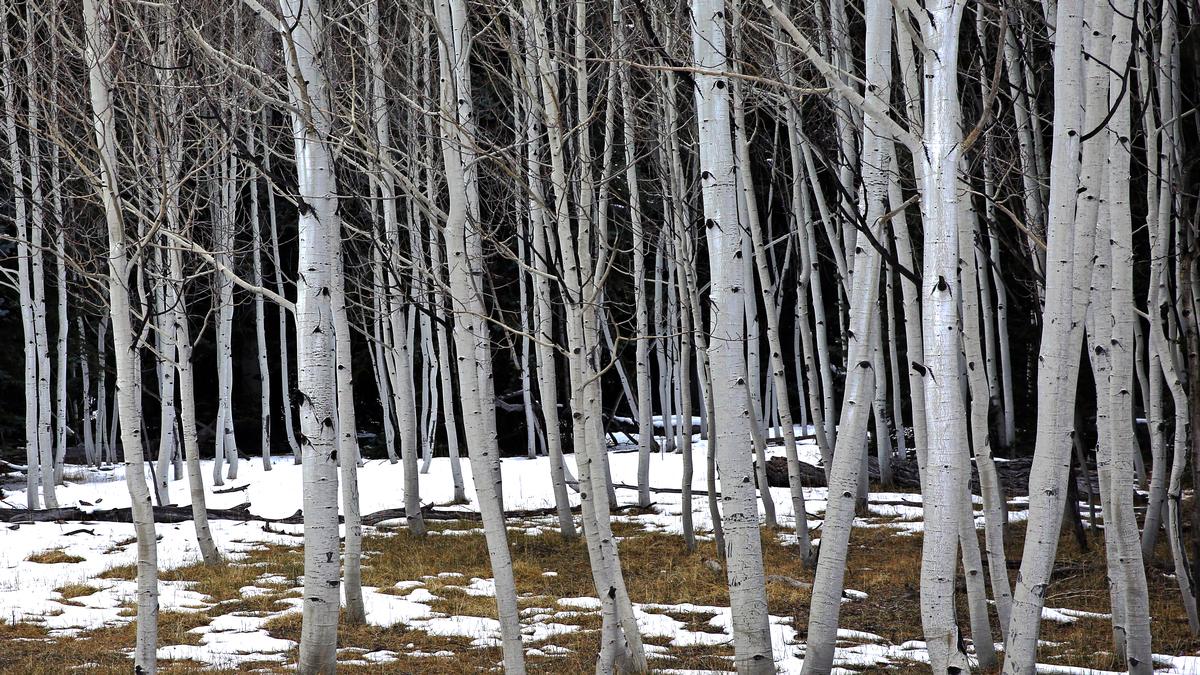
That’s the thing about birches and aspens. If you grew up in a city, or in a part of the country where neither is common, there’s an excellent chance you’ve looked at one and thought it was the other. The white bark. The slender trunks. The tendency to grow in groups. From a passing car, at a highway speed, they are nearly identical. Up close — as a photographer, or a forager, or a Lithuanian farmer — they are completely different.
This article is for everyone who’s ever looked at a grove of white-barked trees and wondered which one they were looking at. And for everyone who’s ever photographed one and wanted to understand what made it worth the drive.
Why People Mix Them Up — And Why It Matters
The confusion is understandable. Both trees are slender. Both have white or light-colored bark. Both tend to grow in groups rather than standing alone. Both are found in the Northern Hemisphere, often in similar-looking mountainous or forested settings. And both are among the most photographed trees in the world — which means if you’ve seen a dramatic autumn shot of golden trees in a western mountain forest, you’ve almost certainly been looking at aspen without knowing it.
For a photographer it matters because the two trees tell completely different visual stories. The birch’s bark peels. It has texture. It catches the light differently in summer and winter, when the white of the trunk stands against dark ground with no foliage to compete with it. The aspen’s bark is smooth, almost waxy, marked with dark eye-shaped knots where branches have dropped over decades. Its leaves shake in the slightest movement of air — incessantly, even when the air seems entirely still — producing a quality of light and sound that has no real equivalent in any other tree I’ve photographed.
Understanding which tree you’re pointing a camera at is understanding what the image is actually about. The birch is texture and resilience. The aspen is motion and community. They look similar from a distance. They mean entirely different things.
How to Tell Them Apart — The Three Tests
This is the quickest way to separate them and it works from several feet away. Reach out and touch the bark. Birch bark peels. It separates in thin, papery horizontal strips that you can pull away with your fingers. Older birch trees develop a rougher, darker, almost craggy texture at the base of the trunk, but the mid-trunk and upper sections retain that distinctive papery quality. If you’ve ever seen someone use tree bark as a writing surface — and historically people absolutely did, including famously in concentration camps and prisons where birch bark was used as a substitute for paper — it was almost certainly birch bark. It has the right combination of flexibility, durability, and surface quality to take ink or charcoal.
Aspen bark does not peel. It is smooth to the touch and slightly greenish in certain light conditions — this green tint comes from chlorophyll in the bark, which means aspen trunks actually photosynthesize. The dark markings on aspen bark are eye-shaped knots where lower branches have dropped off over the years. Both trees have these markings to some degree, but on aspen they tend to be more pronounced and more evenly distributed up the trunk — hence the old folkloric description of these as “watchful trees,” the eyes of the forest.
Quick Field Identification Guide
- Birch bark: Peels in thin, papery horizontal strips; rougher and darker at the base of older trunks
- Aspen bark: Smooth, slightly waxy, faintly greenish from chlorophyll; does not peel
- Birch leaves: Triangular or spear-shaped, tapering to a point, with jagged double-serrated edges
- Aspen leaves: Round or heart-shaped with gently toothed edges; flutter constantly due to a flattened leaf stalk (petiole)
- American West (Colorado, Utah, Sierra Nevada): White-barked trees are almost certainly aspen
- Eastern US, Scandinavia, Baltic states, Russia: White-barked trees are almost certainly birch
- Scientific name, aspen: Populus tremuloides — "trembling poplar"
If the tree has leaves — and for photography purposes you probably want it to, especially in autumn — the leaf shape settles the question immediately. Birch leaves are triangular or spear-shaped, tapering to a point at the tip, with jagged double-serrated edges that have a complex, small-toothed pattern. They are generally somewhat elongated and look like the kind of leaf a child might draw if told to draw a leaf. Aspen leaves are round or heart-shaped with finely toothed but much gentler edges. The key difference is less about shape than about how they move: aspen leaves have a flattened leaf stalk — technically called a petiole — which causes them to flutter in the slightest air movement. The scientific name for the most common North American aspen is Populus tremuloides — “trembling poplar” — and the common name “Quaking Aspen” says the same thing more plainly.
For a photographer, this is probably the most important thing to know about aspen. The motion of the leaves produces a quality of light that is unlike anything else in a forest. On a calm day in an aspen grove, you can stand in what feels like windless air and watch the canopy shimmer above you as if the whole tree is alive with a kind of internal energy. That shimmer is a photographic subject all by itself.
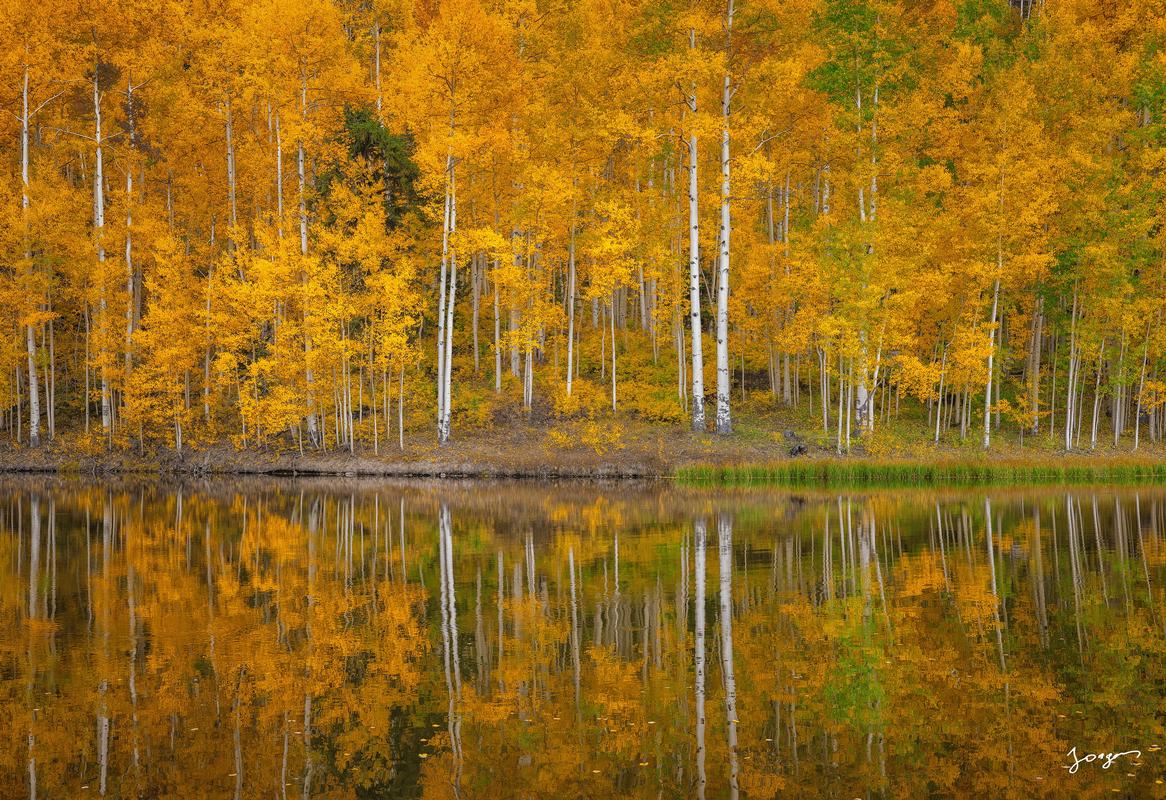
If you’re in the American West — Colorado, Utah, Wyoming, the Sierra Nevada, the mountains of Washington state — and you see white-barked trees, they are almost certainly aspens. Quaking aspen is the most widely distributed tree in North America, and it dominates the high-elevation mountain forests of the West. The spectacular autumn color shows you see from Colorado mountain roads or in the eastern Sierra are almost entirely aspen. Birch is more common in two specific regions: the moist lowland forests and floodplains of the eastern United States and Canada, and across northern and eastern Europe — Scandinavia, Russia, the Baltic states, Poland, Germany. Both overlap in the northern tier of the United States and Canada, where you can find them growing in proximity. But in most of their respective ranges, geography alone will tell you which one you’re looking at before you ever touch the bark or examine a leaf.
The Most Extraordinary Aspen on Earth — Pando
I wrote about this in the tree photography article, but it deserves its own moment here because nothing illustrates what makes aspen fundamentally different from birch more clearly than the existence of Pando. Pando is a quaking aspen colony in Fishlake National Forest in south-central Utah. From above it looks like a forest — 106 acres of aspen trees, roughly 47,000 individual trunks. From the ground it looks like a large grove of aspens doing what aspens do: growing close together, gleaming white, trembling in the mountain air.
What it actually is: a single organism. Every one of those 47,000 trunks is genetically identical, connected underground by a vast root system estimated to weigh approximately 13 million pounds. Pando — from the Latin for “I spread” — is the heaviest living organism ever documented on Earth. The above-ground trunks live for around 100 to 130 years each, but the root system beneath them is ancient — thousands of years old, dating back to the end of the last Ice Age.
“Every trunk on that hillside, every leaf catching the October light, might be a single organism that has been growing there since the Ice Age.”
This is what aspen does that birch fundamentally does not: it propagates primarily through its root system rather than through seeds. A stand of aspens is often a single organism expressing itself through dozens or hundreds of individual trunks. The stand is one thing. This is why aspen groves in autumn turn gold simultaneously — the entire colony is genetically identical and responds to the same seasonal triggers at the same moment. A birch tree, by contrast, is an individual. It grows alone or in small clusters, but each tree is its own organism with its own root system and its own genetic identity. When a birch forest turns color in autumn, the timing varies across individual trees. The aspen grove turns as one.
Birch Sap — The First Drink of Spring
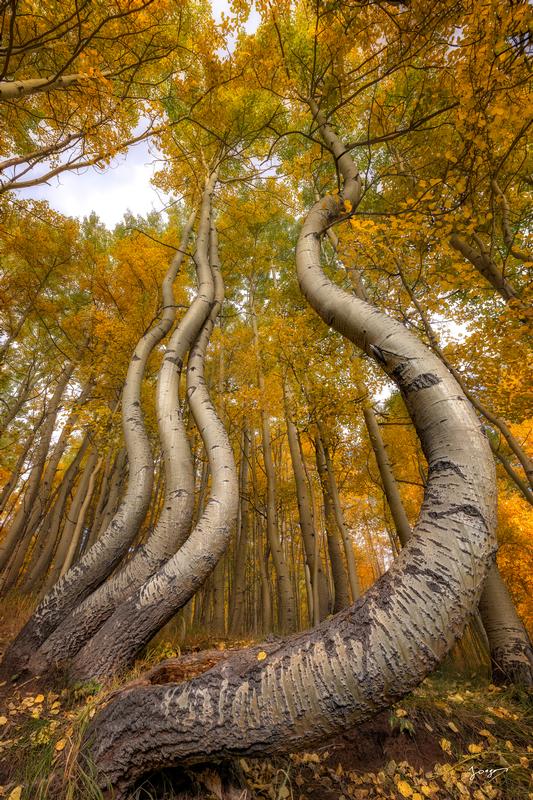
Back to that Lithuanian farmer and his bottle of tree water. Birch sap — also sold commercially as birch water or birch juice — is the fluid the tree draws up from its roots in early spring to support the growth of new leaves. The harvest window is narrow: roughly three to four weeks in March and April, before the leaf buds unfurl. Once the leaves appear, the sap becomes bitter and the season ends. You collect it by drilling a small hole in the trunk and letting the sap drip into a container.
What it tastes like: the most honest comparison I can make is to coconut water, if you’ve had that. It has a similar texture — thin, slightly watery — and a similar quality of sweetness that is genuinely sweet but not in an overpowering way. The sweetness doesn’t announce itself. It’s more like the memory of something sweet rather than the thing itself. It is genuinely refreshing and surprisingly good once you get past the novelty of drinking something directly from a tree.
Birch sap has been consumed in eastern Europe and Scandinavia for centuries as a spring tonic — a vitamin and mineral-rich drink that arrives exactly when winter stores are running out and before anything else is growing. The cultural significance is real: this was the first sweet thing available after months of preserved food and cold, and the arrival of birch sap season meant the worst of winter was over. You can buy it commercially today in health food stores in the United States, often marketed as a European functional beverage. If you find it, it’s worth trying.
It can also be fermented into a mildly alcoholic drink, or boiled down into birch syrup — which is thinner than maple syrup and has a complex, distinctive flavor with notes of caramel, molasses, or berries. It is not widely produced because it takes considerably more sap to produce than maple syrup does, but it exists and it is interesting.
Fresh birch sap is highly perishable — it keeps in a refrigerator for only about three to seven days before it starts to ferment or spoil. If the Lithuanian farmer’s bottle had been sitting around for more than a week, I would have been drinking something considerably more interesting than a spring tonic. As it was, it tasted clean and mild and a little bit magical, which is an accurate description of most things that happen in Lithuanian forests in April.
Aspen Sap — The Lesser-Known Story
Can you drink aspen sap the way you can birch sap? Technically yes, but practically it is not really worth the effort. Aspen is not a high-yield sap producer, and the flavor is reportedly thin, bland, and sometimes has a medicinal or bitter undertone. Where aspen has historically been valued is in its inner bark — the cambium layer, which is rich in nutrients and was consumed as a food source by Indigenous peoples of North America, particularly in spring when other food was scarce. The inner bark can be dried and ground into flour, eaten raw, or used medicinally for respiratory ailments. The aspirin-related compound in willow bark (salicin) is also present in aspen bark, making it historically useful as a pain reliever and fever reducer before modern medicine existed.
So the nutritional and medicinal story of the aspen is in its bark, not its sap. The birch is valued for both its bark and its fluid. Two trees, two different relationships with the humans who have lived among them.
The Mythology — Lady of the Woods and the Shield Tree
Both trees carry deep symbolic weight in the cultures that have lived alongside them, and the mythology in each case reflects something true about the tree’s physical character. The birch is called the “Lady of the Woods” in Celtic and Slavic traditions — associated with feminine grace, renewal, and purification. This makes sense: birch is a pioneer species, often the first tree to colonize land after a fire or the retreat of a glacier. It creates the conditions for other trees to follow. It is the tree of new beginnings. In the Celtic Ogham alphabet, birch is the very first letter — Beithe — because it comes first.
The birch besom, a broom made from birch twigs, was swept through homes at the end of the old year to drive out the spirits of what had passed. In Slavic folklore, the birch was associated with female spirits; it was believed that a young woman who died in unusual circumstances might reside within a birch, only to emerge in moonlight. In the Scottish Highlands, a barren cow herded with a birch stick was said to become fertile the following year.
And then there is Beržulis — the obscure Baltic deity whose name derives directly from “beržas,” the Lithuanian word for birch. Documented only in a 17th-century Polish theologian’s catalogue of Lithuanian spirits, Beržulis is listed with no description, no mythology, no recorded rituals. He is a name from a list, and nothing more. What scholars have extrapolated from the name is that he was likely a local spirit — a “genius loci” in the Latin sense, the spirit of a specific place or grove — associated with birch trees and the seasonal flow of their sap. Not a major deity like Perk?nas, the thunder god. A smaller, quieter figure. The silent observer of a specific birch forest in what is now Lithuania. There is something appealing about that kind of deity — the one who watches a specific grove of trees across the centuries and has no grand mythology attached to his name. Just presence. Just attention.
The aspen has a different mythological character entirely. Its Greek name — aspis — means “shield,” and the wood was historically prized for warrior shields because it is light but resistant to splitting. These were not merely physical shields; they were believed to protect the bearer from psychic harm as well as physical attack. The aspen was thought to be a bridge between this world and the otherworld: in Celtic tradition, placing an aspen leaf under your tongue was said to grant the gift of eloquence and poetry. In Eastern European and Slavic folklore, the aspen took on a darker protective role: it was the wood of choice for stakes used to keep vampires and sorcerers in their graves. The trembling of the aspen leaves was later explained by Christian legend as the tree shivering in shame and sorrow for having provided the wood for the cross of the Crucifixion — a reinterpretation of a pre-Christian trembling myth through a new theological lens.
And then there are the eyes. Both trees develop eye-shaped scars on their trunks where lower branches have dropped — dark oval marks that do genuinely look like lidded eyes gazing out from the bark. Various folk traditions describe these as the forest’s witnesses — the “watchful trees,” silent observers of everything that happens in the wood. Whether you find that comforting or unsettling probably says something about your relationship with forests in general.
Where to Find Them — And Why It Matters for Photographers
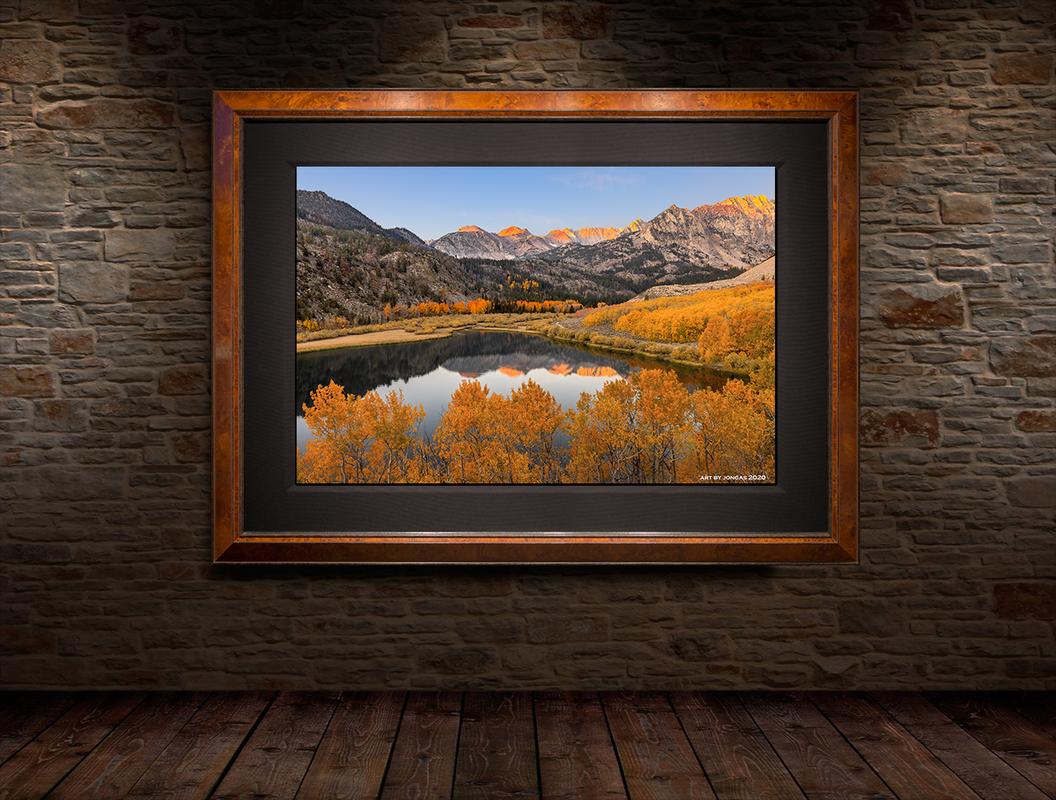
Geography is the practical guide for photographers planning a specific shoot. If you want aspen, the American West in September and October is where you go. Colorado is the most accessible and most photographed — the stretch from Aspen to Crested Butte, and the high passes of the San Juan Mountains, produce some of the most extraordinary autumn color in North America. The eastern Sierra Nevada in California, around Bishop and the White Mountains, has significant aspen stands. So does Washington state, particularly in the Cascades and the Okanogan Highlands. Utah’s high plateaus — Fishlake, Boulder Mountain — are spectacular and less visited than Colorado.
If you want birch, the eastern United States offers hardwood forests in New England and the upper Midwest where birch is prominent. But the most dramatic birch forests I have seen are in Europe — Scandinavia, the Baltic states, and the forests of Poland and Russia where birch is the dominant tree across vast stretches of landscape. Eastern Europe in early spring, when the birch groves are still leafless but the bark is brilliant against the grey sky, has a specific quality of light and silence that I haven’t found anywhere else.
Both are worth the trip. Both photograph completely differently. And the tree photography collection at Jongas Fine Art Photography includes work from both traditions — the western aspen in its autumn gold and the forests of the Pacific Northwest where old growth and birch coexist in the same frame.
The Photographer’s Take — Two Trees, Two Stories
When I point a camera at a birch, I’m thinking about texture and time. The peeling bark tells a story of seasons — each layer representing a year of growth, a record of what the tree experienced in that time. In winter, with snow at the base and the peeling white trunk stark against a dark forest, a birch is almost architectural. In spring, the new pale green leaves against that white bark produce a color combination that is almost impossible to make look bad. Birch rewards patience and close attention. The interesting things are in the detail.
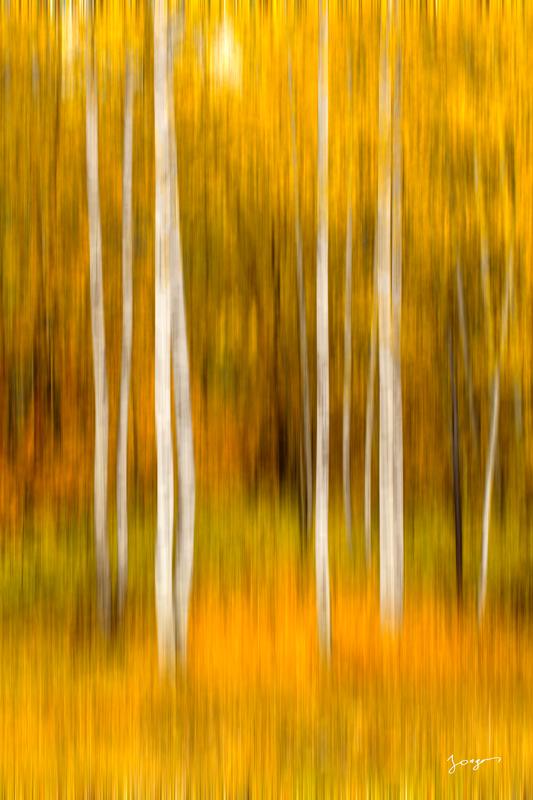
When I point a camera at aspen, I’m thinking about light and community. The trembling of the leaves produces a quality of luminosity that is unlike any other tree. In autumn, when an entire hillside of aspen turns simultaneously — that genetic identity expressing itself as a wall of gold against a blue Colorado sky — the scale of it stops you. You forget about technique for a moment. You just look. And then you remember that all of it — every trunk on that hillside, every leaf catching the October light — might be a single organism that has been growing there since the Ice Age. And the image suddenly has a dimension that no technical skill can add to it. The story was always there. You just had to know what you were looking at.
That’s the thing about trees that the tree photography article explores in depth — they have stories that predate every human photograph ever taken of them. The job of the photographer is to make those stories visible. Understanding the difference between an aspen and a birch is one small part of that job. But it’s an important one.

Browse the Jongas Tree Photography Collection →
Browse Pacific Northwest Photography →
Browse Landscape Photography Prints →
Eddie Jongas is a modern fine art photographer based in Las Vegas, Nevada, who has photographed trees and landscapes across 48 states and 15 countries — including the birch forests of Lithuania where he first drank birch sap straight from the tree. His TruLife acrylic-mounted limited edition prints are available exclusively through jongasfineartphotography.com. Free shipping to all 50 states.
