Picture the classic image of a landscape photographer: a large-format camera on a heavy wooden tripod, set up at a known overlook, waiting with infinite patience for the light to arrive. That image describes Ansel Adams. It describes a generation of photographers who treated the wilderness as a subject to be observed from a careful, deliberate distance.
It does not describe Galen Rowell. Not even slightly.
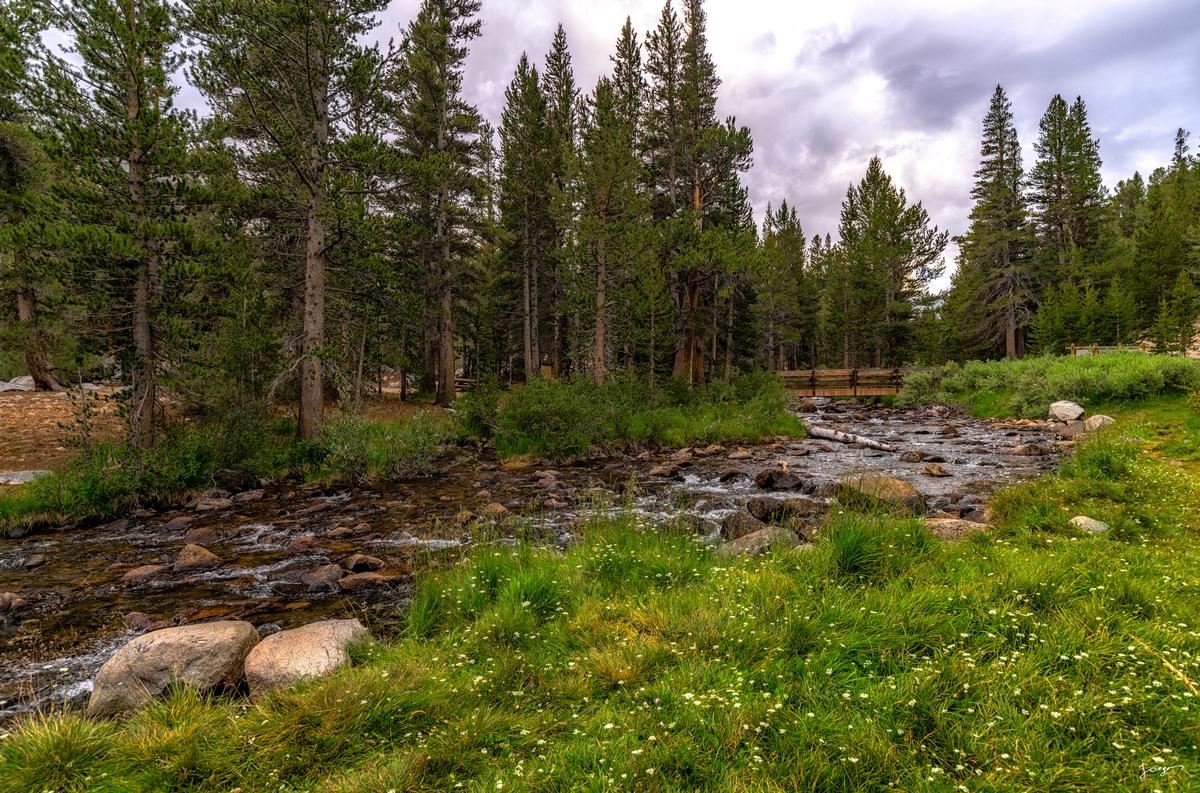
In 1981, while leading a National Geographic expedition in Lhasa, Tibet, Rowell noticed a massive rainbow forming in the distance. The rainbow’s base was not aligning with the Potala Palace — the historic winter home of the Dalai Lama — from where he stood. So he ran. At 12,000 feet of altitude, with full camera gear, he sprinted more than a mile across the city, repositioning himself until the base of the rainbow struck the roof of the palace at exactly the right angle. He made the photograph with seconds to spare before the rainbow dissolved. It became the best-selling fine art print of his career, reportedly earning him over a million dollars in his lifetime.
That sprint is not just a famous story. It is a precise definition of everything Galen Rowell stood for: the idea that the photographer is not a passive observer of the wilderness but an active participant in it — an athlete, a philosopher, a light chaser willing to outrun the Earth itself to make a picture.
I had some help with this article. A good friend of mine from the Eastern Sierra knew Galen Rowell and his world intimately, including the Mountain Light Gallery that Galen and his wife Barbara ran for years in Bishop, California — right in the heart of the country Rowell photographed most obsessively. What follows draws on that firsthand knowledge as much as on the published record.
Participatory Photojournalism — The Philosophy That Changed Everything
To understand Galen Rowell you have to understand the concept he introduced to the world of outdoor photography and that he spent his entire career embodying: participatory photojournalism.
The traditional model of landscape photography, shaped by masters like Ansel Adams, was built around deliberate stillness. Set up at a predictable overlook. Wait for the light. Make one image with absolute precision. The photographer was a careful, patient witness to nature. What Rowell argued — and proved — was that there was another way entirely.
Participatory photojournalism starts from a simple premise: the photographer should not observe the wilderness from a safe distance. The photographer should be inside it, moving through it at the same pace and under the same conditions as the most capable people on the expedition. Rowell was a world-class mountaineer who had established over 100 new climbing routes in the Sierra Nevada. He completed the first one-day ascent of Denali (Mount McKinley). He led expeditions to K2, to Tibet, to the Karakoram Himalaya. Because he possessed the athletic capability to keep pace with the world’s best climbers, he could bring his camera into situations that traditional photographers could not physically access — hanging off a 2,000-foot granite face in Yosemite alongside a free-soloing rock climber, or pushing deep into an uninhabited Tibetan plateau on foot in temperatures that would stop most expeditions cold.
His athleticism was not separate from his photography. It was his most important photographic tool.
The gear philosophy that made participatory photojournalism possible was what Rowell called “fast and light.” In the 1970s, serious landscape photography meant heavy large-format cameras, wooden tripods, sheet film. Rowell rejected all of it. He chose lightweight 35mm SLR cameras — the same format that photojournalists used for news coverage — because they allowed him to move with the speed and agility the approach required. Traditionalists criticized 35mm for having less raw resolution than large-format sheet film. Rowell accepted that trade-off without hesitation. What he gained in return was the ability to react instantly to changing weather, to chase fleeting light phenomena, to sprint a mile at altitude and arrive with a functioning camera and a clear head. The Potala Palace rainbow was not the exception. It was the method.
Technical Genius — The Filter That Every Landscape Photographer Now Uses
Rowell was not just a physically exceptional photographer. He was a genuine technical innovator whose most significant invention is now considered standard equipment in landscape photography worldwide.
The problem he confronted was fundamental to the medium: color slide films like Kodachrome 64 have a much narrower dynamic range than the human eye. When you stand at sunrise and look at a mountain scene, your eyes simultaneously perceive a bright sky and a darker foreground in full detail. A camera cannot. Expose for the bright sky and the foreground goes black. Expose for the foreground and the sky blows out to white. Ansel Adams solved this problem in the darkroom, using his Zone System of precise exposure control during printing to selectively brighten and darken different regions of a monochrome image. But Rowell was shooting color slides — there was no darkroom equivalent for color. The problem had to be solved in the field, before the shutter fired.
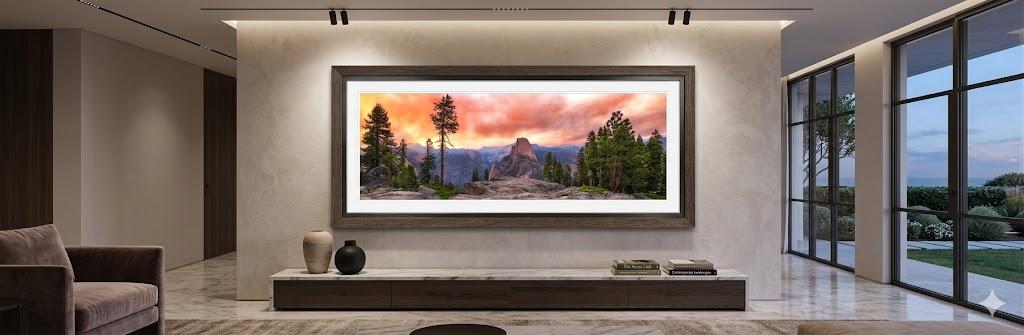
His solution was the Graduated Neutral Density (GND) filter — a piece of glass that is clear on the bottom half and progressively darker on the top half, with a smooth transition in the middle. By placing this filter over the lens and aligning the gradient with the horizon, he could simultaneously darken a bright sky and preserve foreground detail in a single exposure. He co-developed this filter with Singh-Ray, and its introduction to landscape photography was as consequential as the Zone System itself — just executed in the opposite direction, in the field rather than the darkroom.
He combined the GND filter with an obsessive pre-visualization practice: handheld spot metering, mental calculation of exposure values, and a clear image of the final print in his mind before he ever pressed the shutter. This was a direct inheritance from Adams’ philosophy of pre-visualization — the discipline of imagining what the final print will look like before making the exposure — adapted for a faster, more mobile working method.
What has changed in the decades since Rowell pioneered the 35mm fast and light approach is the camera, not the philosophy. Today virtually every serious landscape photographer works with a mirrorless digital body — lighter than Rowell’s 35mm SLRs, with sensors that handle dynamic range in ways Kodachrome could not have imagined. I shoot with a Canon R5, a camera that in Rowell’s hands would have felt like science fiction. But the GND filters still go on the front of the lens, the pre-visualization still happens before the shutter fires, and the discipline of chasing specific light in specific places at specific moments is exactly what it was when he was sprinting across Lhasa at 12,000 feet. The gear evolves. The method does not.
Ansel Adams and Galen Rowell — Two Sides of the Same Coin
The most productive way to understand Galen Rowell is to place him in direct relation to the photographer whose legacy he inherited, evolved, and was most frequently compared to. Rowell was regularly called “the 35mm Ansel Adams” — a phrase that captures something true while simultaneously underselling what made him distinctive.
Both men were shaped by the Sierra Nevada. Both were committed Sierra Club members whose photography was explicitly linked to conservation advocacy. Both believed that a great photograph of the natural world could change how people related to that world, and that this was the highest use of the medium. And both won the Sierra Club’s most prestigious photographic honor — which, fittingly, bears Adams’ own name.
“The photographer should not observe the wilderness from a safe distance. The photographer should be inside it — moving through it at the same pace and under the same conditions as the most capable people on the expedition.”
Adams vs. Rowell — Two Approaches, One Vision
- Primary medium: Adams worked with a large-format view camera and monochrome film. Rowell worked with a lightweight 35mm SLR and vibrant color slide film.
- Working style: Adams was deliberate, stationary, meditative. Rowell was fast, mobile, athletic — the man who outran rainbows.
- Core subject: Adams pursued the timeless, enduring monumentality of nature. Rowell pursued the fleeting, high-energy dynamic landscape — the specific unrepeatable moment.
- Technical mastery: Adams achieved his tonal control in the darkroom through the Zone System. Rowell achieved his in the field through pre-visualization and the GND filter.
What links them across these differences is the conviction that both techniques serve the same underlying purpose. Adams spent decades in the darkroom solving the same high-contrast lighting problem that Rowell solved with a piece of optical glass on a mountain ledge. The solution was different. The vision was the same.
When the Sierra Club awarded Rowell the Ansel Adams Award for Conservation Photography in 1984, they were recognizing something specific: that Rowell had successfully evolved the Adams model for a new era, carrying the same commitment to using art as advocacy into environments and situations that Adams’ large-format camera could never have reached. The Ansel Adams Gallery in Yosemite continues to officially archive and showcase Rowell’s color interpretations of the park’s landscapes today, placing the two photographers in permanent institutional dialogue.
Famous Circles — The People Who Shaped Him and Whom He Shaped
Galen Rowell did not work in isolation. His career was shaped by a specific set of professional relationships that connect him to the full arc of American adventure photography from the 1970s to the present day.
The story of how Rowell became a full-time professional photographer begins with Dewitt Jones, a National Geographic staff photographer who in 1972 contacted Rowell for help with a climbing assignment in Yosemite. When Jones was unexpectedly called away from the project, Rowell suggested an ambitious ascent of Half Dome and documented it himself. National Geographic received Rowell’s images and decided to publish them as a separate feature entirely. That publication launched his professional career. A single assignment, redirected, became the foundation of everything that followed.
His close friendship with Frans Lanting — one of the most celebrated wildlife and nature photographers of the modern era — represented a peer relationship built on mutual respect rather than influence. Lanting praised Rowell’s rare combination of an elite mountaineer’s physical capability and a philosopher’s intellectual approach to the medium, noting that Rowell could produce master-class fine art imagery in high-altitude environments where other professionals would merely be fighting to stay alive.
The most historically significant professional relationship of Rowell’s final years was his work alongside Jimmy Chin during the 2002 Chang Tang expedition to Tibet. Alongside Conrad Anker and Rick Ridgeway, Rowell and the then-young Chin traveled entirely on foot across the uninhabited Tibetan plateau, pulling 200-pound aluminum supply carts, to document the secret calving grounds of the endangered chiru antelope. Chin went on to win the Academy Award for Best Documentary Feature in 2019 for Free Solo. That 2002 expedition was, in the most literal possible sense, a generational passing of the torch — the most experienced adventure photographer in the world, working alongside the man who would define the next generation of the form.
Barbara Cushman Rowell, Galen’s wife, deserves to be named explicitly rather than treated as a biographical footnote. An accomplished pilot, business executive, and photographer in her own right, Barbara managed the Mountain Light Gallery operations and built a substantial body of outdoor and portrait photography that was widely published before her death in the same plane crash that killed Galen in August 2002. They died together, returning from a photography assignment near their home in Bishop.
Mountain Light Gallery — Where the Eastern Sierra Met Fine Art
In 1983, Galen and Barbara Rowell opened the Mountain Light Gallery in Emeryville, California, to sell Galen’s photographs as fine art prints. In 2001, they relocated the gallery to a large former bank building in Bishop, California — right in the heart of the Owens Valley and the Eastern Sierra, the landscape Rowell photographed more obsessively than any other on Earth.
The location was not arbitrary. Bishop sits at the base of the Sierra Nevada crest, gateway to the White Mountains, the ancient bristlecone pine forests that are home to some of the oldest living things on Earth, the Owens Valley cottonwoods, Rock Creek Canyon, and virtually every Eastern Sierra location that Rowell returned to across decades of work. The Mountain Light Gallery was not a city gallery that happened to sell mountain photography. It was a gallery that had moved to the mountains themselves.
My friend from the Eastern Sierra knew this gallery well — knew the Bishop community that Rowell had become part of, the local relationships he had built over years of treating the Eastern Sierra as his home territory. When Galen and Barbara died in 2002, the loss was felt in Bishop in a specific, personal way that went beyond the loss of two famous photographers. They were part of the place.
The Mountain Light Gallery continued to operate for fifteen years after Galen’s death before closing its physical doors in 2017. During that time it sold limited and open edition prints using the high-end LightJet 5000 digital output technology that Rowell had embraced late in his career for its ability to accurately reproduce the wide dynamic color ranges of his slide film originals. His signed and numbered limited edition prints are now valued on the secondary art market and at auction — no longer available through an official storefront, a situation that will be familiar to anyone who has studied what happens to the work of transformative artists when they are gone.
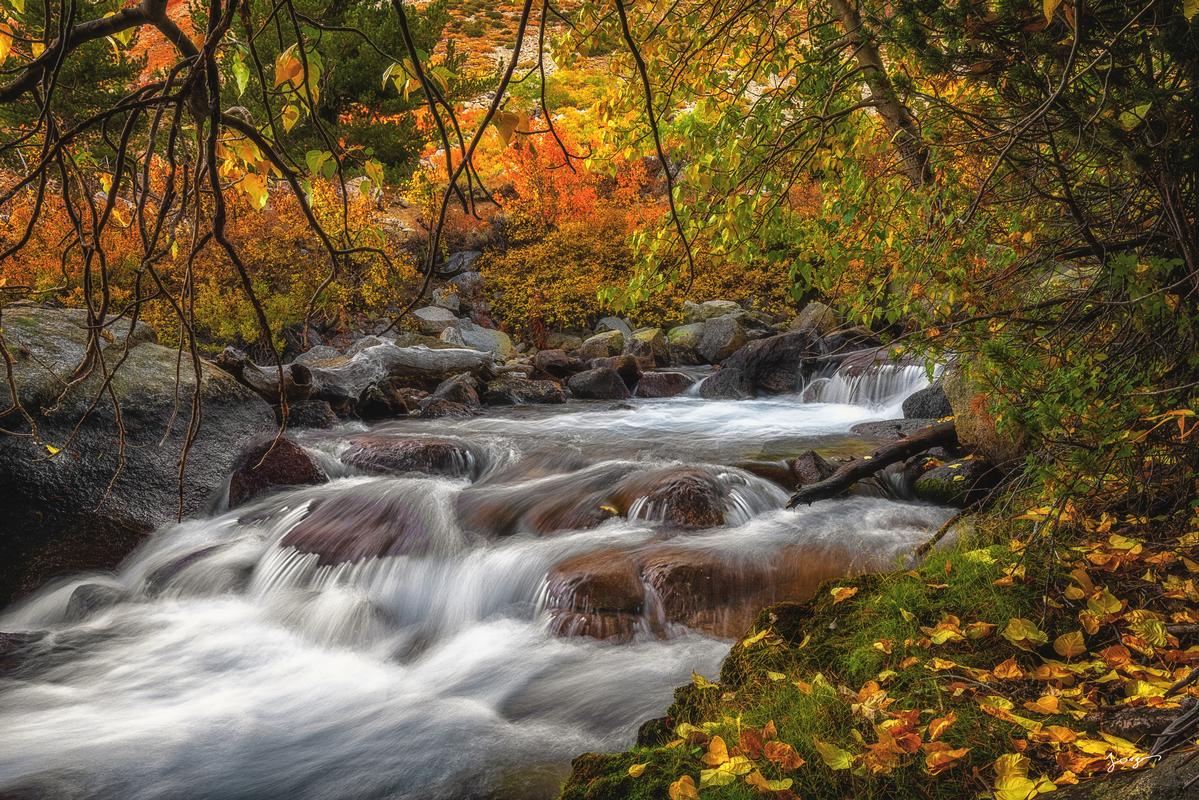
I photograph many of the same Eastern Sierra locations Rowell returned to throughout his career — the same light, the same granite, the same quality of air at altitude. In the fall I drive out toward North Lake, South Lake, and Aspendell just outside Bishop, where the aspen groves turn gold against the Sierra granite in a way that stops you in your tracks every single time. Standing in that country with a camera, you feel his influence in a very specific and grounded way. It is not abstract admiration for a canonical figure. It is the shared recognition of why someone would keep coming back to this particular landscape, in this particular light, looking for the same thing he was looking for. You can see some of that work in the California photography collection and the mountain photography collection on this site.
Mapping the Spirit — Where Rowell Worked in America
Rowell’s photography took him to every significant wilderness on Earth, but his American body of work is the fullest expression of his philosophy because it is where he spent the most time and returned most often.
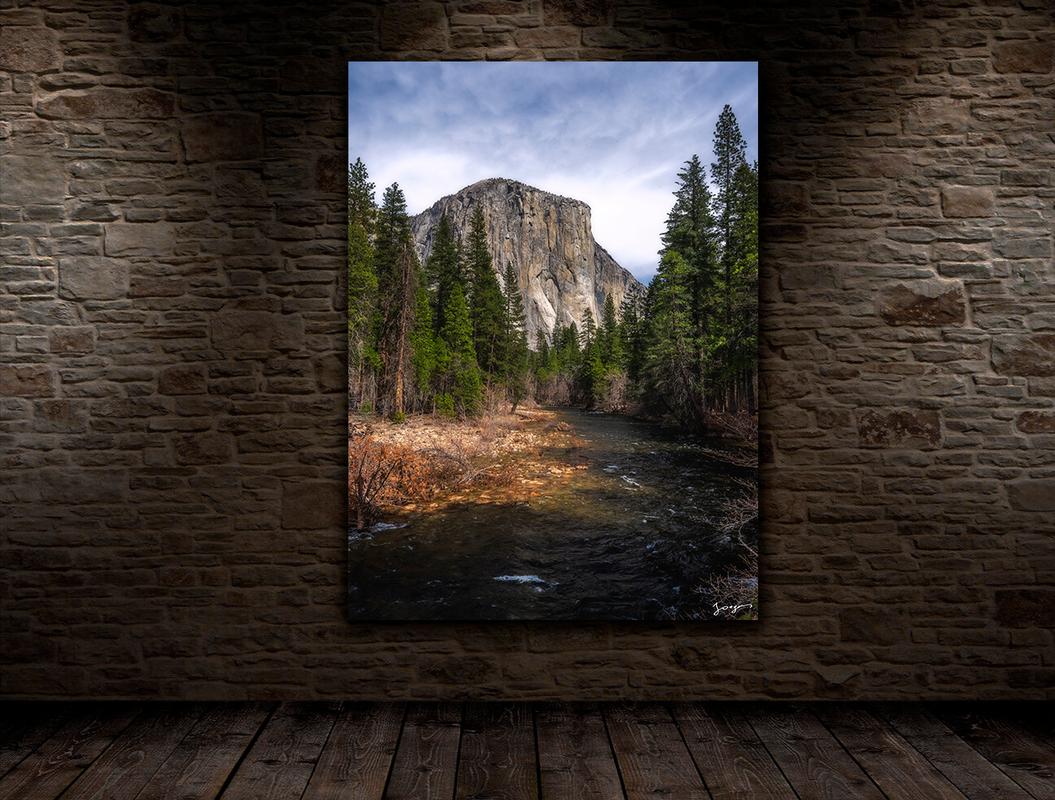
Yosemite National Park was the staging ground of his career — the place where Dewitt Jones first brought him to National Geographic’s attention and where he made some of his most enduring images. His photograph of the last ray of deep orange-red sunset light illuminating Horsetail Fall — making it look like liquid lava pouring down the sheer face of El Capitan — effectively popularized what is now known as the Firefall phenomenon. Thousands of photographers gather in Yosemite Valley every February for a window of two weeks hoping to recreate an image that Rowell first made in 1973. His interpretation of a clearing winter storm over El Capitan brought the same dynamic, high-energy approach to a subject that had been photographed since Carleton Watkins.
The Eastern Sierra and Owens Valley were his spiritual and professional home. The White Mountains to the east of the Sierra crest — where some of the world’s oldest living things, the bristlecone pines, grow at elevations above 11,000 feet — gave him some of his most characteristic images, including Twilight in the White Mountains, which shows Earth’s shadow meeting the twilight wedge over an ancient bristlecone forest. The frosted cottonwoods of the Owens Valley floor in autumn, the Eastern Sierra’s volcanic geology, the specific quality of light that the Sierra crest produces as it catches and holds the last rays of the day — these were subjects he returned to across decades.
The San Francisco Bay Area was his birthplace and the subject of an entire dedicated volume, Bay Area Wild (1997), which brought his signature dynamic color approach to the coastal redwoods, the fog-wrapped eucalyptus forests, the sea stacks of Point Reyes, and the rolling hills of Tilden Regional Park. The Bay Area, in Rowell’s hands, was not background scenery. It was wilderness that happened to be adjacent to a major city.
Sequoia and Kings Canyon gave him the ancient tree groves of the southern Sierra, and he pushed to find original angles on the colossal sequoias by scaling heights rather than pointing the camera upward from the ground. The Grand Tetons and Yellowstone offered the dramatic profiles of the northern Rockies, where he experimented with his GND filters against the high-contrast skies over the Snake River Overlook — the same valley floor where the historic barns of Mormon Row still stand against that unmistakable Teton profile. The Cascades of Washington and Oregon pushed his fast and light limits against the volatile weather systems of Mount Rainier and Mount Adams.
Conservation — The Camera as a Weapon
Rowell did not treat his conservation work as separate from his photography. He treated the camera as a weapon in the most literal practical sense — a tool for forcing attention onto things that would otherwise remain invisible to the public and the policymakers whose decisions determined their fate.
The Chiru expedition of 2002 is the fullest expression of this philosophy. The chiru, or Tibetan antelope, was being systematically slaughtered by poachers for its ultra-fine underwool, used to make luxury shahtoosh shawls. The species was approaching extinction, but its calving grounds on the remote Chang Tang plateau were unknown to the scientific community. Rowell joined Conrad Anker, Rick Ridgeway, and Jimmy Chin on a journey entirely on foot into this uninhabited wilderness, pulling 200-pound aluminum supply carts, to find and photograph the chiru giving birth. The resulting documentation catalyzed international media coverage, drove tougher anti-poaching enforcement, and contributed directly to the creation of massive nature reserves that pulled the species back from the brink. This was not a comfortable assignment. It was a grueling physical ordeal undertaken specifically because Rowell understood that documentation was the only tool that could save the animal in time.
In the Sierra Nevada, he used his platform to publish articles documenting the endangered status of the bighorn sheep herds in the 1970s, building the public and institutional support that eventually led to dedicated habitat protections in the Inyo National Forest. He served on the board of directors of the Sierra Nevada Bighorn Sheep Foundation until his death. His collaboration with His Holiness the 14th Dalai Lama on My Tibet (1990) paired his backcountry photographs of Tibet’s high-altitude landscapes with the Dalai Lama’s text to create a piece of visual diplomacy on behalf of both the Tibetan ecosystem and its people under occupation. He served on the advisory boards of over 20 conservation organizations, including the World Wildlife Fund and the Committee of 100 for Tibet.
In 1984, the Sierra Club presented him with the Ansel Adams Award for Conservation Photography. In 2009, seven years after his death, the International League of Conservation Photographers inducted him posthumously as an Honorary Fellow, cementing his standing as one of the founding fathers of modern conservation photography as a distinct practice.
The Stories Nobody Tells
Before Galen Rowell was a world-famous photographer, he was a Berkeley dropout running a hot-rod shop to fund his weekends at Yosemite. He souped up innocent-looking station wagons with V-8 engines to make the drive from the Bay Area to the Sierra Nevada as fast as possible. On one legendary occasion, he spotted a California Highway Patrol cruiser in his rearview mirror while moving at a speed that would have ended the weekend before it started. He whipped around a mountain curve, screeched into a scenic overlook, threw open the doors, and spread out a picnic blanket with food before the cruiser came around the bend looking for a speeding hot-rod. It drove past a group of peaceful picnickers without slowing down.
He developed a personal field technique he called “unsetting the sunset.” When working a valley or a mountain range, he would capture the last moments of light on the valley floor. The instant the sun dipped below the horizon, he would grab his gear and sprint or drive furiously uphill to a higher elevation, racing the advancing shadow. By reaching higher ground before the shadow did, he could watch the sun reappear over the horizon and photograph a second — sometimes a third — sunset in a single evening.
During a formal meeting of the American Alpine Club, an impromptu chin-up contest broke out among the gathered elite climbers on a hotel staircase. Rather than join in immediately, Rowell stood back and watched in silence, counting each person’s repetitions carefully. He waited until everyone was exhausted and a winner had been declared. Then he stepped up to the bar, performed exactly one more chin-up than the highest score, dropped down, and walked away without a word.
The Legacy of the Light Traveler
Galen Rowell died on August 11, 2002, in a light plane crash near Bishop, California, returning home with Barbara from a photography assignment. He was 61. The phrase “Light Traveler” carries a double meaning that became his defining epithet. Artistically, he was a traveler of light — a man who spent his career crossing the globe to be in specific places at specific moments when light did something that could not be predicted and could not be recreated. Physically, he was a traveler who moved light — a mountaineer who had stripped himself of every unnecessary pound so he could move through extreme terrain at a speed that the landscape demanded and that his camera could keep up with.
His 18 published books, from Mountain Light: In Search of the Dynamic Landscape (1986) to Galen Rowell’s Inner Game of Outdoor Photography (2001), remain essential reading for anyone serious about the philosophy of the form. The Inner Game in particular argues something counterintuitive and still radical: that improving your photography has less to do with upgrading your gear than with developing your physical connection to the places you photograph, your ability to track and anticipate light, and the emotional relationship you build with the landscape over repeated visits and genuine engagement.
The graduated neutral density filter he co-developed with Singh-Ray is now standard equipment in every serious landscape photographer’s kit worldwide. His concept of participatory photojournalism directly shaped the entire genre of adventure photography that produced photographers like Jimmy Chin and the generation that followed him. The work he made in Yosemite, in the Eastern Sierra, and in the wilderness areas of California continues to define how those landscapes are seen and represented.
He is buried, fittingly, in the Eastern Sierra country he photographed for four decades — in the same landscape, under the same light, that he spent his life trying to catch.
Read the Ansel Adams article →
Explore California Photography Prints →
Explore Mountain Photography Prints →
Eddie Jongas is a modern fine art photographer based in Las Vegas, Nevada, who photographs many of the same Eastern Sierra and California wilderness locations that shaped Galen Rowell’s career. His TruLife acrylic-mounted limited edition prints are available exclusively through jongasfineartphotography.com. Free shipping to all 50 states.
