Early Pioneers- Men and Women Who Invented The Art Of Photography
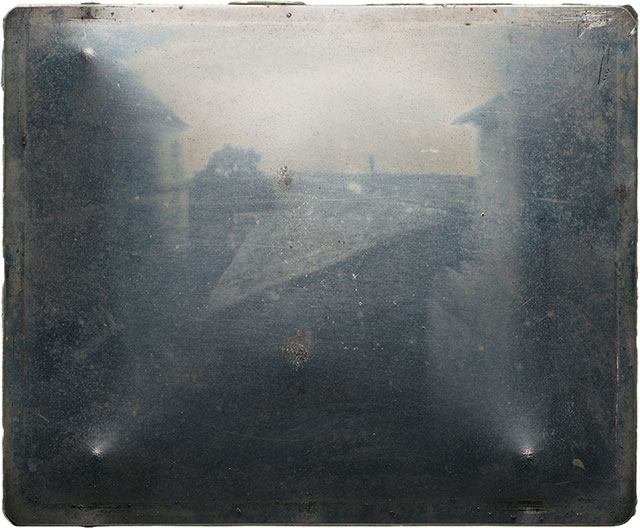
The very first survived photograph on record was created in 1827 by Joseph Nicéphore Niépce at his home in France. He pointed a camera out a window and waited for light to leave a trace on a metal plate. A decade later in England, Anna Atkins placed a various plants on light-sensitive paper and published first photography book using a process called cyanotype that was invented by Sir John Herschel.

Before film ever existed, early photographers had to figure it all out from scratch. First, how to record an image on a surface, how to make more than one print, how to make cameras more practical and how to use a camera in an artistic way. All these things had to be discovered through hard work of experimentation as well as trial and error.
A Complete Timeline of Photography’s Invention and Early History
1827 - Joseph Nicéphore Niépce made what is generally recognized as the earliest surviving photograph produced with a camera. For View from the Window at Le Gras, he coated a pewter plate with light-sensitive bitumen. The areas exposed to more light hardened, allowing the softer material to be washed away. The result is faint enough that the buildings can take a moment to come into view. The image shows what Niépce managed to hold in place: light falling on the buildings outside his window.
In 1839, Louis Daguerre — a French painter and theatrical designer already famous for his immersive Diorama light shows — announced to the world a photographic process that stopped people in their tracks. The daguerreotype produced an image of almost supernatural clarity on a polished, silver-coated copper plate: architectural details, fabric textures, the grain of wood, the veins of a leaf — all rendered with a sharpness that no painter’s hand could rival and that felt, to people seeing it for the first time, like a kind of magic.
Daguerre had arrived at this process through a long collaboration with Joseph Nicéphore Niépce, the French inventor who had produced the world’s very first photograph around 1826 or 1827 — a faint rooftop view requiring an exposure of several hours — and whose earlier experiments laid the chemical groundwork that Daguerre refined and transformed. Niépce died in 1833 before the process was perfected, and it was Daguerre who brought it across the finish line and into the public eye, negotiating a deal with the French government that granted him and Niépce’s son lifetime pensions in exchange for releasing the process freely to the world.
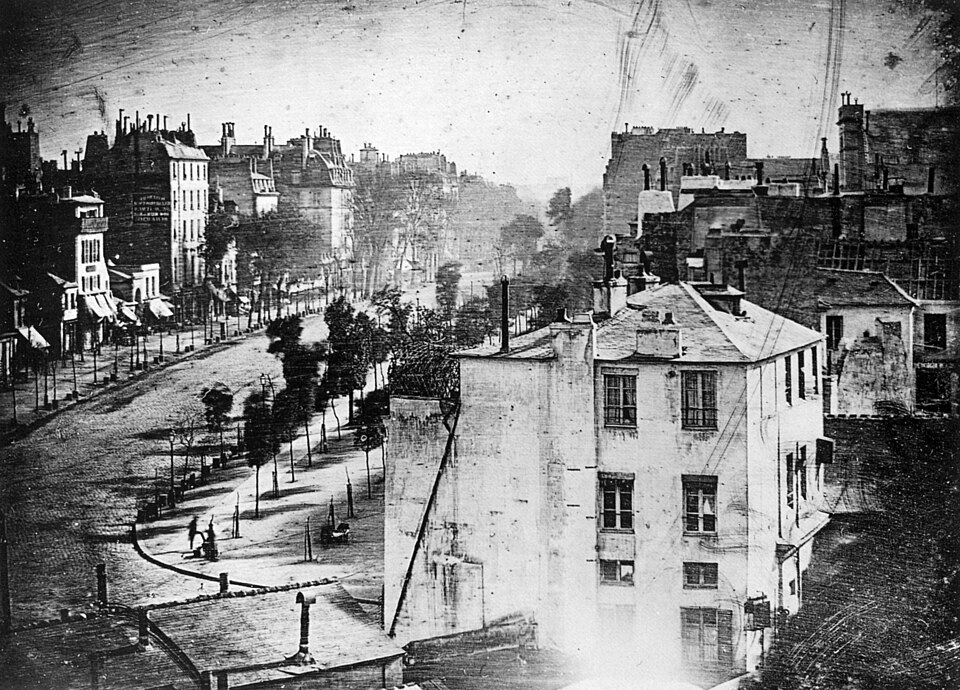
Daguerre’s Boulevard du Temple (1838) shows what the process could capture, as well as what it missed. The buildings along the Paris boulevard are sharply defined, but the street looks almost empty because most people and carriages moved too quickly to register during the long exposure. Near the curb, a person getting a shoeshine stood still long enough to appear in the image.
The announcement on August 19, 1839 caused an immediate sensation across Europe and America. The limitations, however, were real and significant: each daguerreotype was a one-of-a-kind object, a unique image with no negative and no way to make copies. The process required a precisely prepared plate, exposure to mercury vapor during development, and careful handling afterward since the delicate silver surface scratched easily and had to be viewed at exactly the right angle to be legible. It was expensive, technically demanding, and produced something closer to a precious object than a reproducible medium. Beautiful, singular, and ultimately a dead end — the daguerreotype dominated photography’s first decade and then gave way entirely to processes built on the negative/positive relationship that Talbot had identified and that the future belonged to.
 Buy This Print by Eddie Jongas · Limited Edition
Invention of Calotype and the First Woman Photographer
In 1839, the moment Louis Daguerre’s invention was announced publicly in Paris, the English scientist and mathematician William Henry Fox Talbot moved quickly to establish his own independent claim. He rushed to exhibit photographic images he had actually made several years earlier, as far back as 1835, produced through his own entirely separate process which he called the calotype — from the Greek for “beautiful impression.” Where Daguerre’s process produced a single, exquisitely detailed image on a silver-coated copper plate with no way to make copies, Talbot’s calotype produced a paper negative, and from that negative any number of positive prints could be contact-printed onto sensitized paper. This seemingly simple distinction — the negative/positive relationship — turned out to be the architectural foundation of photography for the next 150 years, running in an unbroken line from Talbot’s salted paper prints all the way through the darkroom era and into the logic of digital RAW files. Talbot was prickly about his patents and aggressive in defending them, which created real friction in the photographic community and arguably slowed the medium’s development in Britain compared to France, but his underlying contribution was enormous.
What is less widely known is that his wife, Constance Fox Talbot, has a credible claim to being the very first woman photographer in history — and possibly one of the first photographers of any kind. There is preserved photographic evidence and surviving mail correspondence from as early as 1839 indicating that she was actively experimenting with the calotype process alongside her husband, handling sensitized paper and making exposures independently. She left no published body of work and sought no recognition, but the documentary record exists, quietly placing a woman at the very origin point of the medium at a moment when history was paying attention almost exclusively to the men in the room.
 Buy This Print by Eddie Jongas · Limited Edition
Hippolyte Bayard Makes a First Photograph on Paper
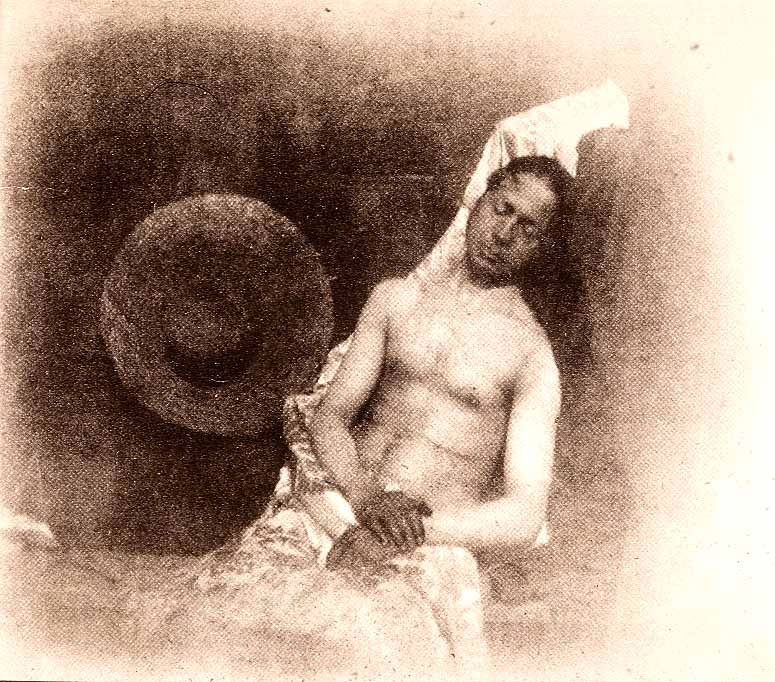
In 1839, the French civil servant Hippolyte Bayard developed a method for producing a direct positive photographic image on paper — a genuine breakthrough that placed him alongside Daguerre and Constance Fox Talbot as one of the true inventors of photography. His process was elegant and immediate: unlike the daguerreotype, which produced an image on a metal plate, or Talbot’s calotype, which required a negative-to-positive transfer, Bayard’s method produced a finished paper print in a single step. The problem was that François Arago, the powerful secretary of the French Academy of Sciences who was championing Daguerre’s process for reasons of national prestige and personal loyalty, quietly pressured Bayard to delay his public announcement so as not to split the credit or complicate the government’s plan to present the daguerreotype as France’s gift to the world.
Bayard complied, delayed his demonstration by several months, and watched Daguerre receive international fame, a generous government pension, and permanent glory while he received a small one-time payment and was largely forgotten.
His response was one of the most quietly devastating acts of protest in the history of art: in 1840 he posed himself as a drowned man, eyes closed, skin darkened by the chemicals, slumped in a chair like a body pulled from the Seine, and wrote a sardonic note on the back of the print in the voice of a corpse — explaining that the government, Daguerre, and Talbot had taken everything while he had been driven to this end by neglect. It was staged photography, conceptual art, and bitter political satire all at once, nearly a century before anyone had words for any of those things.
Anna Atkins - First woman to publish a photobook
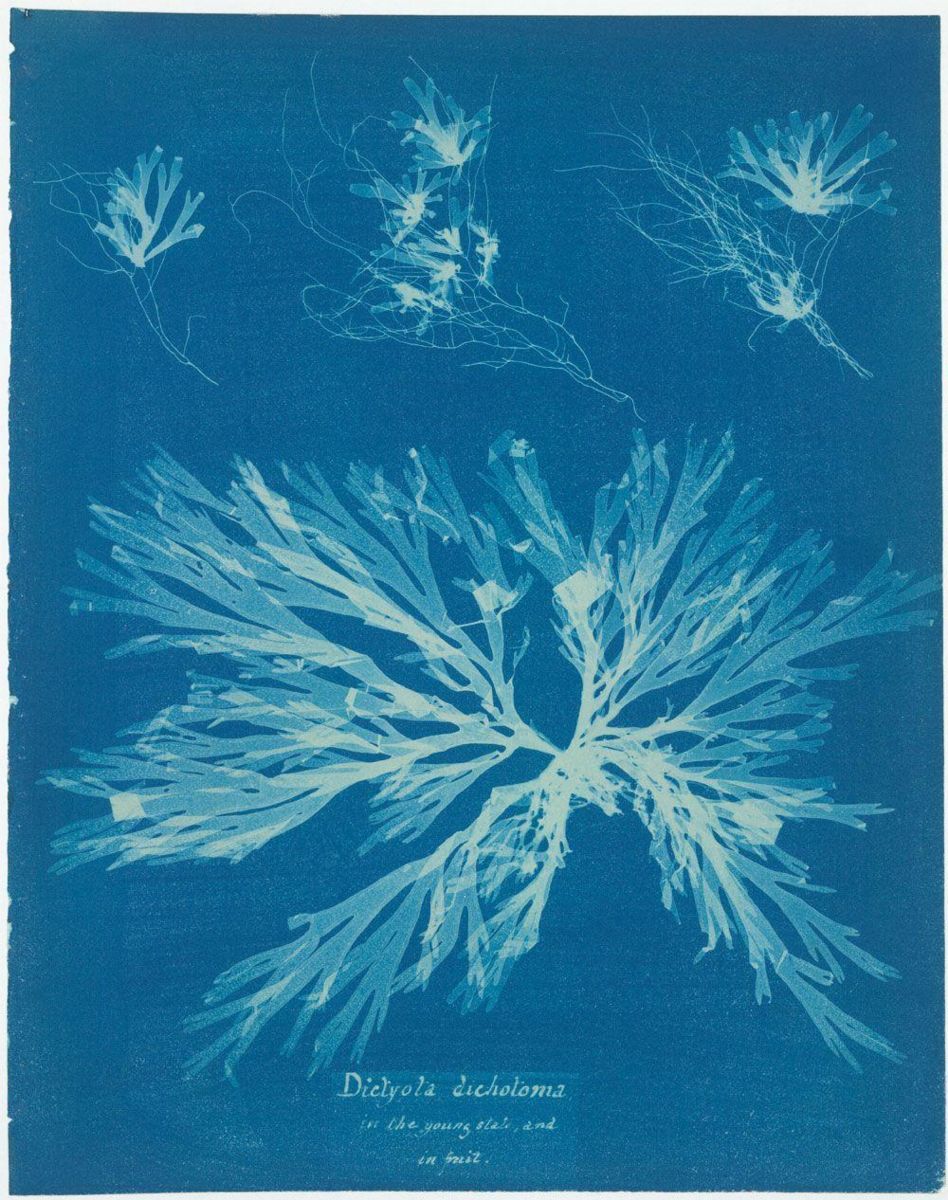
In 1842, the astronomer and scientist John Herschel invented the cyanotype process — a photographic method using iron salts that required no camera, no lens, and no darkroom in the traditional sense. The following year, the botanist Anna Atkins became the first person to use it to create and publish a book. Rather than hiring an illustrator to draw specimens by hand, as scientific publications had always done, she laid actual seaweed and fern leaves directly onto sheets of paper sensitized with Herschel’s iron solution, exposed them to sunlight, and washed them in water. Where the plant blocked the light, the paper stayed pale and white; where light struck the sensitized surface directly, it turned a deep, luminous Prussian blue. The result was something between a scientific record and an accidental work of art — the exact outline, texture, and structure of each specimen preserved with a precision no illustrator’s hand could match, ghostly and pale against that characteristic blue ground.
Beginning in 1843, Atkins issued these prints in installments under the title Photographs of British Algae: Cyanotype Impressions, making it the first book in history to be illustrated with photographic images. She produced the entire publication herself — mixing the chemicals, preparing the paper, making every print by hand, writing the accompanying text — at a moment when most of the men being celebrated as photography’s pioneers were still refining their processes. The Getty Museum holds examples of her work, viewable in their online collection.
The birth of modern photography process
In 1851, Frederick Scott Archer invented the wet collodion process — a method of coating a glass plate with collodion (guncotton dissolved in ether and alcohol), sensitizing it with silver nitrate, exposing it while still wet, and developing it immediately before it dried. The result was a sharp, detailed negative on glass that could produce unlimited paper prints.
This was the breakthrough that ended the daguerreotype era. The daguerreotype was beautiful but produced a single image on metal with no way to make copies. Talbot’s calotype paper negative could be copied but produced soft, fibrous images because light had to pass through the paper grain. Archer’s glass negative gave you the sharpness of the daguerreotype combined with the reproducibility of the paper negative. This invention established the way photography would be for years to come.
 Buy This Print by Eddie Jongas · Limited Edition
First Woman To Use Photography As An Artform
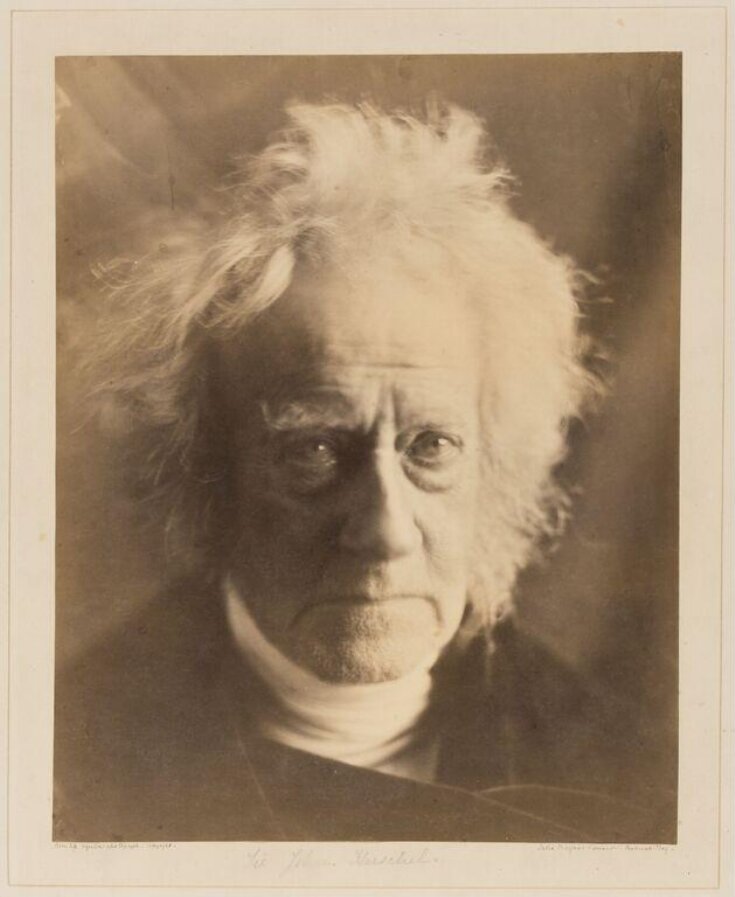
1863- Julia Margaret Cameron (1815–1879) came to photography at age 48 when her daughter gave her a camera as a gift. She worked with Archer's wet plate collodion process, coating large glass plates (roughly 11×14 inches) with collodion, sensitizing them in a silver nitrate bath, exposing while still wet, and rushing back to develop before the emulsion dried — all within about 10 to 15 minutes.
What she was actually doing was importing the aesthetic of Renaissance painting and Pre-Raphaelite art directly into photography. She posed her subjects — maids, neighbors, celebrities, her own family — as biblical figures, Arthurian characters, allegorical personifications. She wanted photographs that felt like paintings by Raphael or Rembrandt, with all the atmospheric depth and emotional weight that implied. The soft focus wasn’t sloppiness; it was the equivalent of the painter’s sfumato, a way of suggesting rather than documenting.
She was the first woman to copyright and sell her photographs in an art gallery.
The Photograph That Shocked the British Art World
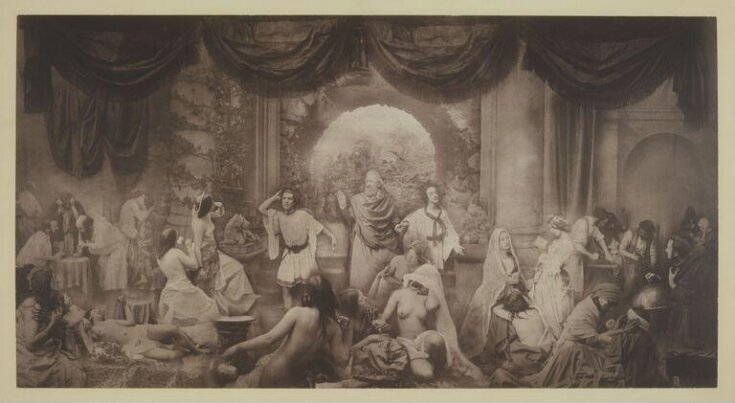
1857- Oscar Gustave Rejlander (1813–1875) was a Swedish-born painter and lithographer who took up photography in England in the early 1850s and immediately treated it as a medium capable of competing with the grandest traditions of European painting. His masterwork, The Two Ways of Life (1857), was a massive allegorical composition assembled from approximately 30 separate negatives combined through an extraordinarily complex darkroom printing process — essentially inventing photomontage decades before anyone named it that. The image depicted a moral allegory of virtue versus vice with the ambition and scale of a history painting, caused a scandal over its partially nude figures, and was purchased by Queen Victoria for Prince Albert, which settled any debate about its artistic legitimacy.
He was also a close collaborator with Charles Darwin, producing the photographs of human emotional expression that illustrated The Expression of the Emotions in Man and Animals (1872) — one of the first uses of photography as scientific illustration in a major academic work, with Rejlander posing for many of the images himself. Beyond the grand allegorical work he made quieter, more intimate studies of street children and working-class subjects that show genuine warmth and directness. He died in 1875 in relative poverty and obscurity, following the same pattern of significant contribution and inadequate recognition that runs through early photography with depressing consistency — but his influence on composite photography and on the argument that the camera could produce morally serious fine art was real and lasting.
 Buy This Print by Eddie Jongas · Limited Edition
The Woman Who Refused to Play by Stieglitz’s Rules
In 1898 Gertrude Käsebier (1852–1934) was one of the most commercially successful and artistically serious photographers in America at the turn of the twentieth century, remarkable partly because she didn’t take up photography professionally until her late thirties. She studied painting in Brooklyn and Paris before opening a portrait studio in New York that became one of the most sought-after in the country. She charged premium prices, maintained full artistic control, and refused to produce the stiff over-lit portraits that most commercial studios delivered.
Her most famous image, Blessed Art Thou Among Women (1899), a soft-focus platinum print of a mother and daughter in a doorway drawing directly on Renaissance Madonna imagery, appeared on the cover of Alfred Stieglitz’s Camera Notes and became one of the defining images of the Pictorialist movement.
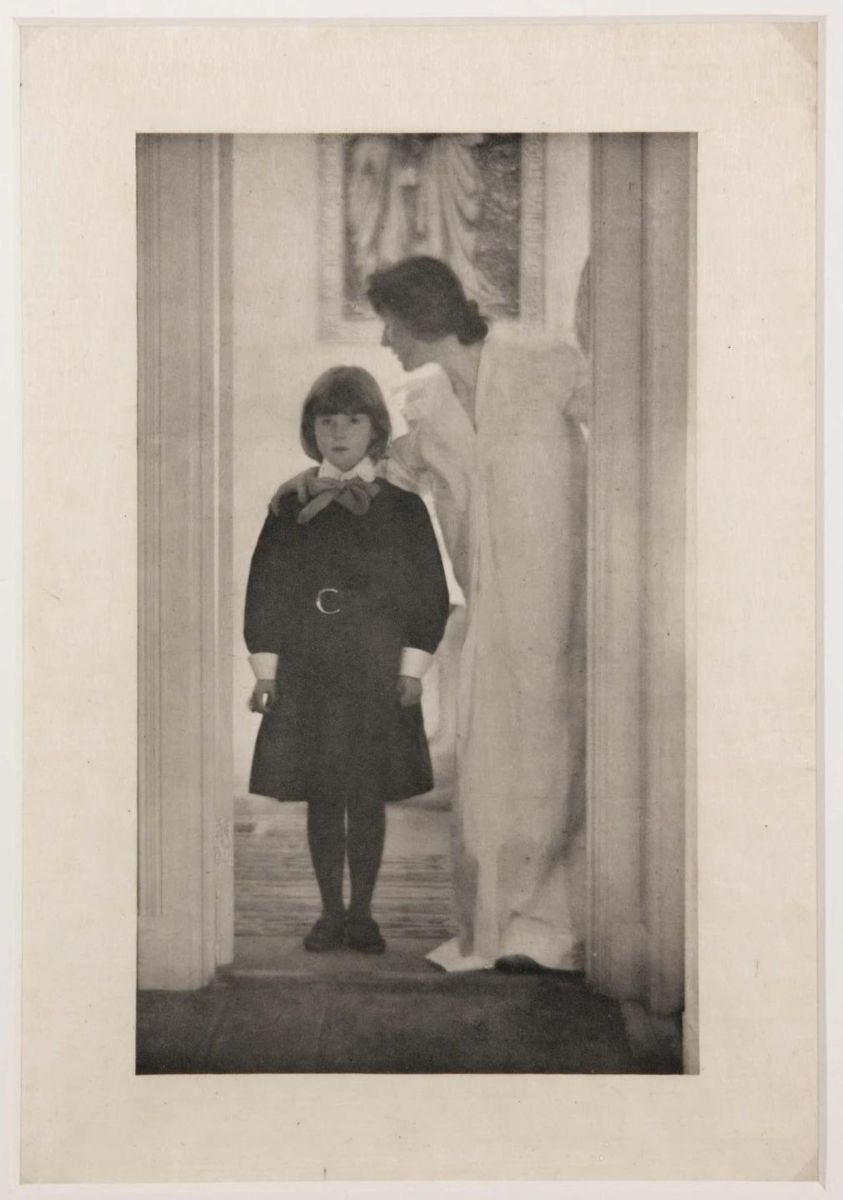
She was a founding member of the Photo-Secession alongside Stieglitz and Steichen, though her relationship with Stieglitz eventually fractured — she was too successful and too independent to remain comfortably within his controlling orbit, and by around 1912 had broken with the group entirely.
She also maintained a long and genuine relationship with Buffalo Bill’s Wild West Show, photographing members of the Lakota Sioux troupe over many years with the same care and atmospheric seriousness she brought to her society commissions — producing some of the most humanizing photographic portraits of Native Americans from that era. She ended her career somewhat overlooked as Pictorialism fell out of fashion, but her best work holds up completely.
 Buy This Print by Eddie Jongas · Limited Edition
190 Years Later
 Buy This Print by Eddie Jongas · Limited Edition
In 2026, it takes a tap of a finger to produce a high-resolution color photo with balanced highlights and shadows and perfectly adjusted tones. Even a three-year-old can do it. Any phone, even on a bad day, can take a better photo, faster and at a lower cost than these early pioneers could ever have imagined. As with many things we take for granted, it’s easy to forget what they went through to get us here.
For those of us who care to know more, and know enough to care more, remembering these men and women is the least we can do. They persevered through uncertainty and a lack of recognition, often without pay, and helped bring about a change that we still benefit from today.
It’s worth knowing their names, what they accomplished, and what they dared to try. They paved the way for future generations to enjoy photography and continue building on the foundations they laid.
At Jongas Fine Art Photography I strive to get artistic images that represent the landscape and nature in its purest form, captured at the right moment, at the right season and in the most perfect natural light.
All my artworks are produced by me only and are offered as acrylic mounted (gallery quality), as metal or as canvas prints. Browse my fine art landscape and nature photography collection to find a piece that resonates with you.
Historical Sources
- Harry Ransom Center on the Niépce heliograph
- The Met on Daguerre and the daguerreotype
- Getty on Hippolyte Bayard and his staged self-portraits
- The Met on William Henry Fox Talbot and the calotype
- Historic England on Constance Fox Talbot and early women photographers
- The Met on Anna Atkins’s Photographs of British Algae
- Getty on Frederick Scott Archer
- The Met on Cameron’s process and print sales and her portrait of Herschel
- The Met on Rejlander’s Two Ways of Life and Corot’s cliché-verre work
- University of Delaware Library on Käsebier’s life and work
- MoMA on Käsebier’s The Manger and The Met on the Photo-Secession
 Buy This Print by Eddie Jongas · Limited Edition
 Buy This Print by Eddie Jongas · Limited Edition
 Buy This Print by Eddie Jongas · Limited Edition
