There is a rule in English Country House interior design that tells you everything you need to know about the style: every great room needs “something a little bit ugly.” That observation came from Nancy Lancaster — the American heiress who, along with British decorator John Fowler, essentially invented the English Country House look as a defined interior style in the mid-twentieth century. The idea was that a room that is too perfectly curated, too pristine, too consistent looks like nobody actually lives in it. The slightly odd object, the mismatched fabric, the threadbare carpet that hasn’t been replaced yet — these are not failures of taste. They are evidence of a life being lived.

That philosophy is both the appeal and the challenge of the English Country House style. It looks effortless because it spent decades pretending to be accidental. It is actually extremely deliberate. Understanding how it works — where it came from, what its core elements are, how it differs from related styles, and what kind of art belongs in it — is the first step to achieving it without making it look like a costume.
What is English Country House interior design?
English Country House interior design is a layered, comfortable style that balances architectural grandeur with lived-in informality. Its defining quality is the appearance of organic evolution over generations — rooms that look inherited rather than purchased. Core elements include mixed-period antique furniture, layered textiles and patterns, glazed walls in rich colors, collected artifacts, Persian rugs, and deliberate eccentricity. It sits within the traditional interior design family but is distinctly more informal and eccentric than classic formal traditional design.
Who invented English Country House style?
The English Country House look as a defined decorating movement was codified in the 1930s–1950s by American heiress Nancy Lancaster and British decorator John Fowler through their firm Colefax & Fowler. While the country houses themselves had existed for centuries, Lancaster and Fowler transformed the accidental accumulation of generations into an intentional aesthetic — using post-war shortages and imperfect surfaces to create an atmosphere of effortless, understated luxury that had never previously been a deliberate style.
What is the difference between English Country House and French Country design?
Both styles favor natural materials, layered textiles, and relaxed comfort. English Country House runs cooler and richer — glazed butter yellow, sage, eau-de-Nil, dark mahogany, patinated brass — and carries an ancestral, eccentric quality. French Country runs warmer and more rustic — terracotta, lavender, whitewashed oak, wrought iron — with a sun-drenched, romantic feeling. English Country feels like a library on a rainy November afternoon. French Country feels like Provence on a summer morning.
What art works best in an English Country House interior?
The most naturally suited categories are: bucolic oil landscapes and pastoral paintings, botanical studies and natural history prints in dark wood frames, ancestral or figure portraits in oil, and black and white fine art photography. Art in this style should feel collected and biographical rather than decorative — as though each piece arrived in the room with its own story. Framing in antique dark mahogany, carved walnut, or patinated gilt enhances the ancestral quality of any image.
Is English Country House design still popular today?
Yes — it is experiencing one of its strongest revivals in decades. After years of dominant minimalism and gray catalog interiors, homeowners are returning to spaces that feel permanent, layered, and characterful. The English kitchen trend, the Grandmillennial micro-trend, Cottagecore, and the broader “anti-catalog” shift in interior design all draw on English Country House principles. The modern interpretation — sometimes called Modern English Country — applies the same principles with a lighter hand, favoring one bold hero piece over full room pattern saturation.
What Is English Country House Interior Design? Definition and Core Characteristics
English Country House interior design is a layered, comfortable, and deliberately unpretentious style that balances architectural grandeur with lived-in informality. The defining quality is not any single element — not the chintz, not the dark mahogany, not the Persian rugs — but the feeling that the room has evolved organically over generations rather than been assembled from a single source at a single moment. It looks inherited rather than purchased.
The style sits firmly within the broader traditional interior design family, sharing its respect for historical architectural elements, rich color palettes, and quality materials. But where classic traditional design tends toward formality and symmetry, English Country House takes those same ingredients and relaxes them deliberately — mixing periods, allowing wear, embracing eccentricity.
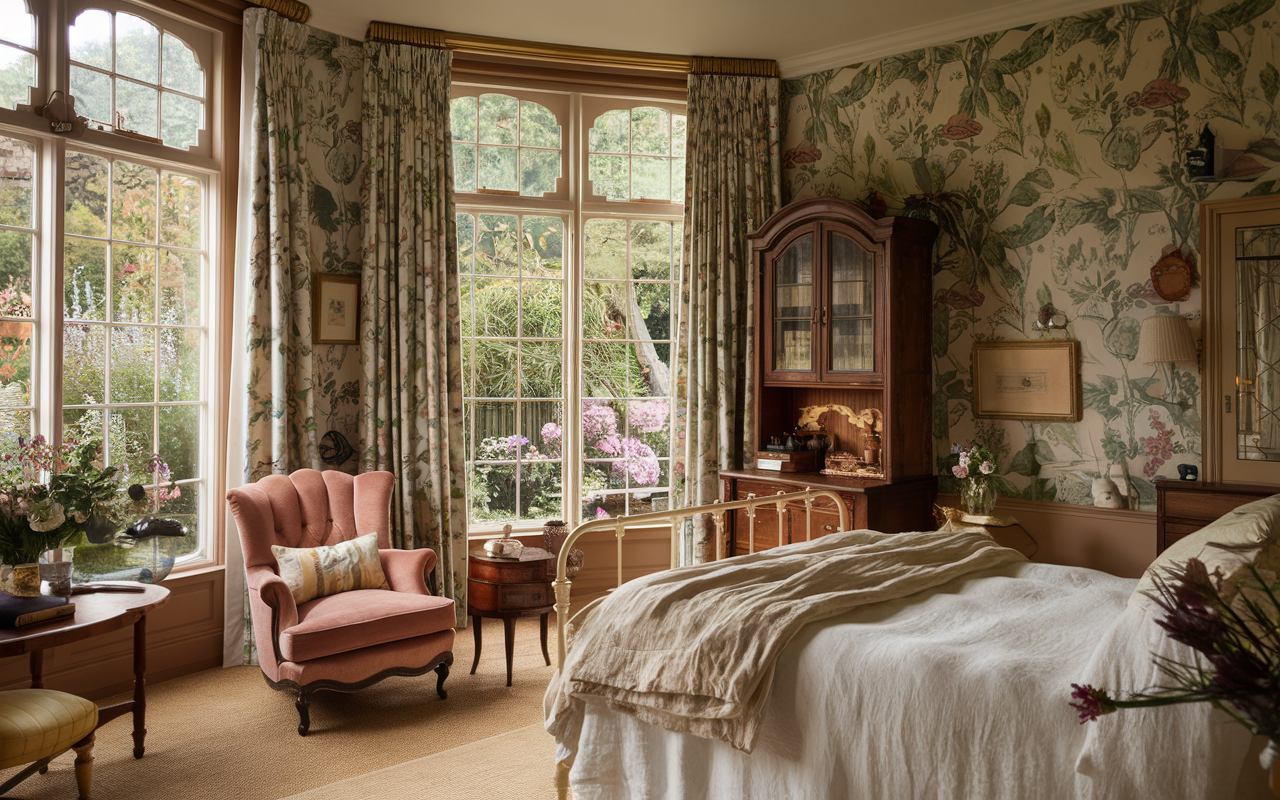
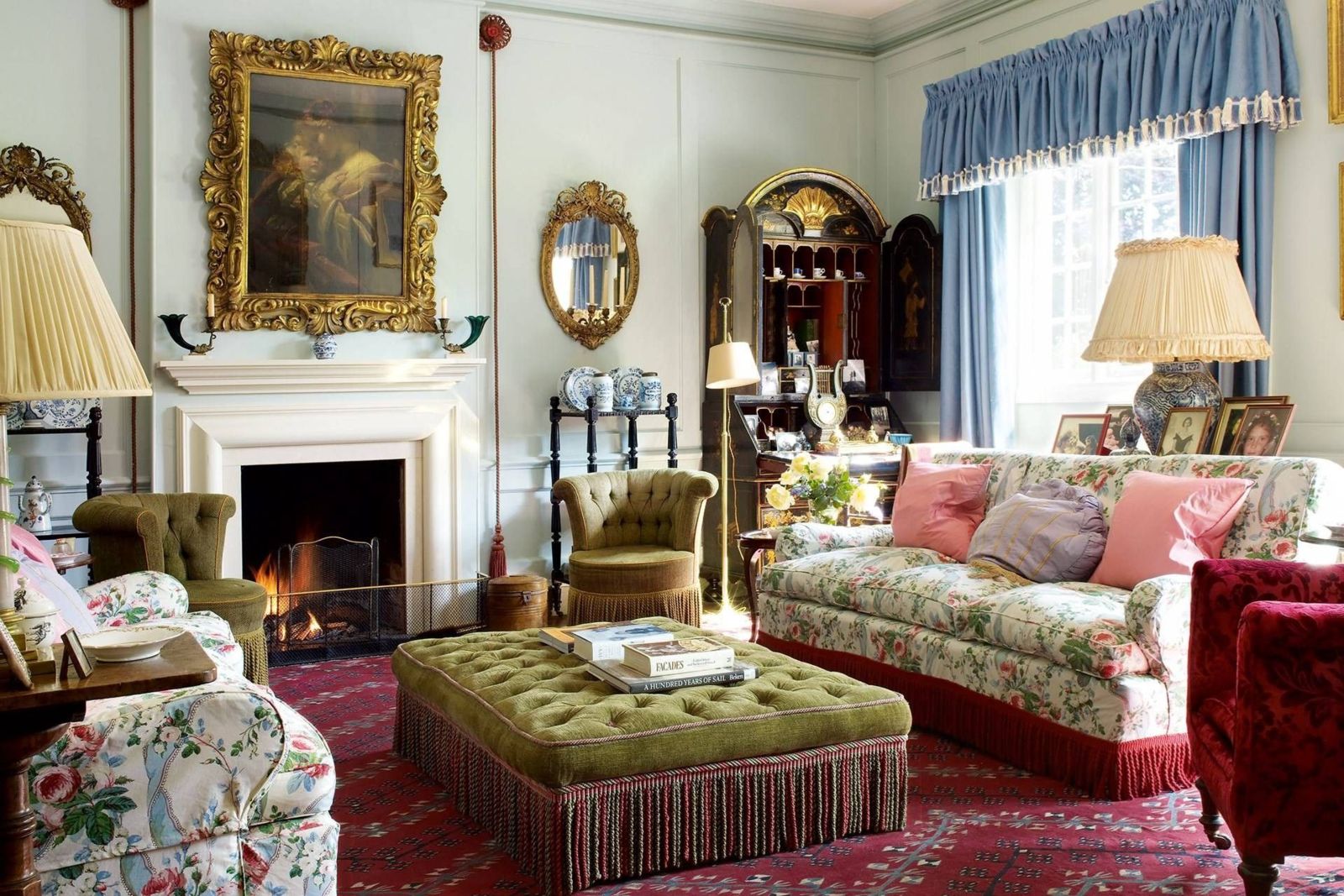
Layered textiles and mixed patterns. Generous use of floral chintz, plaids, stripes, and damasks used within the same room — not matched, but harmonized. The rule is abundance over restraint. Multiple fabrics on multiple surfaces, each with its own pattern, creating an overall impression of warmth and complexity rather than confusion.
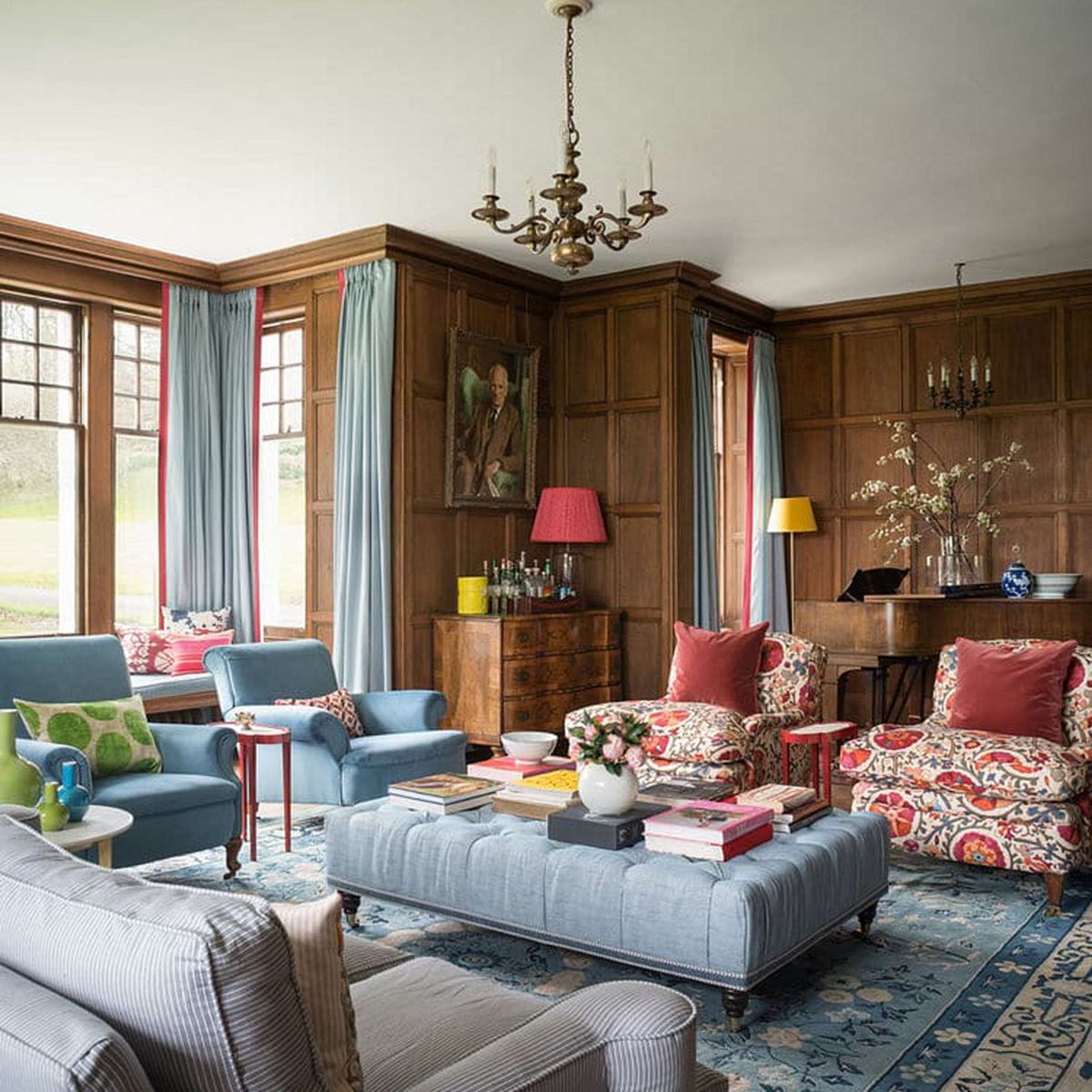
Brown furniture. A mix of antique mahogany, oak, walnut, and rosewood pieces from various periods — Georgian, Regency, Victorian — placed together without anxiety about matching eras. The key word is “antique.” These are real pieces with patina and history, not reproductions. The combination of periods is not carelessness. It is the visual record of a family that acquired things over centuries.
Deep, comfortable seating. Overstuffed armchairs and sofas with slipcovers, plush feather cushions, and tailored skirt trims designed for actual daily use. English Country House furniture is not decorative. It is made to be sat in for long periods by people reading, talking, or watching the fire. The comfort is not incidental — it is the point.
Glazed walls and rich color. Multi-layered glazed paint finishes in butter yellow, soft pinks, eau-de-Nil, or sage green, often paired with historic floral wallpapers. The glazing technique — applying multiple thin layers of translucent paint over a base color — creates depth and warmth that flat paint cannot replicate. It is also, notably, forgiving of imperfect walls.
Collected artifacts and deliberate eccentricity. Displayed family heirlooms, silver-framed photographs, stacks of books, blue-and-white porcelain, garden flowers cut and placed informally. Nancy Lancaster’s ugly object rule applies here: every room needs something unexpected, something slightly wrong, something that confirms a human being made these choices rather than a design formula.
Layered rugs. Antique Persian or Turkish area rugs laid over sisal matting or worn parquet flooring. The layering is practical — it protects the floor, adds warmth, defines zones — but it also adds visual depth and the suggestion of accumulation over time.
History and Origins of English Country House Style — From Ancestral Accumulation to Nancy Lancaster
The history of English Country House interior design is not as old as it looks. The style as a defined visual idiom — as something you could consciously recreate rather than simply inherit — is a twentieth-century invention, even though the houses it draws on are centuries older.
The roots lie in the great landed estates of eighteenth and nineteenth-century Britain, where aristocratic families accumulated objects over generations without a coordinating design philosophy. A Jacobean house might acquire Georgian furniture, import Asian porcelain via the East India Company, bring back Grand Tour souvenirs from Italy and Greece, and layer Persian carpets over flagstone floors. The rooms accumulated because life accumulated. There was no decorator. There was just time.
What these houses shared was a quality of domesticity that the formal parade rooms of the French tradition lacked. English country houses were working houses — they housed farms, hunts, tenants, children, and dogs alongside their ancestral portraits and Chippendale furniture. The informality was not a style choice. It was a function of how people actually lived.
The codification of this accidental quality into an intentional decorating movement happened in the 1930s and 1940s, largely through the partnership of two figures: Nancy Lancaster, a Virginia-born American heiress who had lived in and decorated several significant English country houses, and John Fowler, a British decorator of exceptional skill and historical knowledge. Together they formed the firm Colefax & Fowler, which became the most influential decorating practice in Britain for several decades.
“A new chintz looks like a new chintz. A slightly faded chintz looks like an heirloom.”
What Lancaster and Fowler understood — and what made their work distinctive — was that the English Country House look could not be faked through money alone. Its authority came from the appearance of history, not the reality of it. The post-war shortages that limited what they could source became an aesthetic advantage: they learned to work with worn carpets, faded fabrics, and imperfect surfaces in ways that turned necessity into a defining characteristic of the style. A new chintz looks like a new chintz. A slightly faded chintz looks like an heirloom.
Nancy Lancaster’s most celebrated achievement was her own apartment above the Colefax & Fowler showroom in Brook Street, London — the famous “butter yellow” drawing room that has been photographed, discussed, and imitated more than almost any interior of the twentieth century. The walls were painted in Lancaster’s signature glazed yellow, the upholstery mixed florals and plains at different scales, the furniture spanned three centuries, and the whole composition managed to look simultaneously grand and completely comfortable. It was the blueprint for everything that followed.
The modern legacy of that work is visible in the contemporary revival of the style. After decades of minimalism, gray walls, and “fast furniture” interiors that prioritized visual cleanliness over human warmth, homeowners and designers are returning to spaces that feel permanent, layered, and genuinely lived-in. The micro-trends of Grandmillennial style, Cottagecore, and what design media calls the “Nancy Meyers aesthetic” all draw directly on English Country House principles — the pleated lampshades, the floral wallpapers, the skirted tables, the sense that beautiful things accumulate around a life well-lived.
English Country House Design vs. Similar Styles — What Makes It Different From French Country and Traditional Design
English Country House style is frequently confused with several related styles that share its affection for history, natural materials, and layered comfort. Understanding the differences helps you make deliberate choices rather than accidentally producing a hybrid that captures none of the original.

English Country House vs. French Country. Both styles draw on rural European traditions and both favor natural materials, layered textiles, and a relaxed approach to formality. The key differences are in the palette, the furniture, and the overall emotional tone. French Country runs warmer and more sun-drenched — terracotta, lavender, soft cream, whitewashed oak, wrought iron. English Country runs cooler and richer — glazed butter yellow, sage green, eau-de-Nil, dark mahogany, patinated brass. French Country reads as romantic and rustic. English Country reads as eccentric and ancestral. A French room wants to feel like Provence on a summer afternoon. An English room wants to feel like a library on a rainy afternoon in November.
English Country House vs. Classic Traditional Design. Classic traditional interior design shares the English Country House commitment to quality materials, historical references, and rich color palettes. The distinction is in the formality. Traditional design tends toward symmetry, polish, and order — rooms that look carefully arranged and maintained. English Country House takes the same ingredients and introduces deliberate disorder: mixed periods, worn surfaces, unexpected objects, patterns that clash slightly before resolving. Traditional design says “this room was designed.” English Country House says “this room happened.”
English Country House vs. Cottagecore and Grandmillennial. These contemporary micro-trends borrow heavily from English Country House aesthetics but simplify and sweeten them. Cottagecore emphasizes the pastoral and nostalgic — florals, botanicals, linen, natural textures — without the aristocratic weight of genuine antique furniture and inherited objects. Grandmillennial style similarly adopts the surface elements (pleated lampshades, floral wallpapers, chintz) with a lighter, more accessible hand. Both are legitimate contemporary design approaches. Neither has the full complexity of the original — the dark mahogany, the ancestral portraits, the deliberately ugly object — that gives English Country House its particular authority.
How English Country House Design Is Growing in Popularity Today — The Anti-Catalog Movement
English Country House interior design is experiencing one of its strongest revivals in decades, and the reason is largely a reaction to what came before it.

The dominant interior aesthetic of the 2010s — white walls, gray sofas, open-plan spaces, furniture that could have come from any of six identical retail catalogs — has produced a generation of homeowners who feel that their spaces look identical to their neighbors’ and to the interiors of every hotel they’ve stayed in for the past decade. English Country House design offers the opposite: unique, vintage, and inherited objects that reflect real lived experience rather than the inventory of a single manufacturer.
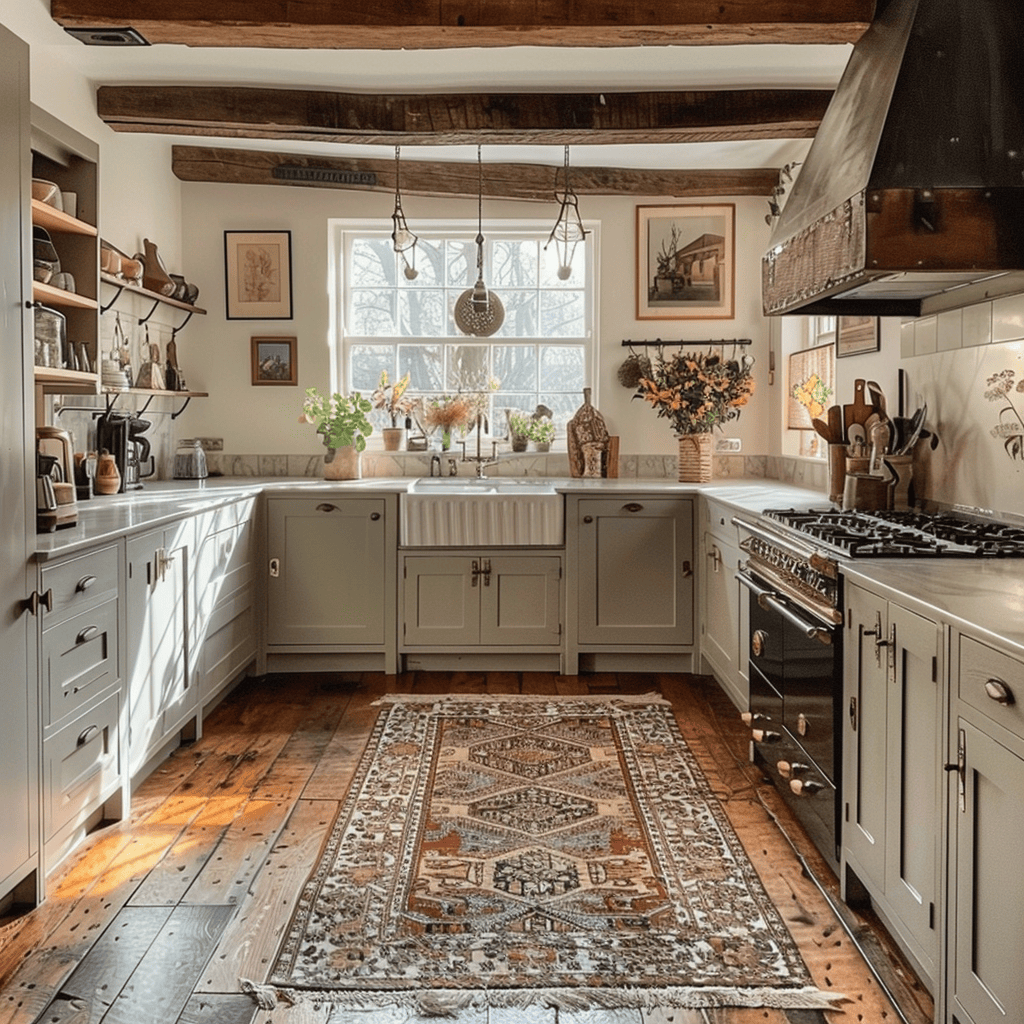
The English kitchen trend is one of the clearest expressions of this shift. Warm Shaker-style cabinetry, range alcoves, freestanding dressers, deep apron-front sinks, and unlacquered brass fixtures have become among the most requested kitchen design elements in the United States and internationally. This is essentially the English Country House aesthetic applied to a single room — and its popularity reflects an appetite for permanence, craft, and the visual evidence of genuine quality over the flatpack alternative.
Social media has accelerated the trend. The Grandmillennial hashtag, the Cottagecore aesthetic, and the consistent cultural resonance of the “cozy library with a fire” image type all draw on English Country House principles. The style has been extensively featured on Pinterest and Instagram, where its visual warmth and complexity photograph exceptionally well against the minimal white backgrounds that dominated the previous era.
The modern interpretation — sometimes called “Modern English Country” — tends to strip away the heaviest Victorian elements in favor of a lighter balance. Natural lime-wash or plaster walls instead of heavily patterned wallpaper throughout. One bold hero piece — a massive floral sofa or a hand-blocked curtain — surrounded by supporting elements that allow it to breathe. Layered warm lighting from table lamps, picture lights, and floor lamps instead of flat overhead fixtures. The principles are the same. The application is slightly more edited.
What Art Belongs in an English Country House Interior — And Where to Find It
Art is not decorative in an English Country House interior. It is biographical. The walls of a genuine country house carry the record of a family’s taste, travels, and relationships across generations — oil portraits of ancestors, landscapes of the estate, botanical watercolors from a grandmother who painted, sporting prints from a grandfather who hunted, Grand Tour views of Rome and Florence acquired by a great-great-uncle who spent a year in Italy in the 1790s.
Replicating that quality of accumulation without the actual history behind it requires understanding what kinds of art belong in this environment and why. The categories that work best:

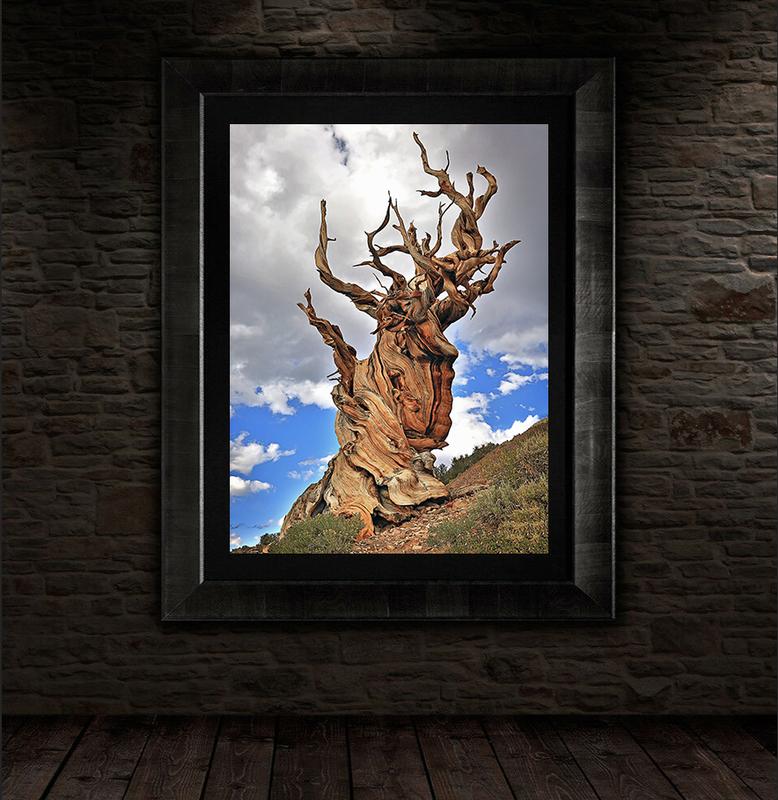
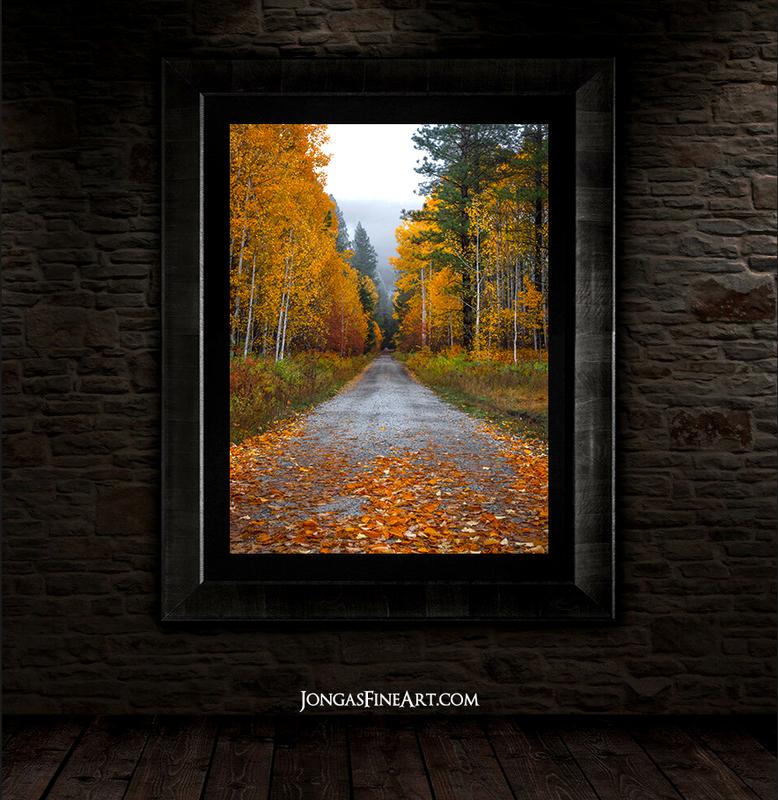
Landscape paintings and prints are the most naturally suited to the English Country House context. Bucolic oil landscapes — pastoral English countryside, atmospheric woodland scenes, coastlines and moors — are visually at home on a glazed butter-yellow wall in a way that contemporary abstract work typically is not. The subject matter echoes the house’s relationship to the land it sits in. Fine art landscape photography in the landscape photography collection by Jongas Fine Art Photography occupies a position in this tradition — images that treat the natural world with the same formal attention that the great landscape painters brought to their canvases, printed in limited editions on museum-grade acrylic.
Botanical studies and natural history prints are a staple of the English Country House wall. Individual prints from historic botanical publications, framed in dark wood or gilt, arranged in grids or loose clusters, add the layer of scholarly collecting that characterizes the style. Originals from the eighteenth and nineteenth centuries are available through auction houses and specialist dealers. High-quality archival reproductions from museum collections — the V&A, Tate Britain, the National Trust — are more accessible and print beautifully on textured rag paper.
Ancestral portraits and figure studies. Oil portraits of people, real or unknown, carry the essential biographical quality of the style. Buying “found” portraits — antique oil paintings of unknown subjects — from auction houses, antique dealers, and estate sales gives a room the visual weight of ancestry without requiring actual ancestors. Charcoal or pencil figure studies, architectural drawings, and classical academic drawings work in a similar register at lower price points.

Black and white fine art photography is a contemporary addition that works exceptionally well in Modern English Country spaces. The tonal restraint of a black and white fine art photograph sits comfortably against a rich wall color and amid pattern-heavy upholstery without competing. It reads as documentary — the photographic equivalent of the silver-framed family photograph that has always been part of the English Country House mantelpiece.
For sourcing, the best options span several tiers. Auction houses — Christie’s, Sotheby’s, Bonhams, and regional houses listed on LiveAuctioneers — are the primary market for authentic antique oils and works on paper. Antique fairs like The Decorative Antiques & Textiles Fair in London and major American shows like Brimfield and Round Top are hunting grounds for unrestored canvases, dark frames, and vintage natural history prints. Museum gift shops from the National Trust, the V&A, and Tate Britain offer archival-quality reproductions of historic English and European works. And for contemporary fine art photography in the same tradition — landscape and nature imagery that carries the landscape photography legacy forward into the present — buying directly from the photographer gives you limited-edition prints, museum-grade production, and a direct provenance chain that a gallery cannot offer.
The framing matters as much as the image. English Country House art wants antique dark mahogany, carved walnut, or patinated gold-leaf wood frames. Works on paper benefit from wide archival linen or silk matting inside dark wood caps. And a note on condition: minor cracking on an old oil canvas — craquelure — or slightly tarnished gilding on a frame only enhances the cozy ancestral atmosphere. In this style, imperfection is not a problem to solve. It is part of the point.
What is English Country House interior design?
English Country House interior design is a layered, comfortable style that balances architectural grandeur with lived-in informality. Its defining quality is the appearance of organic evolution over generations — rooms that look inherited rather than purchased. Core elements include mixed-period antique furniture, layered textiles and patterns, glazed walls in rich colors, collected artifacts, Persian rugs, and deliberate eccentricity. It sits within the traditional interior design family but is distinctly more informal and eccentric than classic formal traditional design.
Who invented English Country House style?
The English Country House look as a defined decorating movement was codified in the 1930s–1950s by American heiress Nancy Lancaster and British decorator John Fowler through their firm Colefax & Fowler. While the country houses themselves had existed for centuries, Lancaster and Fowler transformed the accidental accumulation of generations into an intentional aesthetic — using post-war shortages and imperfect surfaces to create an atmosphere of effortless, understated luxury that had never previously been a deliberate style.
What is the difference between English Country House and French Country design?
Both styles favor natural materials, layered textiles, and relaxed comfort. English Country House runs cooler and richer — glazed butter yellow, sage, eau-de-Nil, dark mahogany, patinated brass — and carries an ancestral, eccentric quality. French Country runs warmer and more rustic — terracotta, lavender, whitewashed oak, wrought iron — with a sun-drenched, romantic feeling. English Country feels like a library on a rainy November afternoon. French Country feels like Provence on a summer morning.
What art works best in an English Country House interior?
The most naturally suited categories are: bucolic oil landscapes and pastoral paintings, botanical studies and natural history prints in dark wood frames, ancestral or figure portraits in oil, and black and white fine art photography. Art in this style should feel collected and biographical rather than decorative — as though each piece arrived in the room with its own story. Framing in antique dark mahogany, carved walnut, or patinated gilt enhances the ancestral quality of any image.
Is English Country House design still popular today?
Yes — it is experiencing one of its strongest revivals in decades. After years of dominant minimalism and gray catalog interiors, homeowners are returning to spaces that feel permanent, layered, and characterful. The English kitchen trend, the Grandmillennial micro-trend, Cottagecore, and the broader “anti-catalog” shift in interior design all draw on English Country House principles. The modern interpretation — sometimes called Modern English Country — applies the same principles with a lighter hand, favoring one bold hero piece over full room pattern saturation.
Related Reading:
→ What Is Traditional Interior Design? A Complete Guide
→ The Complete Interior Design Styles Guide
→ Contemporary Interior Design — What It Is and How to Get It Right
→ What Is Rustic Interior Design? Complete Style Guide
→ How to Light Artwork on a Wall — The Complete Guide
→ Modern Fine Art Photography Prints — Is It a Good Investment?
→ What Is Traditional Art? Definition, Examples & 18 Artists
Jongas Fine Art Photography produces limited edition TruLife acrylic-mounted fine art prints by Eddie Jongas, available exclusively through jongasfineartphotography.com, with free shipping to all 50 states.