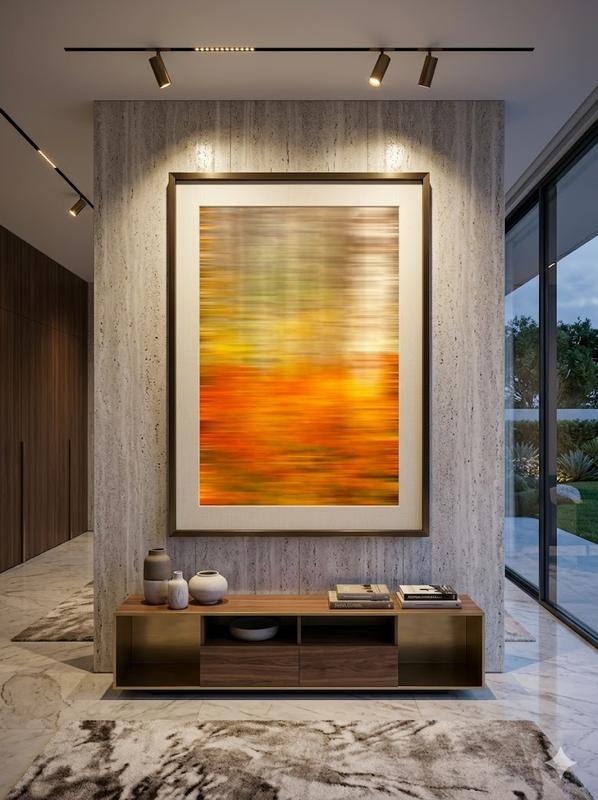
Walk down any block in San Francisco. Look through the glass doors of the apartment buildings as you pass. In lobby after lobby, you will see the same thing: a large canvas, usually somewhere between four and six feet wide, abstract, colorful, saying nothing in particular to no one in particular. In the hotel corridors. In the corporate reception areas. In the interior design magazines, page after page, room after room. Abstract art everywhere you look, used the same way — to fill a wall, match a sofa, and avoid making any statement that anyone could disagree with.
Now open your phone and ask an AI image generator for "abstract art, warm tones, large format." Thirty seconds later you have something that looks identical to what's hanging in every one of those lobbies.
This is the situation abstract art finds itself in today. Not destroyed. Not irrelevant. But desensitized, overextended, and caught in a loop that would have been unthinkable to the people who invented it. Abstract art began as the most radical disruption in the history of Western painting. It ended up at Target for $35.
Is abstract art overrated?
Serious abstract art — work by painters like Gerhard Richter, Julie Mehretu, and Mark Bradford that involves genuine physical rigor, traceable intent, and substantive process — is not overrated. But the broader abstract art trend has been extended well beyond its meaningful applications. When abstract art is used primarily as generic decoration in hotel lobbies and corporate spaces, produced with minimal intent and chosen because it offends no one, it has ceased to function as art and become expensive wallpaper. The criticism is not of abstraction itself but of its deployment as the path of least resistance.
Why is abstract art used so much in hotel lobbies and commercial spaces?
Abstract art dominates commercial spaces because it is politically, emotionally, and aesthetically neutral. It carries no specific narrative, demographic, or cultural weight that might alienate any tenant or visitor. Developers and property managers choose it as a risk-free solution to filling wall space. The irony is that in avoiding anything that could be criticized, they also avoid anything that could be meaningful. A fine art photograph of a local landmark would give the space genuine identity and character. The generic abstract canvas gives it nothing but covered drywall.
Can AI replace abstract art?
AI can replicate the visual surface of decorative abstract art almost perfectly, and this is the existential crisis currently facing the market. However, AI cannot replicate genuine human intent, lived experience, or the physical evidence of craft. The art that survives the AI disruption will be the work that makes its human origin demonstrable — through physical process, through specific traceable intent, or through the kind of grounded human experience that no algorithm can access. Abstract art without intent is already being replaced by AI. Abstract art with genuine substance is not.
What is abstract photography?
Abstract photography strips away recognizable real-world subjects to focus on pure visual elements — color, line, shape, texture, pattern, light, and geometry — using the camera rather than paint. Unlike canvas-based abstraction, abstract photography is grounded in the physical world: it finds abstraction in the patterns and structures of real surfaces, real light, and real natural forms. This grounding in reality gives abstract photography an anchor that pure paint-based abstraction often lacks — the knowledge that what you are seeing was actually there.
Is fine art landscape photography replacing abstract art?
Not replacing, but correcting. The current cultural shift away from surface decoration and toward art grounded in reality, physical craft, and human presence creates conditions where fine art landscape photography — images made by a human being at a specific place and time that actually existed — has a natural advantage over generated or intent-free abstraction. The full historical loop: the camera disrupted classical painting and pushed the art world toward abstraction; AI is now disrupting abstract decoration and pushing the market back toward work with verifiable human presence and real-world grounding.
This article is not a dismissal of abstract art. Some of the most powerful work being made right now is abstract. But the trend itself has a problem, and understanding that problem requires understanding where abstract art came from, what it was actually trying to do, and what happens when a revolutionary idea becomes the path of least resistance.

What Is Abstract Art? Definition, History, and How It Became the Dominant Art Form of the 20th Century
Abstract art, at its simplest, is art that does not attempt to represent the visible world accurately. Instead of painting a face, a landscape, or a historical scene, abstract art uses shapes, colors, forms, and marks to achieve an emotional or psychological effect directly — without the intermediary of a recognizable subject. Where traditional painting is a window into a specific reality, abstract art turns rather inward, using pure visual elements to communicate something that bypasses the need to depict anything.
The roots of this go back further than most people realize. For centuries, classical fine art operated on a single fundamental premise: the highest purpose of visual art was the accurate, idealized representation of the visible world. The human figure, the landscape, the historical event — all of it rendered with the maximum technical precision the artist could achieve. The camera's arrival in 1839 did not end that tradition, but it did remove its primary justification. The main question that arose was, if a machine could record visual reality more accurately than any painter, then what was the purpose of painting?
The answer that emerged over the following decades was the entire history of modern art. Post-Impressionism showed that the emotional experience of seeing — not the factual record of what was seen — was painting's real territory. Fauvism abandoned naturalistic color entirely. Cubism fragmented reality into multiple simultaneous perspectives on a flat surface. And then, in the early 1910s, Wassily Kandinsky painted what are now considered the first purely non-representational works — no figure, no landscape, no object. Only color, form, and line, organized according to their own internal logic.
The revolution accelerated. Kazimir Malevich reduced a painting to a black square on a white ground in 1915. At the time, it was the most radical reductionist statement in the history of art. Piet Mondrian built an entire aesthetic system from grids and primary colors.
Then, after World War II, the center of the art world shifted from Paris to New York, and Abstract Expressionism arrived with the full force of a generation that had lived through the most catastrophic conflict in human history and found that traditional painting could not hold the weight of what they needed to express.
Jackson Pollock poured and dripped paint across canvases laid on the floor, turning the physical act of painting into a kind of performance. Mark Rothko filled enormous canvases with soft rectangles of glowing color specifically calibrated to induce basic human emotions — grief, awe, tranquility — in viewers standing before them. People famously wept in front of Rothko paintings, only because of how the raw psychological weight of color and scale affected the nervous system directly.
It was a breakthrough, it was new. It became the most serious art the twentieth century produced, and it earned every bit of its revolutionary status.
Is Abstract Art Overrated? The Case for Skepticism — and Why It Has a Point
The "my kid could do that" is the most famous criticism of abstract art. It is usually said by an unsophisticated viewer who doesn't understand what they're looking at. But there is also a version of the criticism that isn't naive — it is quite accurate, and it deserves to be discussed to say the least.
In traditional art, there are external benchmarks. A painted face is either a convincing likeness or it isn't. A landscape either captures the quality of specific light at a specific moment or it doesn't. A sculptor either understands human anatomy or the figure will look a little bit off. These are not infallible measures of artistic quality — technical skill and artistic vision work in tandem but they are not the same thing. They allow the viewer to engage with the work on its own terms and make their own personal judgment.
"When abstract art is used to fill a wall, match a sofa, and avoid making any statement that anyone could disagree with — it has ceased to function as art."
In abstract art, when realistic subjects were removed, it also removed those external benchmarks. There is no way to know if the artwork was painted "correctly," because there are no rules for it. Abstract art can be associated with total freedom of expression. You can paint within the lines, outside the lines, or you can only paint in circles if your heart desires so. For the lack of the better word it is synonymous with anarchy where anything goes and no one knows how to really regulate or measure it.
Hence, it created an environment where painters produced work of questionable substance, yet collectors, designers, and institutions readily bought and accepted it, because the alternative was admitting they couldn't tell the difference between a serious work and some decorative wallpaper piece.
When an interior designer chooses a ten-foot canvas of neutral tones and vague shapes for a building lobby not because it has substance, but only because it's an easy choice and it fills the empty wall space without offending anyone — it's no longer art, it becomes an accessory to the whole interior or an expensive type of wallpaper.
The "open to interpretation" defense that abstract artists used, which originally served as a great philosophical position, shifted the burden of finding meaning of abstract art from the artist to the viewer. Which later evolved into a commercial convenience. Where an artist would sell a piece of art that he slapped some strips of paint straight out of a can a few hours earlier, named it something, and sold it to a buyer who now has to figure out the meaning of it.
This got to a point where a duct tape banana was sold for $6 million or an empty space with "invisible statue" sold for $18,000. It started pushing the boundaries of common sense mixed with insanity.
That's what I saw walking past the apartment buildings in San Francisco. Seeing similar abstract paintings in several lobbies as I was strolling by them, I realized there was something strange about it and it wasn't a sign that abstract art has triumphed. It was more of a sign that abstract art had been reduced to a safe choice in terms of risk management. It was chosen because it is easy to pick, it is politically neutral, emotionally inert, and unlikely to alienate a single tenant. I realized it had become a department store commodity.
In Defense of Abstract Art — Why the Serious Work Still Matters
Not all abstract art is the same. Many famous abstract painters who create with genuine passion, calculated intent, emotional vigor, and purpose behind the art should get all the recognition they truly deserve.
Gerhard Richter layers thick oil paint on enormous canvases and drags massive hand-held squeegees across the wet surface in a process that is simultaneously controlled and contingent — a physical study in friction, paint viscosity, and the balance between human intention and material chance. The process is exhausting, unpredictable, and impossible to fake. The resulting paintings carry the literal record of what happened when those specific physical forces met on that specific surface on that specific day.
Julie Mehretu builds massive multi-layered architectural abstractions over months — detailed structural lines and sweeping gestural marks, then hand-sanded back before the next layer is added. The physical labor embedded in the surface is immense. Each layer records decisions made and then partially erased. The paintings are not just compositions. They are time made visible.
Mark Bradford collects physical paper from city streets — billboard remnants, flyers, commercial packaging — layers dozens of sheets onto canvas, then uses industrial hand sanders and power tools to carve back through the paper. The abstract textures that emerge carry the literal material history of the urban environment Bradford documents. The work is abstract in appearance. Yet it is grounded in real life things at every stage of its making.
Jadé Fadojutimi and Stanley Whitney — among the strongest voices in current abstract painting — work with the kind of physical directness and psychological intensity that make the "my kid could do this" objection irrelevant. Standing in front of their work, you understand immediately that a human being spent an enormous amount of effort and intention producing it.
This is the type of abstract art that deserves its status.
The Abstract Artist's Statement — Why Intent and Story Behind The Art Matters
There is a conversation that happens in the abstract art world about whether artists should explain their work or let viewers interpret it themselves. The "open container" school — which is dominant in classic Abstract Expressionism — holds that the moment an artist explains what a painting means, they have constrained the viewer's experience and undermined the fundamental premise of the artform. Jackson Pollock stopped titling his paintings descriptively and switched to numbers specifically to prevent viewers from looking for a hidden subject.
There is some validity to this position. But in practice, the "let the viewer decide" approach has become a convenient escape for artists who had no real intentions with their art to begin with. If your work carries no specific vision, no particular drive, no traceable feeling that drove its creation, then the "open to interpretation" approach might lose its value proposition. If you just splashed some paint on canvas because you needed extra cash this weekend to pay rent, and the person bought it to slap it on an empty wall in a lobby where everyone walks by without noticing — is it really art or just a mass-machine produced wall filler you can pick up at a department store for $35?
Consider two scenarios. In the first, an artist paints an abstract canvas that looks like a bunch of random colors. But the artist's description tells the story of a beach his parents used to take him to in childhood — it's not a photograph, nor a realistic painting, but more like an emotional remains of distant memories: the yellow of the afternoon light, the blue of the sky and the ocean water, the flat pale expanse of the long strip of sand where he built sandcastles. Without the description they're just random shapes. With the story it transforms into a medium. Now the viewer has a chance to make a deeper emotional connection with it.
In the second scenario, an artist paints a large canvas of vaguely warm tones and loosely brushed shapes, displays it in a gallery with a title like "Untitled No. 4," and, when asked what it means, says that meaning is for the viewer to discover. There was no real emotion, reasoning, or purpose behind it. It's like playing hot potato — the real premise behind most of the commercialized abstract art today. Just let the viewer decide what the meaning of it is. Let them figure it out on their own and if they don't, so be it. Who cares, it will be used as wall filler anyway.
That's why I think the story really matters. The story conveys the intent, the story is the substance. Especially in abstract art, where sometimes all there is but a splash of paint scattered randomly over the canvas.
AI and the Abstract Art Crisis — When the Machine Does It in Four Seconds
Abstract art's specific vulnerability to AI is not an accident. It came as a consequence of the artform's own evolution.
As abstract art stripped away the real subject matter in paintings or removed external benchmarks of what a "proper" artwork should look like, it had to rely on external validation, marketing, and being in "certain high net worth circles" framing to create its value. Those are all forms of context rather than content. When AI arrived on the scene, with its ability to generate images in seconds, the true essence of abstract art became exposed and obvious.
If there is no real substance in the artist's work and the only thing that can make it valuable is external validation — and if that external validation is not rooted in the artist's past via a compelling story — then what is the difference between the artwork she created or whether it was done in seconds using generative AI?
Type "large abstract canvas warm tones, contemporary art" into Midjourney. What comes back looks like what's hanging in every lobby described at the top of this article. Not because Midjourney is making great art. Because a significant portion of what was hanging in those lobbies was never great art to begin with. And how would you even tell the difference of who actually made it? If it lacks a compelling story behind it, how do you know the image wasn't made with AI and printed from it?
Role Of Technology In Arts and How AI Is Bringing Art Back to Reality
The historical loop being described here is not a coincidence. It follows the same path that played out when photography arrived in 1839 as part of newly invented technology (Click to read full blog post on evolution of fine art photography on Jongas art blog).
Before the camera, a painter's job was to record visible reality as accurately as possible. Which was strictly policed by the French Académie des Beaux-Arts (Academy of Fine Arts) where they literally held the keys to the Paris Salon — a gallery, the only place at the time, for any artist to get established or get any kind of recognition. The requirements painters had to follow were very rigid and artworks had to be produced based on very specific rules to even get a chance for any type of official recognition by THE academy.
Then to everyone's surprise, a photo camera could do an exact representation of the same world a lot faster, cheaper, and more accurately. Therefore, freed from the obligation to document, painting was forced to shift into the territory only a human mind could inhabit — into emotion, abstraction, and the inner experience of subjective imagination. Rather than the factual record of reality that can be seen. As a result the classical fine arts world freaked. They thought the world had come to an end and technology would soon take over. Sound familiar?
That is how the technology (invention of the camera) disrupted classical fine arts and pushed the entire art world toward conceptualism and abstraction — or what's better known as "Modern Art."
Today's generative AI has arrived just as suddenly and is doing something very similar. It can produce abstract or any other types of images faster, cheaper, in unlimited variations and quite realistic ones. No human can compete with that.
Just like the camera pushed painting away from depicting reality as it is and pushed it toward subjective expression, AI is pushing the art world away from being vain, superficial, and borderline soulless, as the art that can be "mass produced" by printers. A lot of these canvas prints ARE mass produced by massive print houses that sell them through online art marketplaces like MyGreatCanvas, Big Great Canvas, and others, as we discussed in iCanvas Art blog post.
You also see AI skepticism every day on the internet. When I post my photos on social media, nearly every time now it gets a comment or two asking if the image was AI generated. It almost hurts your feelings. And if you don't know any better, it probably does.
As a result, AI skepticism now compels artists to create art of actual substance that machines cannot generate — art made with authentic human presence, physical tools, real materials and evidence of their craft, and work grounded in specific, verifiable, real-world experience (like showing RAW files for photographers), just so they can confidently say: No, my art is NOT AI generated.
You also see some measures being implemented by social media websites where AI generated content now is being marked as such. While the measure is currently optional, I suspect in the future it will become mandatory, to prevent impersonation and plagiarism among other things. Because truth is, it's becoming difficult to tell which videos are real and which are AI generated. AI is becoming way too realistic.
How Fine Art Landscape and Nature Photography Becomes The Driving Force For All Of It
This is where fine art photography enters the story. Not as a competitor to painting, but as one of the mediums best positioned to offer what the current transitional art era demands.
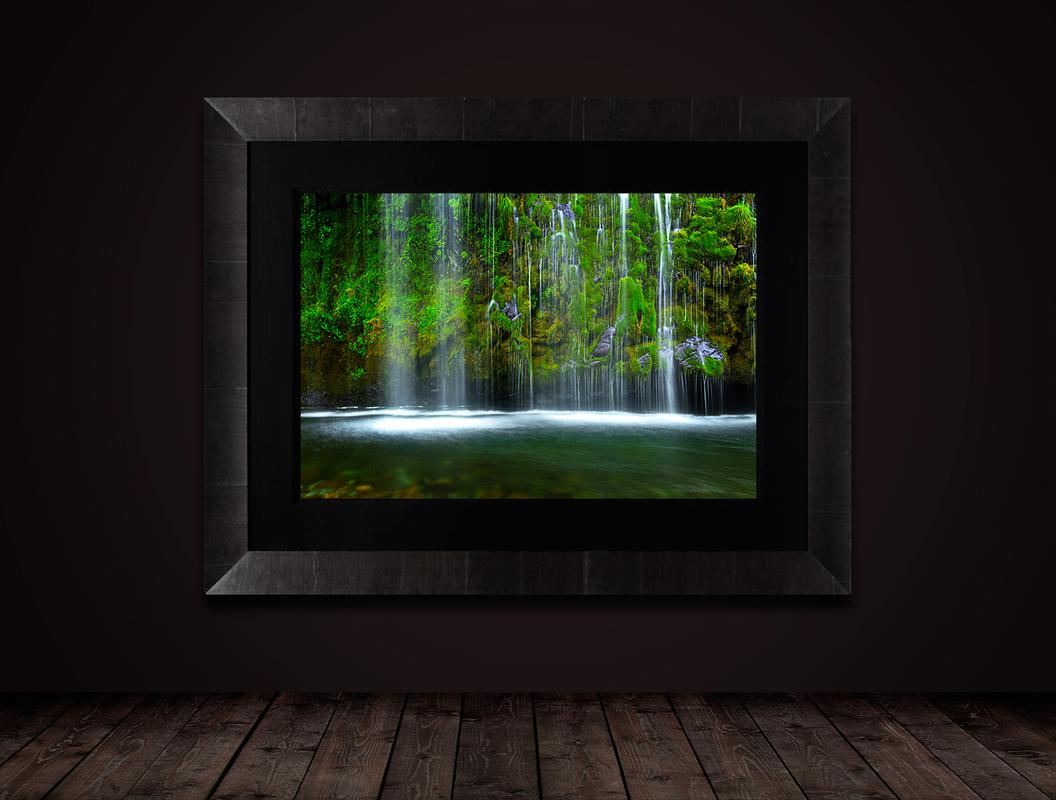
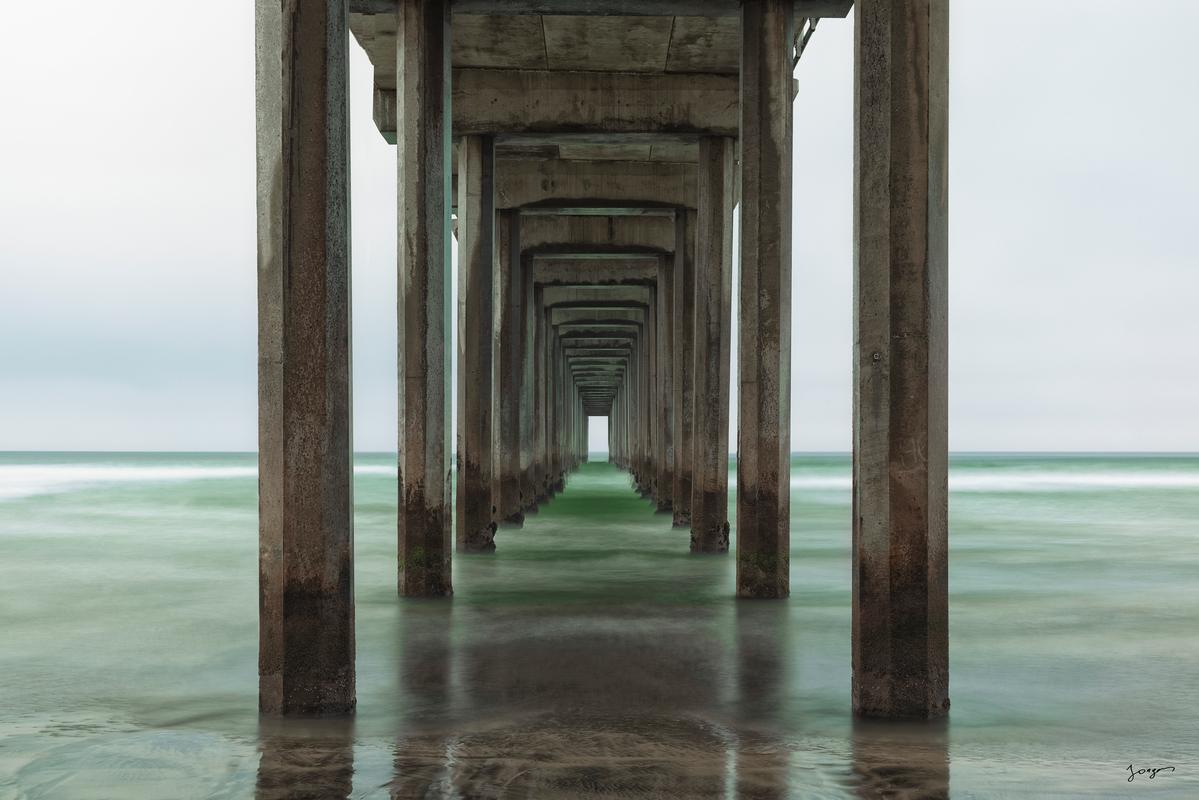
Any modern fine art photography begins with a human being driving for hours to a specific location, standing at a specific place, at a specific time, shivering in 30-degree temps, under specific light that exists this way only in that moment. There is an enormous amount of effort involved in it and there is never a guarantee you will get a good capture. Some days the light is plain or there is rain and you get back home without any "art worthy" photos. It happened to me countless times with gallons of gas, sleepless nights, hours or sometimes even days "wasted."
Fine art landscape photography also carries the same relationship to the natural world that the great Hudson River School painters had before the camera was invented — it's a simple representation of the natural beauty of the natural world, but captured in the best light, the best composition, and best color possible. Landscape photographers even have schedules for that. In fall you go to shoot yellow aspens in the Pacific Northwest and Colorado. In winter you shoot in Death Valley and desert scenes, et cetera. We chase weather, seasons, and the best views to produce the most amazing natural world prints possible. It's not a small feat to be honest; the dedication to it is pretty real — comparable to Michelangelo doing a painting over a three-year period.
Why Fine Art Photography Prints Stand Apart
- Modern and luxury looking: Clean, contemporary aesthetic that suits any premium interior.
- Super detailed and exact: Captures precise light, color, and texture at the moment of capture.
- Best color vibrancy and contrast: Archival inks and professional printing surfaces yield exceptional results.
- Best longevity with very little care: UV protection ensures prints last generations without fading.
- Multiple print surfaces: Available on canvas, acrylic, metal, and more to suit any space.
- Fits any interior design: Makes any room look alive and refreshing regardless of style.
- Can be reprinted: In case of fire or damage, the original digital file is preserved.
- Depicts the real world: Authentic locations, real light — not generated or invented.
If this is not compelling, then I don't know what is. Besides, how many red circles and blue random lines can you be looking at? Doesn't that get tiring at some point?
Abstract Photography Prints As Large Wall Art
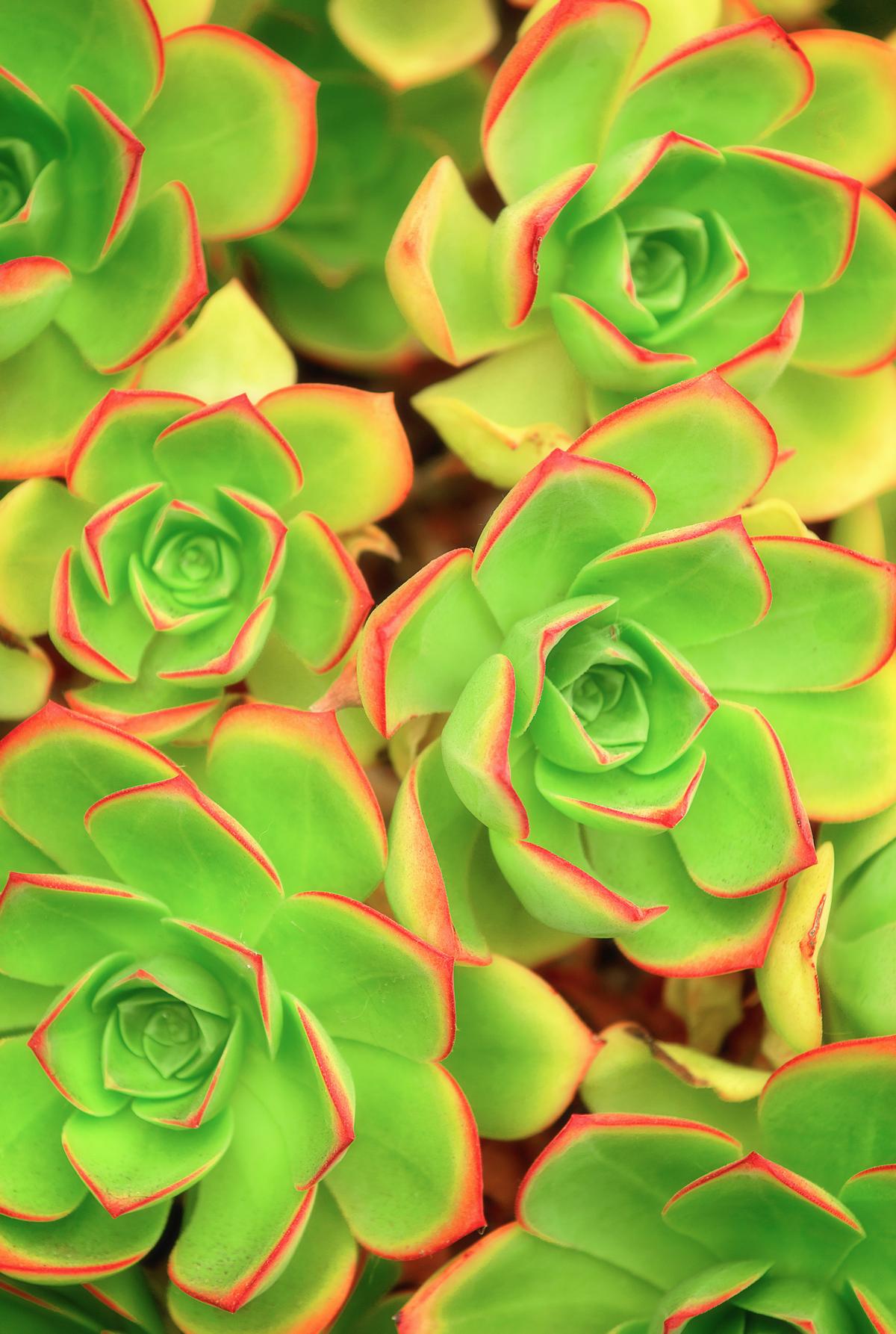
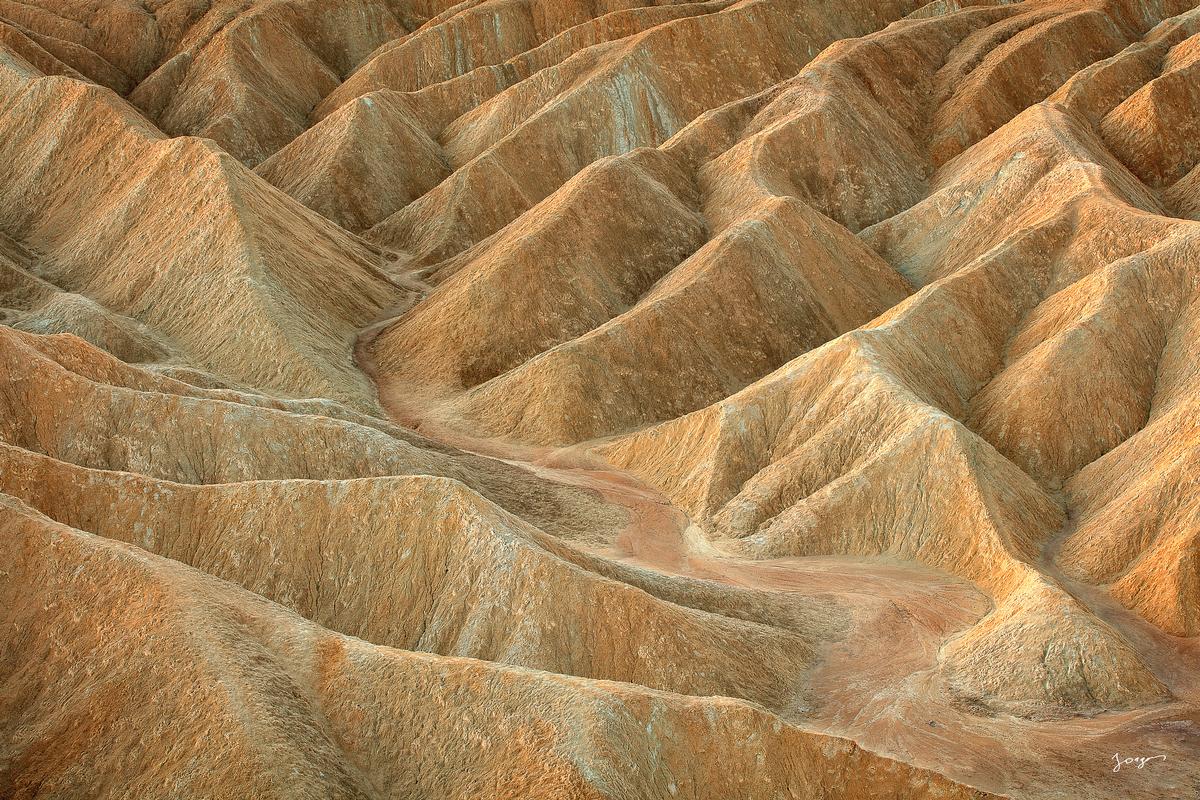
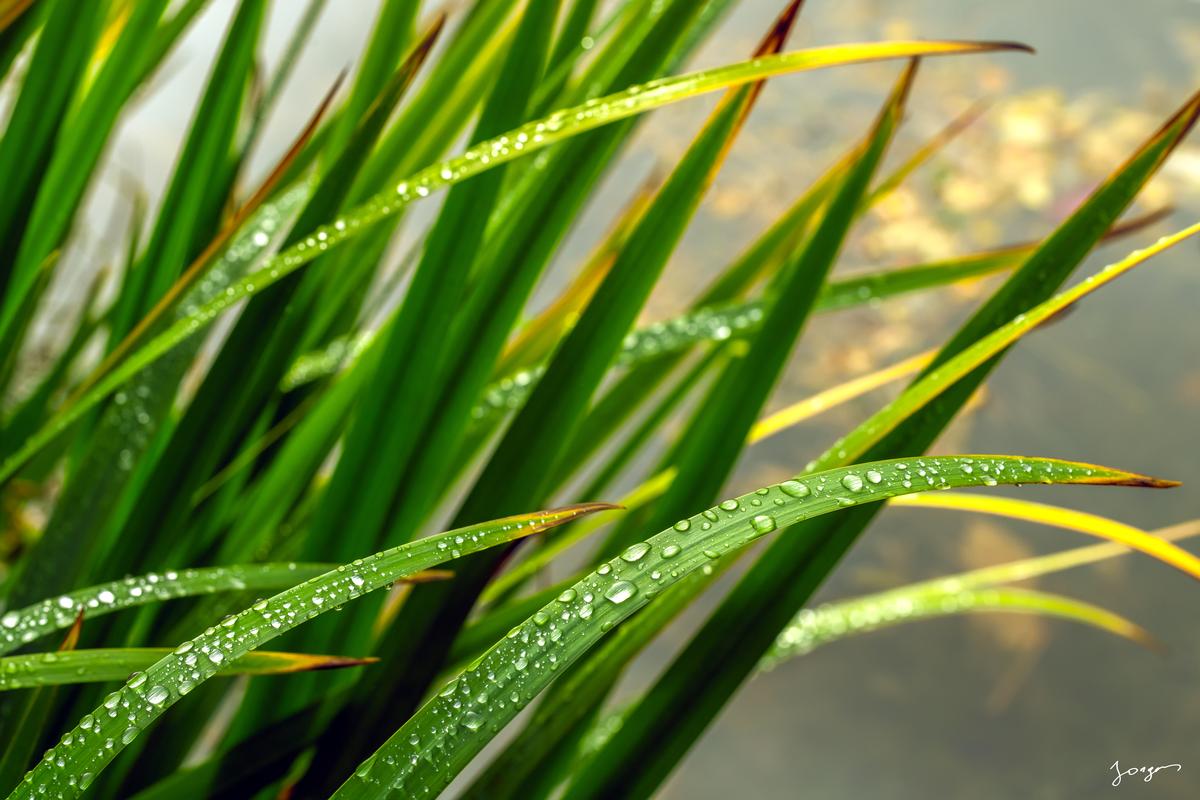
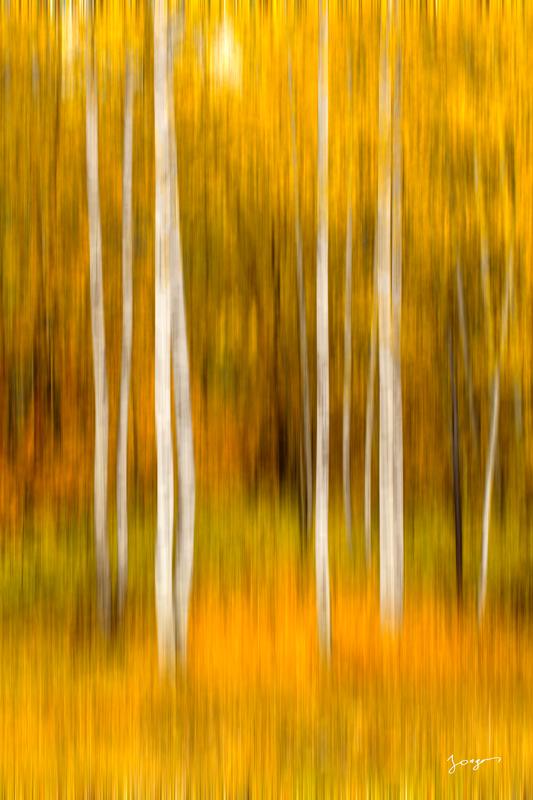
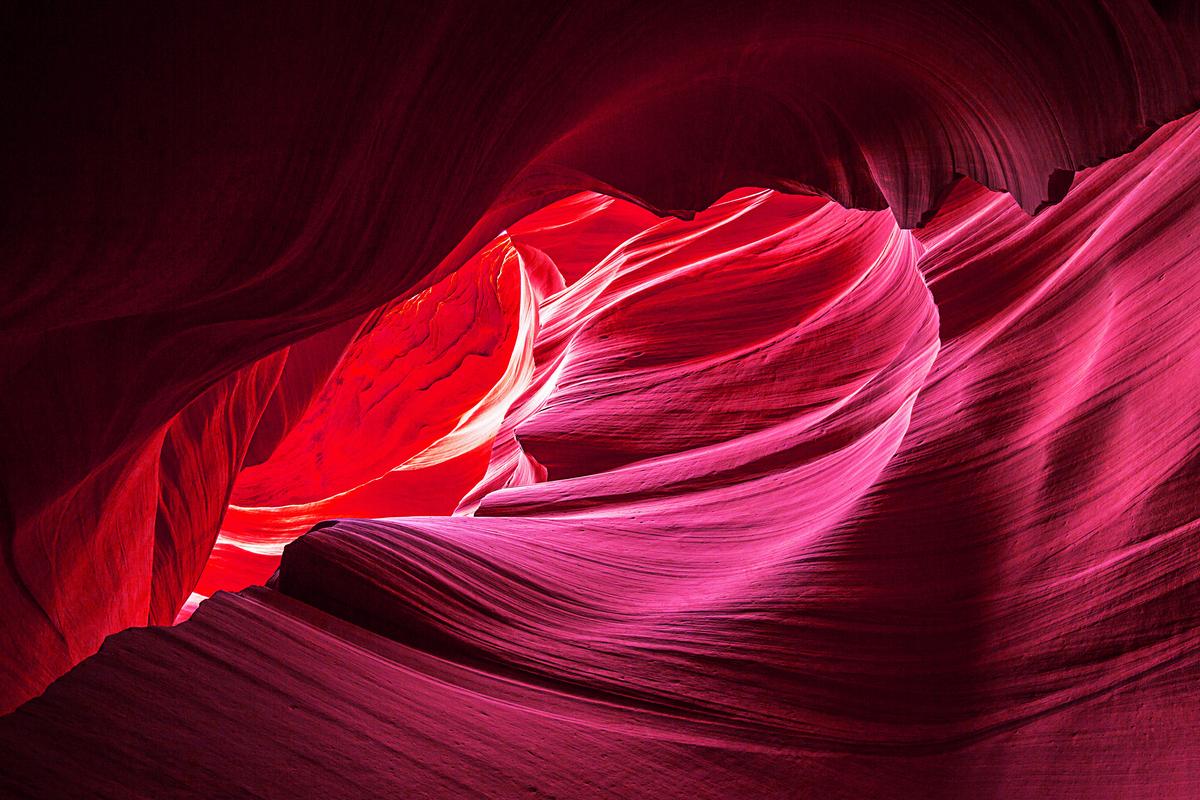
Since we're speaking about abstract art, abstract photography has to be mentioned. It is an artform of recognizing patterns in the real world and capturing photos of them creatively. The patterns in nature show up in many different ways, from cracked ground on the desert floor, to plant leaves or flower petals, to reflections on water, or rock formation patterns from above. Nature is really the best artist. We all are just following what it does.
Abstract photography prints are very popular and are part of the body of work of pretty much any modern fine art photographer. It's a category of photography in itself and has become really desirable among many collectors, who also value abstracts that are formed naturally.
Hence the full circle closes here. Classical fine arts were disrupted by the camera that drove art into conceptual art and abstraction. Abstract art was extended to the point of turning into a commodity and is now being exposed by AI. No matter the era, some things will never change. Technology will always advance and it will disrupt the status quo. People will adapt. AI is just a tool, like a camera, like a brush, like a computer. One thing that will never get replaced is human creativity and the ability to adapt. Humans will always prevail. Humans will always have the power to create. I don't know a lot of answers, but I know these last things mentioned will always be the same.
This is what you get when buying your art from Jongas Fine Art Photography. With the exception of a couple of works, all my art is real, authentic, and portrays real, most captivating earth's landscape locations. Feel free to explore my art collections and contact me any time at 702-781-7871 if you have any questions about any of the artworks. My art is produced as museum grade acrylic mounted using the latest greatest technology possible. The quality of my prints is the best possible. All art is available in Italian Roma Frames. All art is delivered free within the US.
Related Reading:
→ Famous Abstract Art — What It Is, Where It Came From, and Why It Still Hits
→ Classical Fine Art — History, Movements & Photography's Disruption
→ The Evolution of Fine Art Photography — From the First Camera to AI
→ AI and the Art World — Revolution, Controversy & Where Photography Stands
→ What Is Traditional Art? Definition, Examples & 18 Artists
→ What Is Landscape Photography? Definition, History & Fine Art
→ Modern Fine Art Photography Prints — Is It a Good Investment?
Jongas Fine Art Photography produces limited edition TruLife acrylic-mounted fine art prints by Eddie Jongas, available exclusively through jongasfineartphotography.com, with free shipping to all 50 states.