Louis Daguerre — The Showman Who Gave Photography to the World
And there is no negative. That is the single most important fact about a daguerreotype. What came out of the camera was the photograph, and the only one. If you wanted two portraits, you sat twice.
By Eddie Jongas · Jongas Fine Art Photography · History of Photography
On the morning of March 8, 1839, Louis Daguerre walked across Paris to visit an American painter named Samuel Morse. Morse wanted to show off his new electric telegraph. Daguerre had his own secret to share — a process that could freeze an image of the world onto a silver plate. While the two men compared inventions, Daguerre’s Diorama theater caught fire and burned to the ground. His laboratory, his notes, and most of his early experimental plates went with it.
Five months later, the French government announced that the invention Daguerre had nearly lost that morning — the daguerreotype — was a free gift to the whole world. Within a decade there were daguerreotype studios from Boston to the California gold fields. Within two centuries, a single plate made by one of his followers would sell for more than $900,000.
Most people know Daguerre as the name on the first practical photograph. Fewer know he was a theater set painter, a showman, a shrewd businessman, and a man who quietly kept one country out of his “free gift.” This is the full story of the man who taught light to hold still.
Louis Daguerre Before Photography — The Painter of Illusions
Daguerre was born on November 18, 1787, in Cormeilles-en-Parisis, a small town northwest of Paris. He had little formal schooling, but he could draw. As a teenager he was apprenticed to an architect, and then he found his real calling in the theater. He trained under the stage designer Ignace Degotti at the Paris Opéra and later worked with the panorama painter Pierre Prévost, painting giant wraparound scenes that made audiences feel they were standing somewhere else.
That was the thread running through Daguerre’s whole life: he was obsessed with making people believe what they were seeing. By his early thirties he was one of the most admired scene painters in Paris, known especially for the way he handled light on stage.
In 1822 he opened something new with the painter Charles Marie Bouton — the Diorama. Audiences sat in a darkened room facing enormous paintings on translucent fabric. By shifting light from the front to the back of the canvas, and filtering it through colored screens and shutters, Daguerre could make a scene change before their eyes. A sunny valley became a stormy night. A quiet chapel filled with candlelight. People swore they saw movement where there was none.
The Diorama was a hit. A second one opened in London’s Regent’s Park the following year. It made Daguerre famous and, for a time, comfortable. It also made him a master of the one thing photography would need most: an intimate, practical understanding of how light behaves.
Painters of the era routinely used a camera obscura — a box with a lens that projects an image onto a sheet of glass — to sketch scenes accurately. Daguerre used one constantly while planning his Diorama paintings. Like many people before him, he looked at that glowing projected image and asked the obvious question. Why does it have to disappear the moment you close the box?
Daguerre and Niépce — A Partnership by Letter
Someone else had already started answering that question. In the countryside of Burgundy, an inventor named Joseph Nicéphore Niépce had spent years coating plates with light-sensitive materials and leaving them in a camera for hours at a time. Around 1826 he succeeded in recording the view from an upstairs window of his estate at Le Gras onto a pewter plate. That rooftop scene is the oldest surviving photograph made in a camera. I wrote about it, and the people who followed, in my overview of the early photography pioneers.
 Buy This Print by Eddie Jongas · Limited Edition
Niépce’s method worked, but barely. Exposures took many hours, sometimes days, and the results were faint. Daguerre heard about his experiments through an optician they both bought lenses from, and he wrote to Niépce. The older man was suspicious at first — Daguerre had a reputation as a showman, and Niépce worried about being used. Eventually the two men signed a formal partnership in December 1829 to develop a practical way of fixing images made by light.
It was an unusual collaboration. Niépce had the chemistry and years of trial and error. Daguerre had theatrical instincts, optical knowledge, and commercial ambition. They lived far apart, met rarely, and wrote to each other in a private code so no one could steal their progress. Then, in July 1833, Niépce died suddenly of a stroke. The partnership passed to his son, Isidore, and the real work of finishing the invention fell to Daguerre.
The Latent Image — The Discovery That Made the Daguerreotype Possible
Daguerre’s breakthrough came around 1835, and it rested on an idea that sounds almost like magic. He found that a silver plate sensitized with iodine fumes did not need to be exposed until an image appeared. A much shorter exposure left an invisible picture — what photographers now call a latent image — hidden in the silver. It only needed to be brought out.
The tool that brought it out was mercury vapor. Heated mercury fumes clung to the parts of the plate that had been struck by light and formed a bright, fine-grained surface. The dark parts stayed as bare, polished silver. Suddenly exposures dropped from many hours to minutes.
The popular legend says Daguerre discovered this by accident. As the story goes, he put an underexposed plate away in a cabinet full of chemicals, came back the next morning, and found a perfect picture waiting for him. He removed the chemicals one by one until only a dish of spilled mercury remained. Historians treat the tale with caution — it is the kind of embellished story inventors like to tell — but it captures something true about how much of early photography was discovered by literally fumbling in the dark.
By 1837 Daguerre had also learned to stop the image from darkening further by washing the plate in a strong salt solution. That year he made a still life of plaster casts, a framed picture, and a wicker-covered bottle arranged in a corner of his studio. It is generally considered the earliest reliably dated daguerreotype to survive, and it is the work of a man who had spent thirty years arranging objects under stage lights.
He named the process after himself. Isidore Niépce agreed to a revised contract that did exactly that. It was not a modest choice, but Daguerre had never been a modest man.
Who was Louis Daguerre?
Louis-Jacques-Mandé Daguerre (1787–1851) was a French painter, stage designer, and inventor. He created the Diorama, a popular Paris light show, and later invented the daguerreotype, the first photographic process released to the public, announced in 1839.
Did Louis Daguerre invent photography?
Not alone. Joseph Nicéphore Niépce made the earliest surviving camera photograph around 1826, and Daguerre partnered with him in 1829. Daguerre perfected the process after Niépce died, and William Henry Fox Talbot and Hippolyte Bayard developed their own processes at nearly the same time.
What is a daguerreotype?
A daguerreotype is a one-of-a-kind photograph made directly on a highly polished, silver-plated copper sheet. There is no negative, so each plate is unique and cannot be copied the way a film print can.
How much is a daguerreotype worth?
Most ordinary portraits of unknown sitters sell for modest sums. Rare plates are another story: Girault de Prangey’s Temple of Jupiter, Athens sold at Christie’s London in 2003 for about $922,000, still the highest price for a daguerreotype at auction.
Can you still make a daguerreotype today?
Yes. A small community of alternative-process photographers still makes daguerreotypes by hand, using silver-plated copper plates and large-format cameras. The traditional process uses toxic chemicals, so it is done with serious ventilation and safety equipment.
How a Daguerreotype Is Made — Silver, Iodine, and Mercury
The process Daguerre finally revealed was demanding and dangerous, and it has changed very little since. A sheet of copper was plated with a thin layer of pure silver and buffed until it shone like a black mirror. Any scratch on that surface would show up in the final image.
In darkness, the plate was placed face-down over a box of iodine crystals. The fumes turned the silver a golden color as a light-sensitive layer of silver iodide formed. Photographers soon added a second vapor, usually bromine or chlorine, to make plates far more sensitive. The plate then went into a wooden camera, the lens cap came off, and the photographer counted the seconds or minutes.
Back in the dark, the plate was held over a dish of mercury heated by a small spirit lamp. The image slowly rose out of the silver. The plate was then washed to remove the unexposed material, and in later years it was often toned with a warm gold solution that deepened the contrast and toughened the surface. Finally it was sealed under glass in a small hinged case, because a single fingertip could wipe the image away.
The result was unlike anything before it. A good daguerreotype has detail so fine you can study it with a magnifying glass and keep finding more. It also behaves strangely. Because the image sits on a mirror, it flips between negative and positive depending on how you hold it. You have to tilt it against a dark surface to see it properly. Every plate is also reversed left to right, like a reflection, unless the camera used a mirror or prism to correct it.
 Buy This Print by Eddie Jongas · Limited Edition
Boulevard du Temple — The First Photograph of a Human Being
Daguerre’s most famous plate looks, at first, like an empty street. Sometime in 1838 he pointed his camera out of a window of his Diorama building, looking down the Boulevard du Temple, one of the busiest avenues in Paris. The exposure lasted several minutes. Every carriage and every walking pedestrian moved too fast to register, so the boulevard appears deserted.
Except for one corner. Down on the sidewalk, a man stood still long enough to have his boots shined. He and the bootblack working at his feet are the earliest known people ever recorded in a photograph. Neither of them had any idea. They are anonymous forever, and they are also the first human beings in the history of the medium.
That plate was part of a set of three that Daguerre presented to King Ludwig I of Bavaria, mounted together as a triptych — a morning view of the boulevard, a midday view, and a still life of plaster casts between them. Their later history is a hard lesson in how fragile these objects are. During World War II the plates were kept in poor conditions. In 1970 they were loaned to the Munich city museum, and a restoration attempt went disastrously wrong. Today the originals, held by the Bavarian National Museum, are badly damaged, and the images you see in books and online come from earlier reproductions.
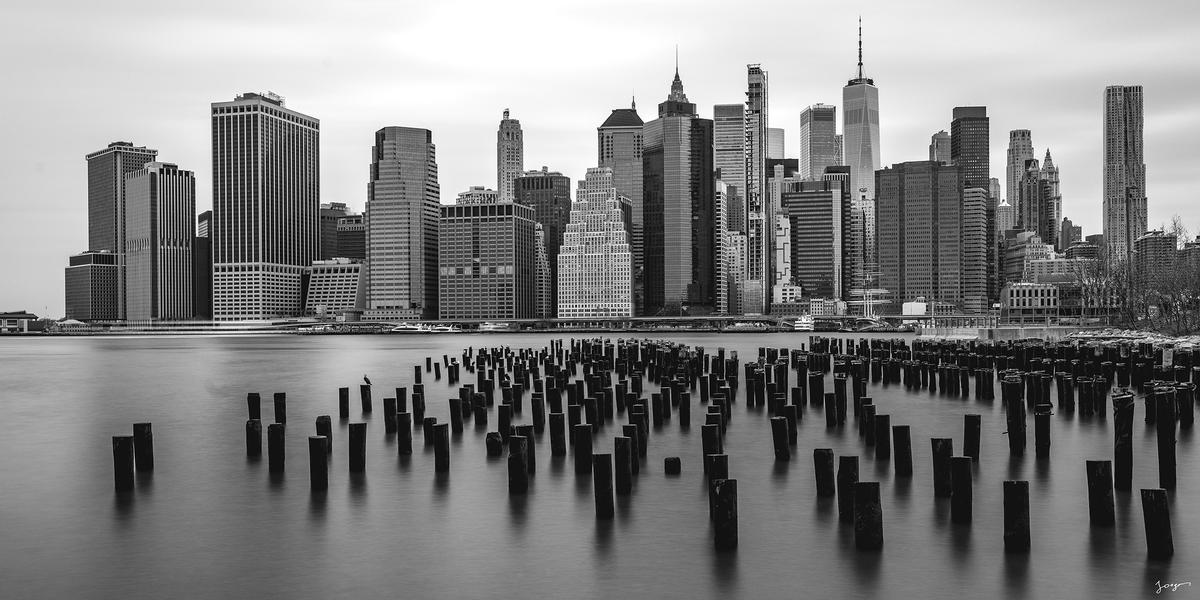
I think about that plate every time I photograph a city. I spend a lot of time trying to make busy places feel still — long exposures that smear traffic into light and empty a street of its noise. Daguerre got there first, by accident, because his process was too slow to see anyone in a hurry. You can see where that instinct has taken me in my city photography collection.
1839 — The Year Photography Went Public
By 1838 Daguerre was ready to sell. He first tried to raise money from private investors through a subscription, but almost no one signed up. People did not want to pay for a secret they could not see. So he turned to a powerful ally: François Arago, a celebrated astronomer, member of the French legislature, and permanent secretary of the French Academy of Sciences.
On January 7, 1839, Arago announced the invention to the Academy without revealing how it worked. The news crossed Europe within weeks. Over the summer, Arago persuaded the government to buy the rights. Daguerre received a lifetime pension of 6,000 francs a year, and Isidore Niépce received 4,000 francs.
On August 19, 1839, at a joint session of the Academy of Sciences and the Academy of Fine Arts, Arago explained the full process step by step. The crowd spilled out into the courtyard. Within days, opticians’ shops in Paris were mobbed. People called it “daguerreotypomania.” August 19 is still celebrated today as World Photography Day.
Business had been arranged in advance. Daguerre’s brother-in-law, Alphonse Giroux, sold the official apparatus: a wooden sliding-box camera with a lens by the optician Charles Chevalier, plus the boxes for iodine and mercury, the plates, the chemicals, and a manual. Each authentic outfit carried a label with Daguerre’s signature and Giroux’s seal. Another Paris firm, Susse Frères, also built licensed cameras. The Giroux outfit is generally credited as the first commercially produced camera in the world.
Those cameras are now among the most valuable objects in photography. In 2007 the WestLicht auction house in Vienna sold a Susse Frères camera for 576,000 euros. In 2010 it sold a signed Giroux camera, found in an attic, for 732,000 euros — nearly $900,000. Its matching mercury box sold separately for another 144,600 euros.
The “Free Gift” With One Exception
Here is the part of the story that rarely makes it onto the plaques. France presented the daguerreotype as a gift “free to the world.” But a few days before the August announcement, Daguerre’s agent quietly filed a patent for the process in England. As a result, England became the one place where you needed a license to make a daguerreotype.
 Buy This Print by Eddie Jongas · Limited Edition
Some see it as national rivalry. Others see a businessman who interpreted “the world” as narrowly as he could get away with. Either way, it slowed photography down in Britain, and it hit William Henry Fox Talbot, who had been developing his own paper process in England, especially hard. Talbot’s story, and that of his wife Constance, is in my article on Constance Fox Talbot and the race to invent photography.
The English rights were eventually bought by a coal merchant and businessman named Richard Beard, who opened some of London’s first portrait studios and licensed the process to others. Remember that name. It comes back later in this story with a very large price tag attached.
Hippolyte Bayard — The Man Who Was Asked to Wait
Daguerre was not the only Frenchman who had cracked the problem. A civil servant at the Ministry of Finance named Hippolyte Bayard had independently invented a way to make direct positive photographs on paper. Like a daguerreotype, each one was unique. Unlike a daguerreotype, it needed no silver plate and no mercury.
Bayard showed his results to Arago on May 20, 1839. Arago — Daguerre’s friend and chief promoter, at the very moment he was steering the government purchase — persuaded Bayard to hold off on publishing his process. Bayard received a small sum to buy better equipment and very little else. On June 24, 1839, he exhibited about thirty of his photographs in Paris, which many historians consider the world’s first public exhibition of photographs. It barely registered next to the daguerreotype’s official launch.
In October 1840, Bayard answered with a photograph. He posed himself slumped against a wall, eyes closed, as a drowned corpse. On the back he wrote a bitter note explaining that the inventor in the picture had drowned himself because the government had given too much to Daguerre and nothing to him. Self-Portrait as a Drowned Man is often called the first staged photograph, and the first selfie.
There is an irony in it I keep coming back to. Within a year of its birth, photography was already being used to tell a story that was not literally true. The medium that was supposed to be pure fact had produced its first piece of fiction, made by an artist who felt erased. That thread runs straight through to the staged self-portraits of Cindy Sherman and on to today’s arguments about AI and what counts as a real image.
How the Daguerreotype Conquered America
Ironically, the place where the daguerreotype thrived most was not France. It was the United States, where there was no patent standing in anyone’s way.
Samuel Morse — the same man Daguerre was visiting the morning his Diorama burned — came home from Paris and became one of the first Americans to teach the process. Others joined him almost immediately. In the autumn of 1839, a young Philadelphia lamp-maker named Robert Cornelius set up a camera behind his family’s shop, uncapped the lens, ran into the frame, and stood still for over a minute. His slightly off-center, wild-haired portrait is one of the earliest surviving photographic self-portraits, and it is now in the Library of Congress. In 1840 the scientist John W. Draper made some of the first daguerreotypes of the Moon from New York.
American practitioners improved the process quickly. Faster lenses and chemical accelerators cut exposures down to seconds in good light. Companies began making plates at home instead of importing them from Europe. By the mid-1840s, daguerreotype studios lined the main streets of every major Eastern city. Mathew Brady opened his New York studio in 1844 and began photographing the most prominent people in the country. In Boston, Albert Sands Southworth and Josiah Johnson Hawes produced portraits so refined they are still regarded as the high point of the medium.
Not every daguerreotypist kept a storefront. Traveling photographers carried their cameras by riverboat and wagon, setting up for a few days in hotels and boarding houses before moving on. When gold was discovered in California, they followed the miners west and photographed camps, rivers, and men who wanted to send a likeness home.
For ordinary families, it was revolutionary. A painted portrait had been a luxury of the rich. Now a farmer, a sailor, or a seamstress could own an exact likeness for a reasonable price. Families also used them to remember their dead — memorial portraits of children were tragically common. Each plate was a small, heavy, private object that fit in the palm of your hand.
 Buy This Print by Eddie Jongas · Limited Edition
Posing for one was an ordeal. Studios were built on top floors under big skylights to gather every bit of daylight, with reflectors bouncing light onto the sitter’s face. Hidden iron headrests held people steady. That is a big part of why so few people in daguerreotypes smile. Holding a smile without twitching for even a few seconds is harder than it sounds, and formal portraiture of the time expected a composed face anyway.
The Most Famous Daguerreotypes — and the Prices They Command Today
Because every daguerreotype is the only copy of itself, the important ones have become serious collectibles. I wrote about how the market treats rare photographs in my list of the most expensive photographs ever sold, and daguerreotypes play by the same rules of scarcity, only more so.
Some of the best-known survivors are portraits of famous Americans. A daguerreotype of John Quincy Adams, made by the Washington photographer Philip Haas in March 1843, is the earliest known original photograph of a U.S. president. It spent generations in a family desk drawer, where its owners believed it showed a different congressman entirely. In October 2017 it sold at Sotheby’s New York for $360,500 to the Smithsonian’s National Portrait Gallery. Adams, then 75, recorded both sittings in his diary. In the picture you can see his socks.
Others are famous for the stories around them. In May 1845, the studio of Richard Beard — the same man who owned the English daguerreotype rights — photographed Sir John Franklin and his officers on the deck of HMS Erebus, just days before they sailed in search of the Northwest Passage. None of them came back. In September 2023, a set of fourteen of those plates, kept by Franklin’s descendants, sold at Sotheby’s London for £444,500, more than double the high estimate.
The all-time record is older still. In May 2003, Joseph-Philibert Girault de Prangey’s daguerreotype of the Temple of Jupiter in Athens, made in 1842, sold at Christie’s London for about $922,000. Girault de Prangey was a French artist who traveled the Mediterranean making architectural plates decades before most people had seen a photograph of anywhere at all.
Whole collections still appear now and then. In June 2025, Christie’s sold the Maillet Daguerreotype Collection, assembled by Lynn and Yann Maillet over some six decades, for about $1.62 million in total. The top lot was a portrait of a woman by Robert Cornelius that sold for $60,480 against an estimate of a few thousand dollars.
Meanwhile, most anonymous portraits of unknown sitters still change hands for modest sums. What pushes a plate into the six figures is a combination of things: a famous or historic subject, an unusual outdoor or documentary scene, a large plate size, excellent condition, and an attribution to a master. If you want to understand how those sales actually work, my guide to art auction houses walks through the process.
How Long Does a Daguerreotype Last?
A daguerreotype ages differently from a paper print. The copper and silver base does not yellow or turn brittle the way cheap paper does, and many plates from the 1840s still show astonishing detail. But the image itself sits on a delicate surface layer. Air pollution tarnishes the silver. Moisture causes haze. A careless wipe can destroy it permanently.
The plates that survive best are the ones that stayed sealed under their original glass. The ones that suffer are the ones people tried to clean or “improve” — as the Boulevard du Temple proved in 1970. Conservators today treat original plates with extreme caution, and most museums show high-resolution scans or facsimiles instead of the plates themselves.
Every medium has a weak point. The job of the print maker, then and now, is to understand it and build against it. That is a big part of why I care so much about the quality of the prints I produce, which I explain on my print creation page.
Can You Still Make a Daguerreotype Today?
 Buy This Print by Eddie Jongas · Limited Edition
Yes, and the people who do it are some of the most dedicated craftspeople in photography. A small worldwide community still makes daguerreotypes by hand, using methods remarkably close to the ones Arago described in 1839.
Most modern daguerreotypists use ordinary large-format view cameras, the same 4×5 and 8×10 cameras landscape photographers have used for a century, with plates cut to fit standard holders. Some even use pinhole cameras, since the long exposures suit them. Plates come from a few specialty makers, and many practitioners silver-plate their own copper by electroplating. Organizations like the Daguerreian Society, along with hands-on workshops, are where people learn current sources and, more importantly, how to work safely.
Safety is the serious part. Mercury vapor is highly toxic, and the halogens used to sensitize plates are dangerous too. Traditional mercury development is done only with proper fume extraction and protective equipment. Some contemporary makers avoid mercury entirely by using the Becquerel method, which develops the plate with colored light instead. It is not a weekend project. It is a discipline.
I admire the people who keep it alive. I do not make daguerreotypes, but I understand the appeal completely. When every image is a single physical object that took real skill to create, you slow down. You think harder about what is worth photographing at all.
Watch this video on how Daguerrotypes are still made today:
Daguerre’s Final Years — A Last Illusion in Bry-sur-Marne
After 1839, Daguerre largely stepped away from photography. The pension gave him security, and he had a house in Bry-sur-Marne, a village east of Paris, across the street from the parish church of Saint-Gervais-Saint-Protais.
In 1842 he spent about six months on one final project for that church: a diorama painted behind the altar that makes the small village choir appear to open into a vast Gothic cathedral. The illusion shifts with the daylight, just as his Paris shows once did. Every painting from his Paris Diorama was destroyed, so this is the only Daguerre diorama known to survive anywhere. It was declared a French historic monument in 1913, spent more than a century largely neglected and hidden behind a curtain, and was finally restored in a project completed around 2013 with support from a Getty Foundation grant.
I find that detail deeply moving. The man who invented photography ended his career doing what he had always loved most — painting light and fooling the eye. He died of a heart attack at Bry-sur-Marne on July 10, 1851.
He was remembered in a very French way. When Gustave Eiffel built his tower for the 1889 World’s Fair, he had the names of 72 French scientists, engineers, and mathematicians engraved around its first level. DAGUERRE is one of them.
One more surprising fact. For all the millions of daguerreotypes made in his name, fewer than twenty-five photographs are securely attributed to Daguerre himself — a handful of still lifes, Paris views, and portraits. The fire of March 8, 1839, took most of the rest. Even the inventor’s own pictures turned out to be one-of-a-kind and nearly impossible to replace.
Painting Is Dead — What Daguerre Changed Forever
 Buy This Print by Eddie Jongas · Limited Edition
A line attributed to the French painter Paul Delaroche, supposedly spoken when he first saw a daguerreotype, says simply that from that day on, painting was dead. While some historians doubt he ever said it.
Painting did not die. It changed. Once a machine could record exactly what something looked like, painters were freed to chase what something felt like: light, motion, emotion, color, the inner world. Impressionism and everything that followed owe something to the silver plate. I discuss that in my article on classical fine art and the camera that disrupted it.
Photography, meanwhile, spent the next eighty years fighting to be taken seriously as art. Julia Margaret Cameron’s soft-focus portraits, Gertrude Käsebier’s Pictorialism, Edward Steichen’s moody Flatiron, and eventually Ansel Adams’s razor-sharp landscapes were all part of that fight. You can follow it through my profiles of Julia Margaret Cameron, Gertrude Käsebier, Edward Steichen, and Ansel Adams, or in my article on the evolution of fine art photography that explains photography's struggle to earn its ranks within the art world.
The daguerreotype itself faded fast. By the late 1850s, glass-plate processes and paper prints made from negatives were cheaper, faster, and could be copied endlessly. Talbot’s idea of the negative, not Daguerre’s mirror, became the foundation of photography for the next 150 years. And yet the daguerreotype proved the point that mattered most. It showed the world that a picture made by light could be precise, beautiful, and worth keeping.
The One-of-a-Kind Image — Why Daguerre Still Matters to Me
The thing I keep coming back to with Daguerre is the plate itself. One exposure, one object, no copies. The value of a daguerreotype today has almost nothing to do with technical perfection. It comes from the fact that there is only one.
Modern photography went the other way. A digital file can be printed a million times, and most images are worth almost nothing because of it. That is exactly why I have thought so hard about scarcity in my own work. My standard editions are limited to 100 and each ships with a Certificate of Authenticity.
But the work closest to Daguerre’s spirit is my Tru Masterpiece™ from Only One Collection- where each photograph is sold as a single print and then permanently retired. No more copies of that image ever again! Complete and absolute ownership. Just like if you bought a daguerreotype or an original Van Gogh.
Read my post on whether fine art photography prints are a good investment. It explains why photography prints might not hold the kind of value long term as you are promised before you buy in some of the famous art galleries
Also a daguerreotype has clarity and depth that people describe as almost three-dimensional, because the image floats on a mirror. My TruLife acrylic-mounted prints are built for a similar effect — the paper print is mounted to a clear acrylic, creating depth and luminosity that no other type of print can match. Like a daguerreotype, acrylic mounted prints are sensitive to light and will change the way they look based on lights placed around them. Read my full guide on how to light artwork on a wall.
Daguerre was a showman, a businessman, and sometimes not entirely generous to the people around him. But he also gave the world a way to hold onto a moment that would otherwise vanish forever. Today we are super thankful to him for it!
Explore the Only One Collection ?
Explore the City Photography Collection ?
Continue the history of photography with Anna Atkins and the first photobook and the men and women who shaped early photography.
 Buy This Print by Eddie Jongas · Limited Edition
 Buy This Print by Eddie Jongas · Limited Edition
 Buy This Print by Eddie Jongas · Limited Edition

Comments (0)
No comments yet. Be the first to comment below.
Leave a Comment